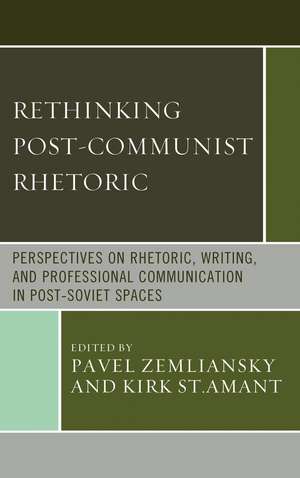
Rethinking Post-Communist Rhetoric: Perspectives on Rhetoric, Writing, and Professional Communication in Post-Soviet Spaces: Communication, Globalization, and Cultural Identity
Editat de Pavel Zemliansky, Kirk St Amant Contribuţii de Nikolai Balykov, Elena Bespalova, Kara M. Bollinger, Yevgen Borodkin, Taras Danko, Olena Goroshko, Steffen Guenzel, Alla V. Kourova, Natalia Matveeva, Doan Modianos, Tatjana Schell, Brooke Ricker Schreiberen Limba Engleză Hardback – 8 apr 2016
By approaching ideas of rhetoric, writing, and communication from the perspective of these four areas, this collection provides readers with a broad foundation for understanding the various overarching and interlocking contexts that affect perceptions of and practices involving communication practices and expectations in the former Eastern Bloc. Additionally, this approach provides researchers, teachers, and students with ideas and approaches that can be used to more effectively engage both with this topic area and with individuals from these nations.
Din seria Communication, Globalization, and Cultural Identity
- 34%
 Preț: 569.12 lei
 - 27%
 Preț: 353.78 lei
 - 32%
 Preț: 616.99 lei
 - 33%
 Preț: 614.65 lei
 - 27%
 Preț: 354.08 lei
 - 28%
 Preț: 346.74 lei
 - 32%
 Preț: 587.46 lei
 - 32%
 Preț: 584.23 lei
 - 36%
 Preț: 578.94 lei
 - 33%
 Preț: 549.82 lei
 - 34%
 Preț: 526.91 lei
 - 34%
 Preț: 597.72 lei
 - 37%
 Preț: 727.28 lei
 - 34%
 Preț: 645.47 lei
 - 36%
 Preț: 524.82 lei
Preț: 614.37 lei
Preț vechi: 911.10 lei
-33%
Puncte Express: 922
Carte tipărită la comandă
Livrare economică 27 noiembrie-11 decembrie
Livrare prin curier în România Termenul estimat este afișat lângă disponibilitate.
Transport gratuit pentru acest produs Plată online sau ramburs, în funcție de opțiunile comenzii.
Retur gratuit în 14 zile Comandă securizată și suport în română.
Specificații
ISBN-13: 9781498523370
ISBN-10: 1498523374
Pagini: 254
Ilustrații: 10 Graphs, 27 Tables
Dimensiuni: 158 x 239 x 23 mm
Greutate: 0.5 kg
Editura: Bloomsbury Publishing
Colecția Lexington Books
Seria Communication, Globalization, and Cultural Identity
Locul publicării:New York, United States
ISBN-10: 1498523374
Pagini: 254
Ilustrații: 10 Graphs, 27 Tables
Dimensiuni: 158 x 239 x 23 mm
Greutate: 0.5 kg
Editura: Bloomsbury Publishing
Colecția Lexington Books
Seria Communication, Globalization, and Cultural Identity
Locul publicării:New York, United States
Cuprins
Part I: Institutional Contexts
Chapter 1: A Survey of Academic and Professional Writing Instruction in Higher Education in Russia and Ukraine, Pavel Zemliansky and Olena Goroshko
Chapter 2: Introducing Western Writing Theory and Pedagogy to Russian Students: The
Writing and Communication Center at the New Economic School, Kara M. Bollinger
Chapter 3: Technical and Communication in Russia, Tatjana Schell
Part II: Workplace Contexts
Chapter 4: Russian Education in the Twenty-First Century: Establishing Links with the Global
Community, Alla V. Kourova
Chapter 5: Rhetoric in Technical Communication: Europe and the United States, Yevgen Borodkin
Chapter 6: Visible and Invisible Boundaries: Documentation Requirements for Opening a Foreign Representative Office in Russia and in the United States, Natalia Matveeva and Elena Bespalova
Part III: Geopolitical Contexts
Chapter 7: Mapping Professional and Technical Communication in German Higher Education in the Neue Länder since 1989, Steffen Guenzel
Chapter 8: Macro Acceptance, Micro Resistance? Perspectives from Serbian Writing
Teachers on the Bologna Process, Brooke Ricker Schreiber
Part IV: Multimedia Contexts
Chapter 9: Creating a Multinational Collaborative Online Community in High-Tech Marketing Domain in Ukraine, Taras Danko
Chapter 10: Media Usage Pattern and Trust in Media among Young People in a Large
Russian City, Nikolai Balykov and Doan Modianos
Chapter 1: A Survey of Academic and Professional Writing Instruction in Higher Education in Russia and Ukraine, Pavel Zemliansky and Olena Goroshko
Chapter 2: Introducing Western Writing Theory and Pedagogy to Russian Students: The
Writing and Communication Center at the New Economic School, Kara M. Bollinger
Chapter 3: Technical and Communication in Russia, Tatjana Schell
Part II: Workplace Contexts
Chapter 4: Russian Education in the Twenty-First Century: Establishing Links with the Global
Community, Alla V. Kourova
Chapter 5: Rhetoric in Technical Communication: Europe and the United States, Yevgen Borodkin
Chapter 6: Visible and Invisible Boundaries: Documentation Requirements for Opening a Foreign Representative Office in Russia and in the United States, Natalia Matveeva and Elena Bespalova
Part III: Geopolitical Contexts
Chapter 7: Mapping Professional and Technical Communication in German Higher Education in the Neue Länder since 1989, Steffen Guenzel
Chapter 8: Macro Acceptance, Micro Resistance? Perspectives from Serbian Writing
Teachers on the Bologna Process, Brooke Ricker Schreiber
Part IV: Multimedia Contexts
Chapter 9: Creating a Multinational Collaborative Online Community in High-Tech Marketing Domain in Ukraine, Taras Danko
Chapter 10: Media Usage Pattern and Trust in Media among Young People in a Large
Russian City, Nikolai Balykov and Doan Modianos
Recenzii
While the collection will appeal to educators, professional technical communicators can find useful information, especially if they specialize in localization or their organizations regularly deal with post-Soviet countries.. I would recommend this collection for libraries and advanced classes in rhetorical and cross-cultural pedagogy.
This book provides a unique international perspective on academic writing and the pedagogy and practice of business, technical, and professional communication over the past two decades in Eastern European and former Soviet countries. The breadth of its scope, the rich variety of studies and the analyses, and the depth of cultural and rhetorical insights make this collection a remarkable scholarly achievement that will greatly benefit scholars, teachers, and practitioners for years to come.
For anyone wishing to interact with communication teachers, researchers, or workplace practitioners in post-Soviet spaces, the essays in this collection will offer numerous useful and thought-provoking perspectives.
Rethinking Post-Communist Rhetoric should be required reading for technical and professional communication practitioners, scholars, teachers, and students-and for anyone else who wants to gain an understanding of how to communicate effectively with individuals in the former Soviet republics and the countries of Eastern Europe. The book provides a comprehensive understanding not only of rhetorical expectations and writing practices but also of the institutional, workplace, and geopolitical contexts in which communication occurs. This groundbreaking collection is a much-needed and valuable reference that expands our understanding of the practice of professional communication in the nations of the former Soviet Union and the former Eastern Bloc.
This book provides a unique international perspective on academic writing and the pedagogy and practice of business, technical, and professional communication over the past two decades in Eastern European and former Soviet countries. The breadth of its scope, the rich variety of studies and the analyses, and the depth of cultural and rhetorical insights make this collection a remarkable scholarly achievement that will greatly benefit scholars, teachers, and practitioners for years to come.
For anyone wishing to interact with communication teachers, researchers, or workplace practitioners in post-Soviet spaces, the essays in this collection will offer numerous useful and thought-provoking perspectives.
Rethinking Post-Communist Rhetoric should be required reading for technical and professional communication practitioners, scholars, teachers, and students-and for anyone else who wants to gain an understanding of how to communicate effectively with individuals in the former Soviet republics and the countries of Eastern Europe. The book provides a comprehensive understanding not only of rhetorical expectations and writing practices but also of the institutional, workplace, and geopolitical contexts in which communication occurs. This groundbreaking collection is a much-needed and valuable reference that expands our understanding of the practice of professional communication in the nations of the former Soviet Union and the former Eastern Bloc.