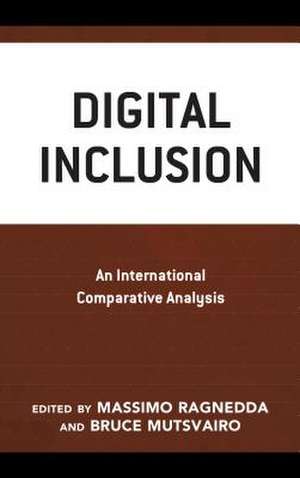
Digital Inclusion: Communication, Globalization, and Cultural Identity
Editat de Massimo Ragnedda, Bruce Mutsvairoen Limba Engleză Hardback – 15 aug 2018
Din seria Communication, Globalization, and Cultural Identity
- 34%
 Preț: 569.12 lei
 - 27%
 Preț: 353.78 lei
 - 32%
 Preț: 616.99 lei
 - 33%
 Preț: 614.37 lei
 - 32%
 Preț: 629.66 lei
 - 27%
 Preț: 354.08 lei
 - 28%
 Preț: 346.74 lei
 - 32%
 Preț: 584.23 lei
 - 36%
 Preț: 578.94 lei
 - 33%
 Preț: 549.82 lei
 - 34%
 Preț: 526.91 lei
 - 34%
 Preț: 597.72 lei
 - 37%
 Preț: 727.28 lei
 - 34%
 Preț: 645.47 lei
 - 35%
 Preț: 537.62 lei
Preț: 587.46 lei
Preț vechi: 866.58 lei
-32%
Puncte Express: 881
Carte tipărită la comandă
Livrare economică 01-15 decembrie
Livrare prin curier în România Termenul estimat este afișat lângă disponibilitate.
Transport gratuit pentru acest produs Plată online sau ramburs, în funcție de opțiunile comenzii.
Retur gratuit în 14 zile Comandă securizată și suport în română.
Specificații
ISBN-13: 9781498562126
ISBN-10: 1498562124
Pagini: 244
Ilustrații: 16 Graphs, 11 Tables
Dimensiuni: 157 x 235 x 19 mm
Greutate: 0.74 kg
Editura: Lexington Books
Colecția Communication, Globalization, and Cultural Identity
Seria Communication, Globalization, and Cultural Identity
Locul publicării:New York, United States
ISBN-10: 1498562124
Pagini: 244
Ilustrații: 16 Graphs, 11 Tables
Dimensiuni: 157 x 235 x 19 mm
Greutate: 0.74 kg
Editura: Lexington Books
Colecția Communication, Globalization, and Cultural Identity
Seria Communication, Globalization, and Cultural Identity
Locul publicării:New York, United States
Cuprins
Introduction: Digital Inclusion: Empowering People through Information and Communication Technologies (ICTs), Massimo Ragnedda and Bruce Mutsvairo
Part I: Digital Inclusion in Advanced Countries
Chapter 1: Reducing and Preventing Digital Discrimination: Digital Inclusion Strategies in Europe, Massimo Ragnedda
Chapter 2: Not So Ubiquitous: Digital Inclusion and Older Adults in Australia, Sue Malta and Raelene Wilding
Chapter 3: Digital Inclusion in International Perspective: An Asset-Based Approach to Digital Inclusion Research in the US Context, Bianca C. Reisdorf and Colin Rhinesmith
Part II: Digital Inclusion in BRICS Countries
Chapter 4: From Access to Proficiency: Reconceptualising Digital Inclusion in a Rural Area in South Africa, Lorenzo Dalvit
Chapter 5: Mapping the Evolutive Trajectories of China's Digital Divide: A Longitudinal Observation, Jianbin Jin, Fanxin Meng, Anfan Chen, Lin Shi, and Tao Wang
Chapter 6: Changes in Knowledge Acquisition According to the Proximity with Digital Media Networks, Andrea Limberto
Part III: Digital Inclusion in the Middle East
Chapter 7: Digital Inclusion in Jordan: Opportunities and Hurdles, Hanna Kreitem
Chapter 8: An Explanatory Analysis of Facebook's Effect on Social Cohesion in Iran, Hamid Abdollahyan and Mahin Sheikh Ansari
Chapter 9: "Nothing Is Ever Truly New": The Persisting Digital Exclusion in Israel, 2002-2013, Amit M. Schejter, Orit Ben-Harush, and Noam Tirosh
Part IV: Digital Inclusion in Africa
Chapter 10: ICT and Development: Narrowing the Digital Divide and the Knowledge Gap of ICT Users in Cameroon and Ghana, Kehbuma Langmia and Christiana Hammond
Chapter 11: Kenya's Digital Divide: Challenged, Evolving, and Persistent, Norbert Wildermuth
Afterword, Why Digital Inclusion Now? Gerard Goggin
Part I: Digital Inclusion in Advanced Countries
Chapter 1: Reducing and Preventing Digital Discrimination: Digital Inclusion Strategies in Europe, Massimo Ragnedda
Chapter 2: Not So Ubiquitous: Digital Inclusion and Older Adults in Australia, Sue Malta and Raelene Wilding
Chapter 3: Digital Inclusion in International Perspective: An Asset-Based Approach to Digital Inclusion Research in the US Context, Bianca C. Reisdorf and Colin Rhinesmith
Part II: Digital Inclusion in BRICS Countries
Chapter 4: From Access to Proficiency: Reconceptualising Digital Inclusion in a Rural Area in South Africa, Lorenzo Dalvit
Chapter 5: Mapping the Evolutive Trajectories of China's Digital Divide: A Longitudinal Observation, Jianbin Jin, Fanxin Meng, Anfan Chen, Lin Shi, and Tao Wang
Chapter 6: Changes in Knowledge Acquisition According to the Proximity with Digital Media Networks, Andrea Limberto
Part III: Digital Inclusion in the Middle East
Chapter 7: Digital Inclusion in Jordan: Opportunities and Hurdles, Hanna Kreitem
Chapter 8: An Explanatory Analysis of Facebook's Effect on Social Cohesion in Iran, Hamid Abdollahyan and Mahin Sheikh Ansari
Chapter 9: "Nothing Is Ever Truly New": The Persisting Digital Exclusion in Israel, 2002-2013, Amit M. Schejter, Orit Ben-Harush, and Noam Tirosh
Part IV: Digital Inclusion in Africa
Chapter 10: ICT and Development: Narrowing the Digital Divide and the Knowledge Gap of ICT Users in Cameroon and Ghana, Kehbuma Langmia and Christiana Hammond
Chapter 11: Kenya's Digital Divide: Challenged, Evolving, and Persistent, Norbert Wildermuth
Afterword, Why Digital Inclusion Now? Gerard Goggin
Recenzii
Massimo Ragnedda and Bruce Mutsvairo provide a long overdue account of digital exclusion from a global perspective. The contributors to this edited volume go beyond Western Europe, the Untied States, and Australia to consider the BRICS countries, the Middle East, and Africa and consider digital access empirically and theoretically. The essays in this volume highlight the costs of exclusion, but also the potential and opportunities that may result from greater inclusion.