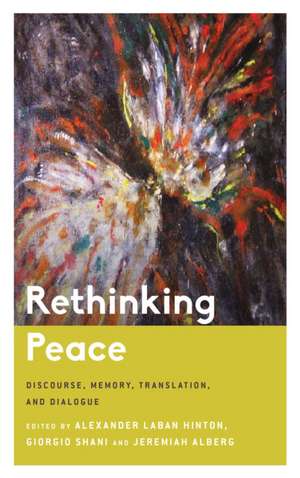
Rethinking Peace: Discourse, Memory, Translation, and Dialogue: Critical Perspectives on Religion in International Politics
Editat de Alexander Laban Hinton, Giorgio Shani, Jeremiah Albergen Limba Engleză Paperback – 19 feb 2019
This edited volume critically interrogates the field of peace studies, considering its assumptions, teleologies, canons, influence, enmeshments with power structures, biases, and normative ends. We highlight four interrelated tendencies in peace studies: hypostasis (strong essentializing tendencies), teleology (its imagined "end"), normativity (the set of often utopian and Eurocentric discourses that guide it), and enterprise (the attempt to undertake large projects, often ones of social engineering to attain this end). The chapters in this volume reveal these tendencies while offering new paths to escape them.
Visit http://www.rethinkingpeacestudies.com/ for further details on the Rethinking Peace Studies project.



Preț: 286.85 lei
Preț vechi: 372.05 lei
-23%
Puncte Express: 430
Carte tipărită la comandă
Livrare economică 01-15 decembrie
Livrare prin curier în România Termenul estimat este afișat lângă disponibilitate.
Transport gratuit de la 400.00 lei Plată online sau ramburs, în funcție de opțiunile comenzii.
Retur gratuit în 14 zile Comandă securizată și suport în română.
Specificații
ISBN-13: 9781786610386
ISBN-10: 1786610388
Pagini: 288
Ilustrații: 29 b/w illustrations;2 b/w photos; 1 charts;
Dimensiuni: 153 x 223 x 18 mm
Greutate: 0.43 kg
Editura: Bloomsbury Publishing
Colecția Rowman & Littlefield
Seria Critical Perspectives on Religion in International Politics
Locul publicării:New York, United States
ISBN-10: 1786610388
Pagini: 288
Ilustrații: 29 b/w illustrations;2 b/w photos; 1 charts;
Dimensiuni: 153 x 223 x 18 mm
Greutate: 0.43 kg
Editura: Bloomsbury Publishing
Colecția Rowman & Littlefield
Seria Critical Perspectives on Religion in International Politics
Locul publicării:New York, United States
Cuprins
Acknowledgments / Preface, Paul Hastings / Introduction: Rethinking Peace Studies, Alexander Laban Hinton, Giorgio Shani, and Jay Alberg / 1. The Inner Battles of Peace Studies: The Limits and Possibilities, Ashis Nandy / 2. Sovereignty, Interference, and Crisis, Stephen Eric Bronner / 3. Towards A Peace with Global Justice, Oliver Richmond / 4. Saving Liberal Peacebuilding: From the "Local Turn" to a Post-Western Peace, Giorgio Shani / 5. Cultural Memory in the Wake of Violence: Exceptionalism, Vulnerability, and the Grievable Life, Marita Sturken / 6. Justice in the Land of Memory: Reflecting on the Temporality of Truth and Survival in Argentina, Natasha Zaretsky / 7. Negotiating Difference and Empathy: Cinematic Representations of Passing and Exchanged Identities in the Israeli-Palestinian Conflict, Yael Zerubavel / 8. Silence and Memory Politics, Leigh A. Payne / 9. A Translational Comics Text and its Translation: Maus in Japanese, Beverly Curran / 10. To Arrive Where We Started: Peace Studies and the Log
Recenzii
Rethinking Peace is a path-breaking book in Peace Studies. Brilliantly exposing the field's recessive underside, it offers radically new avenues of reflection, engagement, and analysis. The volume is likely to emerge as an indispensable resource for innovative research and pedagogy.
This important volume puts into practice Ashis Nandy's admonition not simply to reject Peace Studies for its entanglements with liberal modernity, including the state, but to work to recover resources for peace from spaces and voices that are generally invisible or even exiled from our studies and practices. Though what Nandy calls "undomesticated" voices can be hard to hear from our positions in the Academy or international/transnational institutions, Rethinking Peace wisely makes issues of translation and the challenges and possibilities of dialogue central to its call for rethinking. I recommend that anyone drawn to Peace Studies first read this book as both a cautionary tale and a source of hope.
Moving beyond traditional criticisms of the liberal peace and binary approaches to critical peace research, Rethinking Peace offers to push us into other directions and disciplines to question the emancipation project itself. This edited volume brings together erudite scholars that form the core of peace studies rooted in IR, as well as those that bring insights from development studies and human rights, to work toward a new agenda for the field based on more interdisciplinary foundations. A thought-provoking read that will be interesting for scholars and students, inside and outside the mainstream of peace studies.
This important volume puts into practice Ashis Nandy's admonition not simply to reject Peace Studies for its entanglements with liberal modernity, including the state, but to work to recover resources for peace from spaces and voices that are generally invisible or even exiled from our studies and practices. Though what Nandy calls "undomesticated" voices can be hard to hear from our positions in the Academy or international/transnational institutions, Rethinking Peace wisely makes issues of translation and the challenges and possibilities of dialogue central to its call for rethinking. I recommend that anyone drawn to Peace Studies first read this book as both a cautionary tale and a source of hope.
Moving beyond traditional criticisms of the liberal peace and binary approaches to critical peace research, Rethinking Peace offers to push us into other directions and disciplines to question the emancipation project itself. This edited volume brings together erudite scholars that form the core of peace studies rooted in IR, as well as those that bring insights from development studies and human rights, to work toward a new agenda for the field based on more interdisciplinary foundations. A thought-provoking read that will be interesting for scholars and students, inside and outside the mainstream of peace studies.