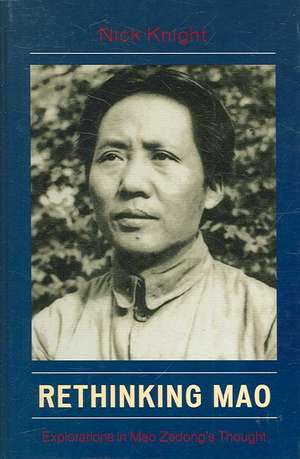
Rethinking Mao
Autor Nick Knighten Limba Engleză Hardback – 15 apr 2007
| Toate formatele și edițiile | Preț | Express |
|---|---|---|
| Paperback (1) | 336.83 lei 43-57 zile | |
| Bloomsbury Publishing – 17 apr 2007 | 336.83 lei 43-57 zile | |
| Hardback (1) | 824.66 lei 43-57 zile | |
| Rowman & Littlefield – 15 apr 2007 | 824.66 lei 43-57 zile |
Preț: 824.66 lei
Preț vechi: 1129.68 lei
-27%
Puncte Express: 1237
Preț estimativ în valută:
145.100€ • 170.00$ • 126.83£
145.100€ • 170.00$ • 126.83£
Carte tipărită la comandă
Livrare economică 23 februarie-09 martie
Preluare comenzi: 021 569.72.76
Specificații
ISBN-13: 9780739117064
ISBN-10: 0739117068
Pagini: 295
Dimensiuni: 160 x 230 x 27 mm
Greutate: 0.62 kg
Editura: Rowman & Littlefield
ISBN-10: 0739117068
Pagini: 295
Dimensiuni: 160 x 230 x 27 mm
Greutate: 0.62 kg
Editura: Rowman & Littlefield
V-ar putea interesa
-
 The Benn DiariesTony Benn-19%Preț: 95.99 lei118.65 lei
 -
 -63%Preț: 138.36 lei369.13 lei
 -
 The New European LeftK. HudsonPreț: 373.03 lei
 -
 Ten Years of New LabourM. BeechPreț: 368.23 lei
 -
 Glasnost, Perestroika, and the Socialist CommunityCharles Bukowski-31%Preț: 356.02 lei515.75 lei
 -
 Preț: 439.08 lei
 -
 Preț: 466.11 lei
 -
 Capitalism, Socialism and DemocracyJoseph A. SchumpeterPreț: 161.67 lei
 -
 China′s Communist Party – Atrophy and AdaptationDavid ShambaughPreț: 228.95 lei
 -
 Why Not Socialism?Gerald a CohenPreț: 69.52 lei
 -
 The Strange Death of Labour ScotlandGerry Hassan-18%Preț: 174.03 lei211.20 lei
 -
 Critique of Other SocialismsKarl MarxPreț: 266.06 lei
 -
 The Spirit Level DelusionChristopher John SnowdonPreț: 109.85 lei
 -
 Red Emma Speaks: An Emma Goldman ReaderEmma Goldman-20%Preț: 214.72 lei269.59 lei
 -
 Edward CarpenterSheila RowbothamPreț: 240.59 lei
 -
 Envisioning Real UtopiasErik Olin WrightPreț: 186.51 lei
Notă biografică
Descriere scurtă
Cuprins
Chapter 1 Introduction: Rethinking Mao
Chapter 2 On Questions of Method I - Rethinking Mao and the Mao Texts
Chapter 3 On Questions of Method II - The Marxism of Mao Zedong
Chapter 4 Working Class and Peasantry in Mao Zedong's Thought, 1923-1945
Chapter 5 Politics and Vision: Historical Time and the Future in Mao Zedong's Thought: A Study of Three Documents, 1937-1940
Chapter 6 Perspectives on Marxism and Social Change in Mao Zedong's Thought: A Study of Three Documents, 1937-1940
Chapter 7 Mao Zedong and the "Sinification of Marxism"
Chapter 8 Mao Zedong on the Chinese Road to Socialism, 1949-1969
Chapter 9 From Harmony to Struggle, From Perpetual Peace to Cultural Revolution: Changing Futures in Mao Zedong's Thought
Chapter 2 On Questions of Method I - Rethinking Mao and the Mao Texts
Chapter 3 On Questions of Method II - The Marxism of Mao Zedong
Chapter 4 Working Class and Peasantry in Mao Zedong's Thought, 1923-1945
Chapter 5 Politics and Vision: Historical Time and the Future in Mao Zedong's Thought: A Study of Three Documents, 1937-1940
Chapter 6 Perspectives on Marxism and Social Change in Mao Zedong's Thought: A Study of Three Documents, 1937-1940
Chapter 7 Mao Zedong and the "Sinification of Marxism"
Chapter 8 Mao Zedong on the Chinese Road to Socialism, 1949-1969
Chapter 9 From Harmony to Struggle, From Perpetual Peace to Cultural Revolution: Changing Futures in Mao Zedong's Thought
Recenzii
Distinguished China scholar Nick Knight has been researching Mao Zedong's thought for nearly four decades. Departing from recent conventional research, which tends to demonize and/or scoff at Mao, Knight takes Mao very seriously, both as a socialist leader and as a Marxist. In this important and aptly titled book, Knight reaches many innovative, balanced, and perceptive conclusions that will surely impact greatly on the future study of a man who, whatever his failings, was undoubtedly among the towering figures of the twentieth century.
Rethinking Mao not only offers something new, it does so with a critical depth that others eschew.... Rethinking Mao not only offers a sophisticated analysis of Mao's historicism, it is itself an excellent example of historicist scholarship.
Nick Knight has distinguished himself over the years as one of the most astute readers and interpreters of Mao's thought. Rethinking Mao brings together a lifetime of scholarship, revisited and revised with the benefit of contemporary hindsight. The volume is a serious reminder of the historical and theoretical significance of Mao's thought at a time when most writing on Mao, riding the wave of anti-socialism, has degenerated into little more than malicious gossip. It also coincides with a reevaluation of Mao's policies in the PRC as possible inspiration in confronting the problems created by three decades of reform that turned its back on his revolutionary legacy.
Rethinking Mao not only offers something new, it does so with a critical depth that others eschew.... Rethinking Mao not only offers a sophisticated analysis of Mao's historicism, it is itself an excellent example of historicist scholarship.
Nick Knight has distinguished himself over the years as one of the most astute readers and interpreters of Mao's thought. Rethinking Mao brings together a lifetime of scholarship, revisited and revised with the benefit of contemporary hindsight. The volume is a serious reminder of the historical and theoretical significance of Mao's thought at a time when most writing on Mao, riding the wave of anti-socialism, has degenerated into little more than malicious gossip. It also coincides with a reevaluation of Mao's policies in the PRC as possible inspiration in confronting the problems created by three decades of reform that turned its back on his revolutionary legacy.