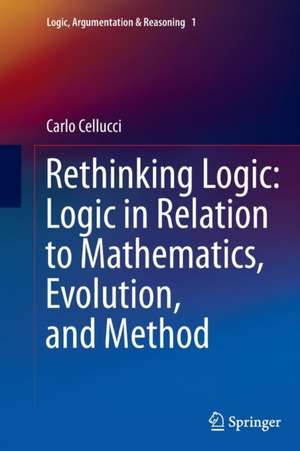
Rethinking Logic: Logic in Relation to Mathematics, Evolution, and Method: Logic, Argumentation & Reasoning, cartea 1
Autor Carlo Celluccien Limba Engleză Paperback – 23 aug 2016
Observăm în literatura academică actuală o lacună semnificativă în ceea ce privește utilitatea practică a logicii matematice în procesul de descoperire științifică. Rethinking Logic: Logic in Relation to Mathematics, Evolution, and Method vine să corecteze această perspectivă, argumentând că restrângerea logicii la simpla deducție a văduvit disciplina de rolul său fundamental: acela de a furniza metode pentru generarea de noi cunoștințe. Autorul Carlo Cellucci propune o schimbare de paradigmă, trecând de la o logică a demonstrației la o logică a descoperirii.
Volumul extinde cadrul propus de Mathematics and Logic in History and in Contemporary Thought de Ettore Carruccio prin integrarea unor date noi despre mecanismele euristice și evolutive ale rațiunii. Structura cărții reflectă o progresie riguroasă, fiind organizată în patru părți: de la perspectivele antice (unde analizează metoda analitică și viziunea euristică a lui Aristotel) la cele moderne (critica abordărilor lui Frege și Gentzen) și, în final, către formularea unei alternative bazate pe reguli de descoperire precum analogia, metafora și diagramele.
Această lucrare reprezintă o evoluție naturală în opera lui Carlo Cellucci. Dacă în The Theory of Gödel acesta analiza limitările interne ale sistemelor formale, iar în Rethinking Knowledge deplângea distanțarea filosofiei de științele aplicate, Rethinking Logic oferă soluția constructivă. Suntem de părere că ediția din 2013, publicată de Springer, este esențială pentru cercetătorii care doresc să înțeleagă cum logica poate redeveni un instrument viu, ancorat în evoluție și în metodologia științifică reală.
Din seria Logic, Argumentation & Reasoning
- 20%
 Preț: 593.68 lei
 - 15%
 Preț: 665.89 lei
 -
 Preț: 419.31 lei
 - 15%
 Preț: 673.55 lei
 - 15%
 Preț: 666.11 lei
 - 18%
 Preț: 754.69 lei
 -
 Preț: 407.38 lei
 - 15%
 Preț: 668.64 lei
 - 20%
 Preț: 581.62 lei
 -
 Preț: 412.58 lei
 -
 Preț: 376.01 lei
 - 15%
 Preț: 665.89 lei
 - 15%
 Preț: 474.43 lei
 - 15%
 Preț: 558.14 lei
 - 18%
 Preț: 701.88 lei
 - 18%
 Preț: 709.90 lei
 - 18%
 Preț: 916.67 lei
 - 15%
 Preț: 672.93 lei
 - 15%
 Preț: 613.18 lei
 -
 Preț: 357.20 lei
 - 18%
 Preț: 751.45 lei
 - 18%
 Preț: 726.68 lei
 - 38%
 Preț: 861.70 lei
 - 15%
 Preț: 667.42 lei
 - 18%
 Preț: 756.75 lei
 - 24%
 Preț: 748.24 lei
Preț: 616.23 lei
Preț vechi: 770.28 lei
-20%
Carte tipărită la comandă
Livrare economică 30 noiembrie-07 decembrie
Specificații
ISBN-10: 9402401024
Pagini: 404
Ilustrații: XV, 389 p. 35 illus.
Dimensiuni: 155 x 235 x 21 mm
Greutate: 0.57 kg
Ediția:Softcover reprint of the original 1st ed. 2013
Editura: SPRINGER NETHERLANDS
Colecția Springer
Seria Logic, Argumentation & Reasoning
Locul publicării:Dordrecht, Netherlands
V-ar putea interesa
-
 Elements of Set TheoryHerbert B. Enderton-31%Preț: 382.75 lei558.35 lei
 -
 Constructibility and Mathematical ExistenceCharles S. Chihara-18%Preț: 371.00 lei452.88 lei
 -
 Conceptual Notation and Related ArticlesGottlob Frege-32%Preț: 880.71 lei1289.14 lei
 -
 -27%Preț: 412.76 lei566.87 lei
 -
 -32%Preț: 716.73 lei1047.74 lei
 -
 -28%Preț: 471.91 lei659.32 lei
 -
 Automorphisms of First-order StructuresRichard Kaye-31%Preț: 673.24 lei978.69 lei
 -
 Category TheorySteve Awodey-21%Preț: 477.02 lei602.73 lei
 -
 Godel's ProofErnest NagelPreț: 138.96 lei
 -
 -36%Preț: 66.83 lei104.45 lei
 -
 Introduction to LogicAlfred TarskiPreț: 87.22 lei
 -
 TopoiRobert Goldblatt-23%Preț: 162.04 lei211.69 lei
 -
 Principia Mathematica to *56Alfred North Whitehead-14%Preț: 799.94 lei930.17 lei
 -
 Conceptual MathematicsF. William Lawvere-19%Preț: 438.13 lei540.90 lei
 -
 Incompleteness in the Land of SetsM. FittingPreț: 237.44 lei
 -
 Theory of SetsN. BourbakiPreț: 476.32 lei
De ce să citești această carte
Recomandăm această carte cercetătorilor în logică, matematică și filosofia științei care caută o alternativă la formalismul rigid. Cititorul câștigă o înțelegere profundă a metodelor non-deductive de cercetare, precum inducția și analogia, esențiale pentru progresul științific. Este un volum riguros care demonstrează că logica nu este doar despre validitatea demonstrației, ci mai ales despre mecanismul descoperirii de noi ipoteze.
Descriere scurtă
Therefore, this volume proposes a view of logic according to which logic is intended, first of all, to provide rules of discovery, that is, non-deductive rules for finding hypotheses to solve problems. This is essential if logic is to play any relevant role in mathematics, science and even philosophy. To comply with this view of logic, this volume formulates several rules of discovery, such as induction, analogy, generalization, specialization, metaphor, metonymy, definition, and diagrams. A logic based on such rules is basically a logic of discovery, and involves a new view of the relation of logic to evolution, language, reason, method and knowledge, particularly mathematical knowledge. It also involves a new view of the relation of philosophy to knowledge. This book puts forward such new views, trying to open again many doors that the founding fathers of mathematical logic had closed historically.
trigger
Cuprins
Recenzii
“Well documented, closely argued, and informed by truly inspired, and truly incompatible, interpretations of the Western tradition of logic, mathematics, and metaphysics.” (Emily R. Grosholz, Philosophia Mathematica, Vol. 23 (1), February, 2015)
“This textbook traces the history of Logic ranging from epistemology to induction and deduction. … I can recommend it to the philosophical audience for which it is addressed.” (Joseph Grenier, Amazon.com, March, 2014)
“Rethinking Logic is a valuable and remarkable book, especially because it does not resemble to any of the books dealing with logic which normally can be found on the market. … It is … a global and wide philosophical reflection on what logic and knowledge are, which argues for a theoretically purposeful view, with which one may obviously disagree, but with which it is certainly interesting confronting.” (Fabio Sterpetti, Philosophical Inquiries, Vol. 2 (2), 2014)