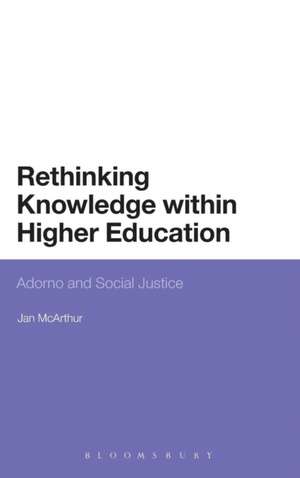
Rethinking Knowledge within Higher Education: Adorno and Social Justice
Autor Dr Jan McArthuren Limba Engleză Hardback – 20 dec 2012
Preț: 897.67 lei
Preț vechi: 1189.35 lei
-25%
Puncte Express: 1347
Carte tipărită la comandă
Livrare economică 19 noiembrie-03 decembrie
Livrare prin curier în România Termenul estimat este afișat lângă disponibilitate.
Transport gratuit pentru acest produs Plată online sau ramburs, în funcție de opțiunile comenzii.
Retur gratuit în 14 zile Comandă securizată și suport în română.
Specificații
ISBN-13: 9781441197535
ISBN-10: 1441197532
Pagini: 208
Dimensiuni: 156 x 234 x 20 mm
Greutate: 0.45 kg
Ediția:New.
Editura: Bloomsbury Publishing
Colecția Bloomsbury Academic
Locul publicării:London, United Kingdom
ISBN-10: 1441197532
Pagini: 208
Dimensiuni: 156 x 234 x 20 mm
Greutate: 0.45 kg
Ediția:New.
Editura: Bloomsbury Publishing
Colecția Bloomsbury Academic
Locul publicării:London, United Kingdom
V-ar putea interesa
-
 Reading and the Reader: The Literary AgendaPhilip Davis-15%Preț: 168.82 lei199.77 lei
 -
 Surviving Your Academic Job HuntK. HumePreț: 352.95 lei
 -
 Conflict Resolution and Peace EducationC. CarterPreț: 288.31 lei
 -
 Preț: 443.90 lei
 -
 Global Perspectives on Spirituality and EducationJacqueline Watson-18%Preț: 1331.40 lei1623.65 lei
 -
 -15%Preț: 467.09 lei549.52 lei
 -
 -18%Preț: 1307.40 lei1594.39 lei
 -
 The Handbook of Transformative LearningEdward W Taylor-8%Preț: 516.45 lei561.36 lei
 -
 Arms and the UniversityDonald Alexander DownsPreț: 314.92 lei
 -
 Preț: 368.65 lei
 -
 Preț: 226.12 lei
 -
 Learning as a Way of LeadingStephen PreskillPreț: 298.72 lei
 -
 FE Lecturer's Survival GuideDr Angela Steward-17%Preț: 238.35 lei285.54 lei
 -
 FE Lecturer's Guide to Diversity and InclusionAnne-Marie Wright-30%Preț: 576.01 lei819.31 lei
 -
 Preparing to Teach in the Lifelong Learning SectorAnn GravellsPreț: 323.27 lei
 -
 Leadership for a Better WorldNclp (National Clearinghouse for Leadership Programs)Preț: 329.83 lei
 -
 -16%Preț: 294.23 lei351.17 lei
 -
 Critical Narrative as PedagogyIvor Goodson-16%Preț: 207.74 lei248.61 lei
 -
 From My HeartNeil HawkesPreț: 124.44 lei
 -
 British Universities Past and PresentProf Robert Anderson-39%Preț: 627.57 lei1021.98 lei
Cuprins
Introduction: Adorno and Higher Education
1. Knowledge and Social Justice in Higher Education
2. Approaches to Critical Theory and Critical Pedagogy
3. The Importance of Knowledge Being Not Easily Known
4. Beyond Standardized Engagement with Knowledge
5. The Social Implications of Engaging with Knowledge in Higher Education
6. Challenging the Theory-Practice Dichotomy
7. Towards a Higher Education Transcending Both the Elite and the Mainstream
References
Index
1. Knowledge and Social Justice in Higher Education
2. Approaches to Critical Theory and Critical Pedagogy
3. The Importance of Knowledge Being Not Easily Known
4. Beyond Standardized Engagement with Knowledge
5. The Social Implications of Engaging with Knowledge in Higher Education
6. Challenging the Theory-Practice Dichotomy
7. Towards a Higher Education Transcending Both the Elite and the Mainstream
References
Index
Recenzii
A highly intelligent book in which the author brings her considerable scholarship to bear on crucial questions regarding the role and purpose of higher education. Her reading of Adorno is acute and nuanced and her application of 'critical theory' to the current higher education policy context is sharp and politically astute. McArthur's argument for the necessary relation between higher education and social justice is both compelling and inspiring.
Writers on social theorists often fall into the trap of being as 'difficult' to follow as those whose theories they are discussing. Jan McArthur is unusual in this respect, writing clearly, incisively and intelligibly, demonstrating what the work of one of the less quoted social theorists, Adorno, has to offer for a critical understanding of higher education today.
For those of us who refuse to abandon knowledge's special place in higher education, McArthur's book reminds us that there is a job to be done in fighting for it - not as an end itself - but as part of a commitment to social justice. Situated within a tradition of critical pedagogy and with the aid of Adorno's writings, the project of McArthur's book is to reclaim a transformative narrative for knowledge, and to demonstrate why this ought to be the way forward for higher education. Amid the now familiar contradictory narratives of higher education thesis, McArthur's analysis is not only striking and intelligent, as a practice of 'thinking otherwise' it might also be seen as a welcome piece of dangerous scholarship. Any serious researcher or scholar of higher education looking for conceptual and theoretical gems to re-ignite their commitment to knowledge as a complex endeavour will find that this book has plenty to offer.
This necessarily brief overview of the book cannot adequately convey the significance of McArthur's refreshing and well-written work. Her argument for placing social justice at the very core of higher education is both forceful and convincing and relevant for those teaching in religious studies or theology departments. For faculty struggling with questions regarding the future of higher education and who are looking for something beyond a business-model approach, McArthur's book offers a worthy conversation partner.
Writers on social theorists often fall into the trap of being as 'difficult' to follow as those whose theories they are discussing. Jan McArthur is unusual in this respect, writing clearly, incisively and intelligibly, demonstrating what the work of one of the less quoted social theorists, Adorno, has to offer for a critical understanding of higher education today.
For those of us who refuse to abandon knowledge's special place in higher education, McArthur's book reminds us that there is a job to be done in fighting for it - not as an end itself - but as part of a commitment to social justice. Situated within a tradition of critical pedagogy and with the aid of Adorno's writings, the project of McArthur's book is to reclaim a transformative narrative for knowledge, and to demonstrate why this ought to be the way forward for higher education. Amid the now familiar contradictory narratives of higher education thesis, McArthur's analysis is not only striking and intelligent, as a practice of 'thinking otherwise' it might also be seen as a welcome piece of dangerous scholarship. Any serious researcher or scholar of higher education looking for conceptual and theoretical gems to re-ignite their commitment to knowledge as a complex endeavour will find that this book has plenty to offer.
This necessarily brief overview of the book cannot adequately convey the significance of McArthur's refreshing and well-written work. Her argument for placing social justice at the very core of higher education is both forceful and convincing and relevant for those teaching in religious studies or theology departments. For faculty struggling with questions regarding the future of higher education and who are looking for something beyond a business-model approach, McArthur's book offers a worthy conversation partner.