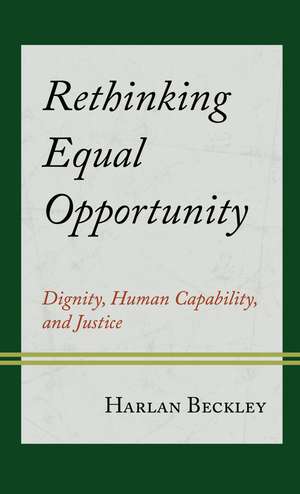
Rethinking Equal Opportunity: Dignity, Human Capability, and Justice
Autor Harlan Beckleyen Limba Engleză Paperback – 26 mar 2024
Even if our collective consent to equal opportunity is devoid of much substance, it forms a shaky platform for a more thoughtful exploration and deliberation of what equal opportunity requires of us individually and collectively. This book offers a substantive concept, principle, and disposition that can guide our thinking about justice and rescue us from an empty cliché. It proposes meaningful content for equal opportunity as a morally, socially, politically, and science-informed conception.
The "how" of equal opportunity requires that society-its structures, its associations, and its individual citizens-foster the capability of persons to become qualified to pursue a variety of outcomes they may choose. The absence of prejudice irrelevant to qualifications in making appointments to positions at some starting line is required but insufficient. Equality of opportunity calls for many renewals by society throughout the lives of its participants, which includes new possibilities for persons disabled or incarcerated and for all persons as they age.
Preț: 142.60 lei
Preț vechi: 188.93 lei
-25%
Puncte Express: 214
Carte tipărită la comandă
Livrare economică 04-18 decembrie
Livrare prin curier în România Termenul estimat este afișat lângă disponibilitate.
Transport gratuit de la 400.00 lei Plată online sau ramburs, în funcție de opțiunile comenzii.
Retur gratuit în 14 zile Comandă securizată și suport în română.
Specificații
ISBN-13: 9781538191057
ISBN-10: 1538191059
Pagini: 180
Dimensiuni: 139 x 216 x 14 mm
Greutate: 0.24 kg
Editura: Bloomsbury Publishing
Colecția Rowman & Littlefield
Locul publicării:New York, United States
ISBN-10: 1538191059
Pagini: 180
Dimensiuni: 139 x 216 x 14 mm
Greutate: 0.24 kg
Editura: Bloomsbury Publishing
Colecția Rowman & Littlefield
Locul publicării:New York, United States
Recenzii
This is an important book for anyone concerned with public policy. Readers will readily appreciate how the formal principle of fair opportunity is wholly dependent on the substantive principle of human capability. The former pertains to social structures: the latter to human agency. The author's discussion is altogether captivating.
Harlan Beckley's book offers a careful and powerful rethinking of equal opportunity. Deeply grounded in both theoretical and practical debates, it presents a rich account of equal opportunity as a central part of justice and draws out its implications for institutions, policies, and practices. Interested readers will find this account quite illuminating as will students in undergraduate and graduate courses. I enthusiastically recommend it.
Harlan Beckley has done a remarkable job of integrating the theoretical case for equal opportunity with the policy questions that shape current debates. Rethinking Equal Opportunity offers a comprehensive review of the strategies for increasing opportunity and a moral argument for equality that links these strategies to our political history and our understanding of human nature.
Drawing on decades of experience as a poverty-alleviation educator and inter-institutional leader, Harlan Beckley invites us to consider what "equality of opportunity" really means, beyond a trite synonym for the American Dream. What he offers is a nuanced, realistic, and socially embedded interpretation of human capability and freedom, where no one is guaranteed specific successes, but all citizens are empowered to pursue a vision of the good life, unencumbered by food, housing, health, or educational deficiencies, and unimpeded by gender and racial biases. In arguing for a collective responsibility to maximize human capability, Beckley draws on the insight of John Rawls, Martha Nussbaum, Amartya Sen, and Michael Sandel (among others), and in the second half of the book he offers a rich policy discussion of what structural commitment to freedom of opportunity in the US would require. Rethinking Equal Opportunity is a helpful contribution to the discourse around poverty alleviation, suitable for experts, undergraduates, and invested citizens alike.
Harlan Beckley's book offers a careful and powerful rethinking of equal opportunity. Deeply grounded in both theoretical and practical debates, it presents a rich account of equal opportunity as a central part of justice and draws out its implications for institutions, policies, and practices. Interested readers will find this account quite illuminating as will students in undergraduate and graduate courses. I enthusiastically recommend it.
Harlan Beckley has done a remarkable job of integrating the theoretical case for equal opportunity with the policy questions that shape current debates. Rethinking Equal Opportunity offers a comprehensive review of the strategies for increasing opportunity and a moral argument for equality that links these strategies to our political history and our understanding of human nature.
Drawing on decades of experience as a poverty-alleviation educator and inter-institutional leader, Harlan Beckley invites us to consider what "equality of opportunity" really means, beyond a trite synonym for the American Dream. What he offers is a nuanced, realistic, and socially embedded interpretation of human capability and freedom, where no one is guaranteed specific successes, but all citizens are empowered to pursue a vision of the good life, unencumbered by food, housing, health, or educational deficiencies, and unimpeded by gender and racial biases. In arguing for a collective responsibility to maximize human capability, Beckley draws on the insight of John Rawls, Martha Nussbaum, Amartya Sen, and Michael Sandel (among others), and in the second half of the book he offers a rich policy discussion of what structural commitment to freedom of opportunity in the US would require. Rethinking Equal Opportunity is a helpful contribution to the discourse around poverty alleviation, suitable for experts, undergraduates, and invested citizens alike.