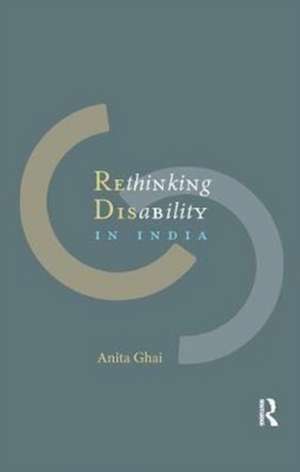
Rethinking Disability in India
Autor Anita Ghaien Limba Engleză Paperback – 28 noi 2017
Preț: 492.93 lei
Puncte Express: 739
Carte tipărită la comandă
Livrare economică 20 noiembrie-04 decembrie
Livrare prin curier în România Termenul estimat este afișat lângă disponibilitate.
Transport gratuit pentru acest produs Plată online sau ramburs, în funcție de opțiunile comenzii.
Retur gratuit în 14 zile Comandă securizată și suport în română.
Specificații
ISBN-13: 9780815373216
ISBN-10: 081537321X
Pagini: 392
Dimensiuni: 138 x 216 x 21 mm
Greutate: 0.73 kg
Ediția:1
Editura: Taylor & Francis
Colecția Routledge India
Locul publicării:Oxford, United Kingdom
ISBN-10: 081537321X
Pagini: 392
Dimensiuni: 138 x 216 x 21 mm
Greutate: 0.73 kg
Ediția:1
Editura: Taylor & Francis
Colecția Routledge India
Locul publicării:Oxford, United Kingdom
V-ar putea interesa
-
 Emma and ISheila Hocken-20%Preț: 83.71 lei104.93 lei
 -
 Disability and DisadvantageKimberley Brownlee-11%Preț: 385.39 lei431.69 lei
 -
 Learning Disability Policy and Practice: Changing Lives?Valerie Williams-24%Preț: 260.26 lei342.97 lei
 -
 Preț: 294.87 lei
 -
 Functional Impairment: Management, Types & ChallengesEmaad M O Abdel-Rahman-23%Preț: 1303.41 lei1701.90 lei
 -
 Education of Students with Disabilities: Federal Issues & PoliciesHarrison Garlach-27%Preț: 889.01 lei1210.67 lei
 -
 -27%Preț: 533.37 lei726.37 lei
 -
 -27%Preț: 1218.26 lei1660.03 lei
 -
 -27%Preț: 1024.41 lei1396.36 lei
 -
 -27%Preț: 1216.82 lei1659.07 lei
 -
 -27%Preț: 1023.75 lei1395.94 lei
 -
 -27%Preț: 1271.92 lei1734.85 lei
 -
 Disabled People and Housing: Choices, Opportunities and BarriersLaura HemingwayPreț: 282.66 lei
 -
 -21%Preț: 91.67 lei116.33 lei
 -
 -12%Preț: 65.59 lei74.57 lei
Public țintă
PostgraduateRecenzii
"Ghai’s book gives an extensive, detailed and complex overview of disability in India. It is the author’s position at the interface between a research scholar on disability, a disability rights activist and a disabled person that makes her book so interesting and demonstrative. As do her remarkable expressions of hope and strength as illustrated by her comment, “Polio was a gift –an opportunity from which to learn, experience, understand, and then move on” (p. 15)."
Anna-Lena Wolf, International Quarterly for Asian Studies
Anna-Lena Wolf, International Quarterly for Asian Studies
Cuprins
Acknowledgements . Introduction . 1. An Autobiographical Note: My Own Journey 2. Conversations about Disability: The Cultural Landscape 3. Understanding Disability: Slippery Ropes 4. At the Periphery: Marginalised Disabled Lives 5. Mystifying Realities: Right to Life 6 . Theorising Disability 7. Politics of Identity: Oppression and Resistance 8. Need for a Paradigm Shift: Conceptualising Disability Studies. Bibliography
Descriere
Moving away from clinical, medical or therapeutic perspectives on disability, this book explores disability in India as a social, cultural and political phenomenon, arguing that this ‘difference’ should be accepted as a part of social diversity. It further interrogates the multiple issues of identification of the disabled and the forms of oppression they face.