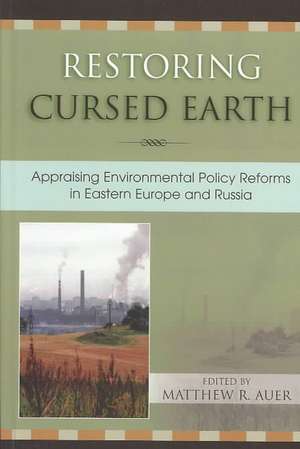
Restoring Cursed Earth: Appraising Environmental Policy Reforms in Eastern Europe and Russia
Editat de Matthew R. Auer Contribuţii de Joshua E. Abrams, Ruth Greenspan Bell, Susan Legro, M Cristina Novacen Limba Engleză Hardback – 12 mai 2004
Preț: 720.47 lei
Preț vechi: 1093.73 lei
-34%
Puncte Express: 1081
Carte tipărită la comandă
Livrare economică 02-16 decembrie
Livrare prin curier în România Termenul estimat este afișat lângă disponibilitate.
Transport gratuit pentru acest produs Plată online sau ramburs, în funcție de opțiunile comenzii.
Retur gratuit în 14 zile Comandă securizată și suport în română.
Specificații
ISBN-13: 9780742529151
ISBN-10: 0742529150
Pagini: 200
Dimensiuni: 160 x 232 x 20 mm
Greutate: 0.44 kg
Ediția:New.
Editura: Bloomsbury Publishing
Colecția Rowman & Littlefield
Locul publicării:New York, United States
ISBN-10: 0742529150
Pagini: 200
Dimensiuni: 160 x 232 x 20 mm
Greutate: 0.44 kg
Ediția:New.
Editura: Bloomsbury Publishing
Colecția Rowman & Littlefield
Locul publicării:New York, United States
V-ar putea interesa
-
 This Idea Is BrilliantJohn BrockmanPreț: 108.90 lei
 -
 -17%Preț: 67.00 lei80.66 lei
 -
 Preț: 233.02 lei
 -
 Birds of East AsiaMark BrazilPreț: 249.95 lei
 -
 The Crossley Id Guide RaptorsRichard CrossleyPreț: 191.91 lei
 -
 -34%Preț: 599.71 lei909.89 lei
 -
 -30%Preț: 352.43 lei506.67 lei
 -
 Open HorizonsSigurd F. OlsonPreț: 93.22 lei
 -
 -30%Preț: 764.79 lei1093.79 lei
 -
 On the Spine of TimeHarry MiddletonPreț: 107.53 lei
 -
 -9%Preț: 1300.02 lei1428.59 lei
 -
 A Wind-Storm in the ForestsApplewood BooksPreț: 65.75 lei
 -
 Permafrost in CanadaRoger J E BrownPreț: 358.79 lei
 -
 Ecocriticism of the Global SouthScott Slovic-26%Preț: 286.85 lei389.35 lei
 -
 -18%Preț: 765.51 lei933.55 lei
 -
 -36%Preț: 525.43 lei816.07 lei
 -
 -32%Preț: 565.09 lei831.07 lei
 -
 The Truth Has ChangedJosh Fox-14%Preț: 76.46 lei88.93 lei
 -
 Ice Diaries: An Antartic MemoirJean McNeil-17%Preț: 96.69 lei116.85 lei
 -
 The Memory We Could Be: Overcoming Fear to Create Our Ecological FutureDaniel Macmillen Voskoboynik-18%Preț: 57.89 lei70.57 lei
 -
 -33%Preț: 609.90 lei912.22 lei
 -
 Through the WoodsH. E. BatesPreț: 98.78 lei
 -
 Einführung in die synoptische WetteranalyseS. P. ChromowPreț: 427.98 lei
Cuprins
Chapter 1 Lessons from Leaders and Laggards: Appraising Environmental Reforms in Central and Eastern Europe and Russia
Chapter 2 Environmental Reforms in the Czech Republic: Uneven Progress after 1989
Chapter 3 Hungary: Developing Institutions to Support Environmental Protection
Chapter 4 Forestry Resources in Transition: The Romanian Experience
Chapter 5 Estonian Environmental Reforms: A Small Nation's Outsized Accomplishments
Chapter 6 The Disappearance of Popular Environmental Activism in Post-Soviet Russia
Chapter 7 Conclusion: Lessons Learned for the Road Forward
Chapter 2 Environmental Reforms in the Czech Republic: Uneven Progress after 1989
Chapter 3 Hungary: Developing Institutions to Support Environmental Protection
Chapter 4 Forestry Resources in Transition: The Romanian Experience
Chapter 5 Estonian Environmental Reforms: A Small Nation's Outsized Accomplishments
Chapter 6 The Disappearance of Popular Environmental Activism in Post-Soviet Russia
Chapter 7 Conclusion: Lessons Learned for the Road Forward
Recenzii
After a synoptical introduction by the author, this book effectively becomes a collage of detailed studies of the Czech Republic, Hungary, Romania, Estonia, and post-Soviet Russia. . . .[S]o far as the rest of Eastern Europe is concerned. . . [this book] identifies far more permanent and longstanding achievements.
Exploring thorny questions about how to reverse practices and results from the environmental devastation left by communist rule in Eastern Europe and Russia, Matt Auer and his colleagues offer hope, insight and despair. Their analysis of efforts by various reforming institutions-government bodies, NGOs and advocacy networks-offers sophisticated tales of the interplay of politics, economics and environment. The myriad difficulties of post-Soviet countries seeking environmental improvements turn out to vary greatly. The obvious is often false, while the inertial and subtle hold sway.
This compelling book reviews the successes and failures of environmental reforms in Eastern Europe and Russia. It argues that progress is due more to evolving institutions than to structural change and clearly explains how international cooperation and environmental agreements shape institutions that favor environmental protection and natural resource management.
Fifteen years into Europe's post-communist transition, Restoring Cursed Earth is a timely and important contribution to our collective understanding of environmental policy developments in Russia and Central and Eastern Europe. The volume explores the connections and contradictions in the dual projects of constructing a more united Europe and building more sustainable economies and societies. Auer and his colleagues' use of institutional analysis helps to explain the region's environmental policy accomplishments to date, and the challenges that remain. In particular, the authors' interest in the dynamic interaction between domestic and international institutions reveals both revolutionary change in Russian and Eastern European environmental policy enabled by international assistance programs since 1989, and the persistence and recreation of pre-1989 social institutions.
Exploring thorny questions about how to reverse practices and results from the environmental devastation left by communist rule in Eastern Europe and Russia, Matt Auer and his colleagues offer hope, insight and despair. Their analysis of efforts by various reforming institutions-government bodies, NGOs and advocacy networks-offers sophisticated tales of the interplay of politics, economics and environment. The myriad difficulties of post-Soviet countries seeking environmental improvements turn out to vary greatly. The obvious is often false, while the inertial and subtle hold sway.
This compelling book reviews the successes and failures of environmental reforms in Eastern Europe and Russia. It argues that progress is due more to evolving institutions than to structural change and clearly explains how international cooperation and environmental agreements shape institutions that favor environmental protection and natural resource management.
Fifteen years into Europe's post-communist transition, Restoring Cursed Earth is a timely and important contribution to our collective understanding of environmental policy developments in Russia and Central and Eastern Europe. The volume explores the connections and contradictions in the dual projects of constructing a more united Europe and building more sustainable economies and societies. Auer and his colleagues' use of institutional analysis helps to explain the region's environmental policy accomplishments to date, and the challenges that remain. In particular, the authors' interest in the dynamic interaction between domestic and international institutions reveals both revolutionary change in Russian and Eastern European environmental policy enabled by international assistance programs since 1989, and the persistence and recreation of pre-1989 social institutions.