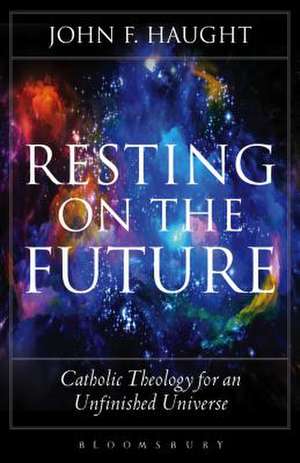
Resting on the Future: Catholic Theology for an Unfinished Universe
Autor Professor John F. Haughten Limba Engleză Paperback – 24 sep 2015
Adresată studenților de la facultățile de teologie, cercetătorilor în filosofia religiei și practicienilor interesați de dialogul dintre credință și rațiune, Resting on the Future propune o recalibrare a gândirii catolice în contextul descoperirilor științifice moderne. Remarcăm modul în care Professor John F. Haught demontează viziunea tradițională a unui univers static, argumentând că o cosmologie care recunoaște caracterul narativ și neterminant al creației oferă un cadru mult mai fertil pentru viața spirituală contemporană.
Structura volumului este riguroasă și progresivă, cele 13 capitole marcând tranziția de la concepte „fixiste” la cele „futuriste”. Subliniem capitolele dedicate evoluției și ecologiei, unde autorul mută accentul de la conservare la pregătire și de la design la dramă. Această abordare transformă suferința din ispășire în așteptare și moralitatea dintr-un stadiu de perfecțiune într-un proces continuu. Apreciem claritatea cu care este expusă ideea că mintea umană nu este o simplă consecință tardivă a evoluției, ci axa centrală a unui univers care încă se scrie.
Lucrarea completează perspectiva oferită de A John Haught Reader, adăugând o structură teologică aplicată pe dogme specifice, acolo unde antologia anterioară oferea doar o privire de ansamblu. Totodată, se distinge de A New Copernican Turn prin concentrarea pe tradiția catolică și pe modul în care „viitorul” devine noul punct de sprijin al credinței, spre deosebire de analiza lui Doru Costache care explorează potențialul teologiei ortodoxe în raport cu angoasa spațială modernă. Ediția de față, apărută la Bloomsbury Academic, integrează decenii de cercetare într-o sinteză accesibilă, esențială pentru curriculumul academic de teologie sistematică.
Preț: 206.34 lei
Preț vechi: 274.81 lei
-25%
Carte tipărită la comandă
Livrare economică 01-15 decembrie
Specificații
ISBN-10: 1501306219
Pagini: 232
Dimensiuni: 140 x 216 x 13 mm
Greutate: 0.32 kg
Editura: Bloomsbury Publishing
Colecția Bloomsbury Academic
Locul publicării:New York, United States
V-ar putea interesa
-
 Why Beliefs Matter: Reflections on the Nature of ScienceE. Brian Davies-16%Preț: 187.51 lei224.52 lei
 -
 Religion as a Social Determinant of Public HealthEllen L. Idler-28%Preț: 506.35 lei700.87 lei
 -
 -31%Preț: 962.83 lei1401.09 lei
 -
 -19%Preț: 345.51 lei427.17 lei
 -
 Buddhist BiologyDavid P. Barash-19%Preț: 457.62 lei564.97 lei
 -
 -23%Preț: 352.91 lei458.59 lei
 -
 Preț: 107.99 lei
 -
 True Scientists, True FaithR J BerryPreț: 97.48 lei
 -
 In Praise of Darwin: George Romanes and the Evolution of a Darwinian BelieverProfessor J. David Pleins-23%Preț: 260.32 lei337.21 lei
 -
 Preț: 140.75 lei
De ce să citești această carte
Recomandăm această carte oricărui cititor care dorește să înțeleagă cum poate supraviețui teologia într-o eră a științei riguroase. Veți câștiga o perspectivă optimistă asupra viitorului, învățând să priviți universul nu ca pe un mecanism fix, ci ca pe o poveste în desfășurare. Este o resursă valoroasă pentru a depăși conflictul aparent dintre evoluționism și credință, oferind argumente solide pentru o spiritualitate a anticipării.
Descriere
Science's recent realization that the universe is dramatic, however, has yet to penetrate deeply into either spiritual or intellectual life. Most Christian thought and spirituality still presuppose an essentially static universe while influential academic and intellectual culture remains stuck in a stagnant materialist naturalism and cosmic pessimism.
Resting on the Future asks about the meaning of an unfinished universe from the point of view of both Christian theology and contemporary intellectual life. Each chapter covers a distinct aspect of what Haught takes to be an essential transition to a new age in Catholic life and thought. Biology, cosmology, and other fields of science now provide the setting for a wholesome transformation of Catholic thought from a still predominantly pre-scientific to a more hopeful and scientifically informed vision of God, humanity and the natural world.
Cuprins
1. Nature: From Sacrament to Promise
2. God: From Governor to Goal
3. Dogma: From Fixist to Futurist
4. Spirituality: From Contemplation to Anticipation
5. Life: From Design to Drama
6. Evolution: From Outcome to Opportunity
7. Suffering: From Expiation to Expectation
8. Dignity: From Duality to Relationality
9. Morality: From Perfection to Process
10. Mind: From Afterthought to Axis
11. Humanity: From Term to Transition
12. Ecology: From Preservation to Preparation
13. Destiny: From Personal to Cosmic
Bibliography
Index
Recenzii
John F. Haught's latest book provides a brilliant theological analysis of what the Catholic faith means in an age of evolution. It is an intellectually adventurous, most inspiring work-a creative response to the Second Vatican Council's call for the much needed renewal of the Catholic Church. This illuminating account of what Haught calls 'the metaphysics of the future' unfolds before us the grandeur of cosmic and Christian hope. Deeply influenced by Teilhard de Chardin, Lonergan, Rahner, and other modern theologians and philosophers, Haught's thought challenges its readers in every fibre of their being to think afresh about the much misunderstood relationship between religion and evolution. It also addresses such topical issues as ecology, transhumanism, the value of human life, suffering and death, and the great biblical promise of the future. I cannot recommend this book too highly-it is a model of clarity, strength of argument, original thinking, and a most persuasive summons to re-examine our life and thought in the light of evolutionary becoming.
Professor Haught provides us with a readable, thoughtful synthesis. Not merely responding to the 'New Atheists,' as he has done so well, he offers a way forward for Catholics to think about how the faith relates to issues in science. He reminds us that it is 'good news' that the universe is unfinished.