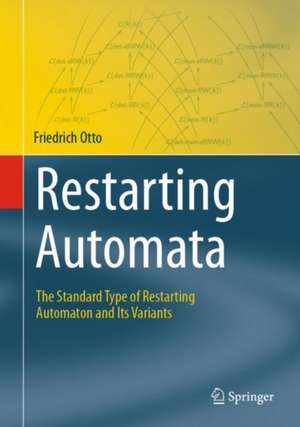
Restarting Automata: Theory and Applications of Computability
Autor Friedrich Ottoen Limba Engleză Hardback – 30 oct 2024
Preț: 1245.75 lei
Preț vechi: 1557.20 lei
-20%
Puncte Express: 1869
Carte tipărită la comandă
Livrare economică 18 noiembrie-02 decembrie
Livrare prin curier în România Termenul estimat este afișat lângă disponibilitate.
Transport gratuit pentru acest produs Plată online sau ramburs, în funcție de opțiunile comenzii.
Retur gratuit în 14 zile Comandă securizată și suport în română.
Specificații
ISBN-13: 9783031700934
ISBN-10: 3031700937
Pagini: 420
Ilustrații: Approx. 425 p.
Dimensiuni: 183 x 260 x 29 mm
Greutate: 0.98 kg
Ediția:2025
Editura: Springer
Colecția Theory and Applications of Computability
Seria Theory and Applications of Computability
Locul publicării:Cham, Switzerland
ISBN-10: 3031700937
Pagini: 420
Ilustrații: Approx. 425 p.
Dimensiuni: 183 x 260 x 29 mm
Greutate: 0.98 kg
Ediția:2025
Editura: Springer
Colecția Theory and Applications of Computability
Seria Theory and Applications of Computability
Locul publicării:Cham, Switzerland
V-ar putea interesa
-
 Automata TheoryJavier Esparza-23%Preț: 511.80 lei660.96 lei
 -
 Mathematical Structure of Syntactic MergeMatilde Marcolli-14%Preț: 411.52 lei478.51 lei
 -
 Programming Language PragmaticsMichael Scott-40%Preț: 484.42 lei806.85 lei
 -
 MeditationsMarcus AureliusPreț: 33.79 lei
 -
 Sipser, M: Introduction to the Theory of ComputationMichael (Massachusetts Institute of Technology) Sipser-25%Preț: 599.79 lei801.72 lei
 -
 -41%Preț: 581.04 lei981.40 lei
 -
 CompilersAlfred V. Aho-20%Preț: 629.07 lei786.34 lei
 -
 Philosophical Writing - An Introduction, 5th EditionA. P. MartinichPreț: 249.89 lei
 -
 Learning A New Language For DummiesMaria J. Cabrera-PuchePreț: 96.59 lei
 -
 Agentic AI For DummiesPam Baker-20%Preț: 145.74 lei182.17 lei
 -
 Rosen's AlmanacMichael RosenPreț: 121.22 lei
 -
 AlgospeakAdam AleksicPreț: 121.84 leiRecomandat
 -
 -35%Preț: 286.54 lei443.60 lei
 -
 Speaking in TonguesJ. M. CoetzeePreț: 105.11 lei
 -
 Preț: 89.52 lei
 -
 Writing better English A2-B2Rolf GiesePreț: 103.25 lei
 -
 Preț: 284.74 lei
 -
 Preț: 158.56 lei
 -
 Metaphor: ReFantazio Official Strategy GuideFuture Press-20%Preț: 354.55 lei443.18 lei
 -
 Theory of ComputationK. R. Chowdhary-20%Preț: 745.34 lei931.68 lei
Cuprins
Introduction.- Analysis by Reduction.- The Restarting Automaton and Its Parameters.- Descriptional Complexity.- Learnability for Restarting Automata.- Appendix A: List of Open Problems.- Appendix B: List of Example Languages.
Notă biografică
Prof. Dr. Friedrich Otto is affiliated with the University of Kassel. He is a retired associate professor of the Department of Electrical Engineering and Computer Science.
Textul de pe ultima copertă
In this unique volume, the expressive capacity of the various types of restarting automata is studied, and the resulting classes of languages are compared to each other and to the classes of an extended Chomsky hierarchy.
A restarting automaton consists of a finite-state control, a flexible tape with end-of-tape markers that initially contains the input, and a read-write window of a fixed finite size. The objective here is to collect the many results that have been obtained on the various types of restarting automata in one place and to present them in a uniform and systematic way.
Among the book’s topics and features:
* Delivers a comprehensive survey of the numerous types of restarting automata and results that obtained on them
* Shows how the restarting automaton is motivated by the linguistic technique of ‘analysis by reduction’
* Presents the many types of restarting automata in a uniform and systematic way
* Provides a significantly complete list of references on restarting automata
* Offers a text that is accessible to advanced undergraduate and graduate students
Accordingly, this comprehensive monograph may serve as a book of reference for researchers, as a guide to the literature on restarting automata, and as a textbook for an advanced undergraduate or graduate course in formal language and automata theory.
A restarting automaton consists of a finite-state control, a flexible tape with end-of-tape markers that initially contains the input, and a read-write window of a fixed finite size. The objective here is to collect the many results that have been obtained on the various types of restarting automata in one place and to present them in a uniform and systematic way.
Among the book’s topics and features:
* Delivers a comprehensive survey of the numerous types of restarting automata and results that obtained on them
* Shows how the restarting automaton is motivated by the linguistic technique of ‘analysis by reduction’
* Presents the many types of restarting automata in a uniform and systematic way
* Provides a significantly complete list of references on restarting automata
* Offers a text that is accessible to advanced undergraduate and graduate students
Accordingly, this comprehensive monograph may serve as a book of reference for researchers, as a guide to the literature on restarting automata, and as a textbook for an advanced undergraduate or graduate course in formal language and automata theory.
Caracteristici
Offers a comprehensive survey of restarting automata and results generated from them Presents systematically the various types of restarting automata Provides extremely complete reference lists, for maximum utility
Descriere
Descriere de la o altă ediție sau format:
Other topics include the descriptional complexity and inductive inference of certain types of restarting automata, cooperating distributed and parallel communicating systems of restarting automata, restarting automata with output, weighted restarting automata, and restarting automata for picture languages and tree languages.
Other topics include the descriptional complexity and inductive inference of certain types of restarting automata, cooperating distributed and parallel communicating systems of restarting automata, restarting automata with output, weighted restarting automata, and restarting automata for picture languages and tree languages.