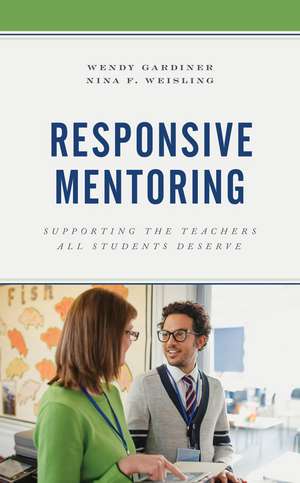
Responsive Mentoring: Supporting the Teachers All Students Deserve
Autor Wendy Gardiner, Nina F. Weislingen Limba Engleză Hardback – 4 aug 2020
Preț: 345.39 lei
Preț vechi: 417.03 lei
-17%
Puncte Express: 518
Carte tipărită la comandă
Livrare economică 01-15 decembrie
Livrare prin curier în România Termenul estimat este afișat lângă disponibilitate.
Transport gratuit de la 400.00 lei Plată online sau ramburs, în funcție de opțiunile comenzii.
Retur gratuit în 14 zile Comandă securizată și suport în română.
Specificații
ISBN-13: 9781475851366
ISBN-10: 1475851367
Pagini: 140
Ilustrații: 5 b/w illustrations;2 b/w photos; 5 tables
Dimensiuni: 162 x 240 x 18 mm
Greutate: 0.42 kg
Editura: Bloomsbury Publishing
Colecția Rowman & Littlefield
Locul publicării:New York, United States
ISBN-10: 1475851367
Pagini: 140
Ilustrații: 5 b/w illustrations;2 b/w photos; 5 tables
Dimensiuni: 162 x 240 x 18 mm
Greutate: 0.42 kg
Editura: Bloomsbury Publishing
Colecția Rowman & Littlefield
Locul publicării:New York, United States
Descriere
Responsive Mentoring: Supporting the Teachers All Students Deserve advocates for a collaborative approach to mentoring that is teacher-centered, scaffolded, and contextualized to teachers' work. This approach is designed to help teachers across their careers set and meet ambitious instructional goals, while also developing as reflective practitioners who learn in and from their teaching, in order to ensure all students receive a rigorous and engaging educational experience.
Mentoring is a highly complex and critical endeavor. To guide mentors' work, a clear vision for mentoring is coupled with a highly-responsive set of mentoring practices. Recommendations and real world examples help mentors make informed decisions about which practices to use, under what circumstances, and in what combinations, in order to responsively and effectively facilitate teacher learning and development. Concrete and practical advice along with questions for reflection and action help mentors across contexts and levels of experience. A final section outlining intentional and versatile strategies for mentoring-the-mentor ensures that all mentors also have supports to grow as professionals.
Mentoring is a highly complex and critical endeavor. To guide mentors' work, a clear vision for mentoring is coupled with a highly-responsive set of mentoring practices. Recommendations and real world examples help mentors make informed decisions about which practices to use, under what circumstances, and in what combinations, in order to responsively and effectively facilitate teacher learning and development. Concrete and practical advice along with questions for reflection and action help mentors across contexts and levels of experience. A final section outlining intentional and versatile strategies for mentoring-the-mentor ensures that all mentors also have supports to grow as professionals.
Cuprins
Foreword
Preface
Introduction
Part I: Foundations of Effective Mentoring
Chapter 1: Educative Mentoring: A Fundamental Shift in Mentoring
Chapter 2: Trust: The Cornerstone for Educative Mentoring
Chapter 3: Goal Setting and Collecting Useful Data Within the Mentoring Cycle
Part II: Mentoring Practices
Chapter 4: Debriefing Sessions: The Heart of Mentoring
Chapter 5: Brief Interactions: Making the Most of a Few Minutes
Chapter 6: Co-Planning and Resource Supports: Helping Fill in the Gaps
Chapter 7: Video Analysis: Visual Support for Teacher Growth
Chapter 8: Collegial Visits: Learning from Peers
Chapter 9: Demonstrations & Rehearsal: Ensuring Teachers Feel Ready to Teach
Chapter 10: Stepping into the Action to Provide "Real-Time" Support
Chapter 11: Demonstration Teaching: Contextualized Mentor Modeling
Chapter 12: Co-teaching: Sharing the Risk and Responsibility for Ambitious Teaching
Part III: Mentoring The Mentor
Chapter 13: Mentoring the Mentors
Chapter 14: Video Analysis: A Visual Support for Mentor Growth
Chapter 15: It Takes Two (or More): Co-Mentoring For Improved Practice
Chapter 16: Mentor Development Sessions: Learning With and From Team Leaders
Afterword: Final Thoughts As You Move Forward with Educative Mentoring
References
Appendix A
Appendix B
Appendix C
Preface
Introduction
Part I: Foundations of Effective Mentoring
Chapter 1: Educative Mentoring: A Fundamental Shift in Mentoring
Chapter 2: Trust: The Cornerstone for Educative Mentoring
Chapter 3: Goal Setting and Collecting Useful Data Within the Mentoring Cycle
Part II: Mentoring Practices
Chapter 4: Debriefing Sessions: The Heart of Mentoring
Chapter 5: Brief Interactions: Making the Most of a Few Minutes
Chapter 6: Co-Planning and Resource Supports: Helping Fill in the Gaps
Chapter 7: Video Analysis: Visual Support for Teacher Growth
Chapter 8: Collegial Visits: Learning from Peers
Chapter 9: Demonstrations & Rehearsal: Ensuring Teachers Feel Ready to Teach
Chapter 10: Stepping into the Action to Provide "Real-Time" Support
Chapter 11: Demonstration Teaching: Contextualized Mentor Modeling
Chapter 12: Co-teaching: Sharing the Risk and Responsibility for Ambitious Teaching
Part III: Mentoring The Mentor
Chapter 13: Mentoring the Mentors
Chapter 14: Video Analysis: A Visual Support for Mentor Growth
Chapter 15: It Takes Two (or More): Co-Mentoring For Improved Practice
Chapter 16: Mentor Development Sessions: Learning With and From Team Leaders
Afterword: Final Thoughts As You Move Forward with Educative Mentoring
References
Appendix A
Appendix B
Appendix C
Recenzii
This book on effective teacher mentoring in schools is an invaluable gift we have been waiting for. Drawing from extensive research, Wendy Gardiner and Nina Weisling offer practical guides to support aspiring and seasoned teachers and to provide mentoring to mentors themselves. Each chapter unwraps important concepts and lessons that can fundamentally lead to transforming both teaching practices and the teaching profession.
This is definitely the book I would've wanted to read when I was coaching and mentoring teachers as a young "veteran" teacher and then again when I was helping to build a district mentoring program. Nevertheless, I am supremely grateful that Wendy and Nina have combined their incredible research and boots-on-the-ground experience to give us this insightful, practical, and immediately applicable set of definitions, knowledge, and skills for the development of mentors in a time when our profession is suffering greatly from declines in enrollment in teacher prep programs and extremely high rates of attrition. In my current work, helping to build teacher residency programs in which mentors are a pillar of the model and part of the solution to our teacher shortage, quality, and retention challenges, this book couldn't come at a better time as a resource to my programs and their mentors and also as a resource to help elevate the teaching profession writ large.
Responsive Mentoring: Supporting the Teachers All Students Deserve is a theoretically sound road map of how best to improve teaching practices by focusing on "ambitious instruction" and preparing a cadre of teacher leaders. Gardiner and Weisling advance our understanding of two core assumptions as they provide thick description of powerful routines and procedures for looking deeply and creatively within classrooms: 1) Teachers can and should "learn in and from teaching"; and 2) Being a highly effective teacher does not automatically make you an exemplary mentor. The techniques come alive with examples drawn from the authors' own experiences as teacher educators, mentors and master teachers. This volume is more than a "how-to" manual. It is a call to action for making schools vibrant learning environments for adults and children.
Responsive Mentoring: Supporting the Teachers All Students Deserve presents the case for the use of Educative Mentoring -- shifting the way we think of, plan for, and implement mentoring in education. Drs. Gardiner and Weisling use the voices of teachers, mentors, and researchers to provide support and a framework for inside and outside mentoring, mentoring cycles, and cycles of inquiry that can be used to develop mentoring strategies and practices. As an educator and administrator with over 30 years of experience, I learned something new with each chapter. I highly recommend this text for anyone in the field who is interested in innovative ways to develop our next generation of educational leaders. The unique blend of practical and developmental strategies can be used by practitioners, colleges of education, and school leaders in order to develop a varied repertoire in support of teachers' professional development.
This is a clear, practical guide to effective, responsive mentoring built on trust and collegiality. Drawing from a wealth of research and on-the-ground experience, the authors share approaches to mentoring that include building strong relationships; collaborative goal setting; different types of classroom observations; teaching demonstrations and rehearsals; and debriefing with tools like video analysis. Highly recommended for new and experienced mentors alike.
This is definitely the book I would've wanted to read when I was coaching and mentoring teachers as a young "veteran" teacher and then again when I was helping to build a district mentoring program. Nevertheless, I am supremely grateful that Wendy and Nina have combined their incredible research and boots-on-the-ground experience to give us this insightful, practical, and immediately applicable set of definitions, knowledge, and skills for the development of mentors in a time when our profession is suffering greatly from declines in enrollment in teacher prep programs and extremely high rates of attrition. In my current work, helping to build teacher residency programs in which mentors are a pillar of the model and part of the solution to our teacher shortage, quality, and retention challenges, this book couldn't come at a better time as a resource to my programs and their mentors and also as a resource to help elevate the teaching profession writ large.
Responsive Mentoring: Supporting the Teachers All Students Deserve is a theoretically sound road map of how best to improve teaching practices by focusing on "ambitious instruction" and preparing a cadre of teacher leaders. Gardiner and Weisling advance our understanding of two core assumptions as they provide thick description of powerful routines and procedures for looking deeply and creatively within classrooms: 1) Teachers can and should "learn in and from teaching"; and 2) Being a highly effective teacher does not automatically make you an exemplary mentor. The techniques come alive with examples drawn from the authors' own experiences as teacher educators, mentors and master teachers. This volume is more than a "how-to" manual. It is a call to action for making schools vibrant learning environments for adults and children.
Responsive Mentoring: Supporting the Teachers All Students Deserve presents the case for the use of Educative Mentoring -- shifting the way we think of, plan for, and implement mentoring in education. Drs. Gardiner and Weisling use the voices of teachers, mentors, and researchers to provide support and a framework for inside and outside mentoring, mentoring cycles, and cycles of inquiry that can be used to develop mentoring strategies and practices. As an educator and administrator with over 30 years of experience, I learned something new with each chapter. I highly recommend this text for anyone in the field who is interested in innovative ways to develop our next generation of educational leaders. The unique blend of practical and developmental strategies can be used by practitioners, colleges of education, and school leaders in order to develop a varied repertoire in support of teachers' professional development.
This is a clear, practical guide to effective, responsive mentoring built on trust and collegiality. Drawing from a wealth of research and on-the-ground experience, the authors share approaches to mentoring that include building strong relationships; collaborative goal setting; different types of classroom observations; teaching demonstrations and rehearsals; and debriefing with tools like video analysis. Highly recommended for new and experienced mentors alike.
Notă biografică
Wendy Gardiner is currently an Associate Professor and the Jolita Hylland Benson Endowed Chair in Elementary Education at Pacific Lutheran University where she teaches literacy courses. For nearly 20 years she has mentored pre-service, new, and veteran teachers in urban schools and has worked with mentors conducting research to inform and advance this important work.