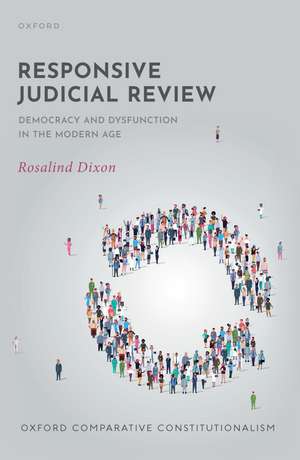
Responsive Judicial Review: Democracy and Dysfunction in the Modern Age: Oxford Comparative Constitutionalism
Autor Rosalind Dixonen Limba Engleză Paperback – 28 mai 2025
Din seria Oxford Comparative Constitutionalism
- 33%
 Preț: 725.36 lei
 - 32%
 Preț: 663.55 lei
 - 33%
 Preț: 688.10 lei
 - 22%
 Preț: 214.24 lei
 - 32%
 Preț: 659.20 lei
 - 20%
 Preț: 149.37 lei
 - 32%
 Preț: 695.53 lei
 - 32%
 Preț: 696.23 lei
 - 32%
 Preț: 694.38 lei
 - 29%
 Preț: 745.35 lei
 - 29%
 Preț: 757.03 lei
 - 29%
 Preț: 871.06 lei
 - 31%
 Preț: 730.01 lei
 - 23%
 Preț: 702.04 lei
 - 11%
 Preț: 371.98 lei
 - 23%
 Preț: 725.34 lei
 - 31%
 Preț: 878.43 lei
 - 31%
 Preț: 647.62 lei
 - nou
 Preț: 681.72 lei
Preț: 216.26 lei
Preț vechi: 274.20 lei
-21%
Puncte Express: 324
Carte disponibilă
Livrare economică 12-18 noiembrie
Livrare express 24-30 octombrie pentru 87.85 lei
Livrare prin curier în România Termenul estimat este afișat lângă disponibilitate.
Transport gratuit de la 400.00 lei Plată online sau ramburs, în funcție de opțiunile comenzii.
Retur gratuit în 14 zile Comandă securizată și suport în română.
Specificații
ISBN-13: 9780198938910
ISBN-10: 0198938918
Pagini: 320
Dimensiuni: 155 x 235 x 17 mm
Greutate: 0.46 kg
Editura: OUP OXFORD
Colecția OUP Oxford
Seria Oxford Comparative Constitutionalism
Locul publicării:Oxford, United Kingdom
ISBN-10: 0198938918
Pagini: 320
Dimensiuni: 155 x 235 x 17 mm
Greutate: 0.46 kg
Editura: OUP OXFORD
Colecția OUP Oxford
Seria Oxford Comparative Constitutionalism
Locul publicării:Oxford, United Kingdom
Recenzii
In this masterful work, Rosalind Dixon returns judicial representation-reinforcement to center stage in our understanding of judicial review. Her theory of how judicial intervention can counteract democratic dysfunction is rooted in rich examples and a breadth and depth of comparative expertise that reflects her position as a leading scholar in the field. What makes this book of exceptional importance is its close attention to the opportunities and challenges in operationalizing responsive judicial review; Dixon speaks directly to judges in outlining how constitutional courts might function as democracy-protecting and democracy-promoting. In presenting a theory of judicial review alongside guidance for its implementation, Dixon reanimates our aspirations for courts as valued participants in achieving a society committed to democratic responsiveness.
Comprehensive in its sweep, systematic in its analysis, and yet distinctive in its focus, Rosalind Dixon's insightful book is a major contribution to the growing comparative literature on political process approaches to constitutional review.
Professor Dixon has written a landmark book on the theory of judicial review. Using excellent examples drawn from around the world, she shows how courts should modulate their decision-making in response to legal, social, and political context. Her book will become the go-to resource for the field, on which all future work will build.
Dixon's stimulating work presents a reformist vision that is sure to re-energise the debates on judicial review and constitutional democracy.
Dixon formulates a meticulously crafted dialogic theory- one that embodies equilibrium, yet firmly rooted in principles of self-restraint and cautious calibration of the extent and potency of Judicial decision-making.
Dixon's work draws on experiences from many jurisdictions, including Australia, Brazil, Canada, Colombia, Fiji, Germany, Hong Kong, India, Israel, Korea, Pakistan, Singapore, South Africa, the UK, the US, and New Zeaand. The sheer breadth of her comparative exercise of constitutional theory makes the book a must-read for academic scholars and practioners who turn to courts to litigate critical questions of constitutional law.
Dixon's exposition of modern democratic dysfunction and responsive judging arrives at an opportune time, in which both newer and more established democracies are experiencing considerable challenges to their democratic norms and structures. Dixon contributes to the growing literature on this topic by offering a careful definition and catalogue of the ills plaguing modern democracies alongside reflections on the legitimacy and effectiveness of institutional responses.
Comprehensive in its sweep, systematic in its analysis, and yet distinctive in its focus, Rosalind Dixon's insightful book is a major contribution to the growing comparative literature on political process approaches to constitutional review.
Professor Dixon has written a landmark book on the theory of judicial review. Using excellent examples drawn from around the world, she shows how courts should modulate their decision-making in response to legal, social, and political context. Her book will become the go-to resource for the field, on which all future work will build.
Dixon's stimulating work presents a reformist vision that is sure to re-energise the debates on judicial review and constitutional democracy.
Dixon formulates a meticulously crafted dialogic theory- one that embodies equilibrium, yet firmly rooted in principles of self-restraint and cautious calibration of the extent and potency of Judicial decision-making.
Dixon's work draws on experiences from many jurisdictions, including Australia, Brazil, Canada, Colombia, Fiji, Germany, Hong Kong, India, Israel, Korea, Pakistan, Singapore, South Africa, the UK, the US, and New Zeaand. The sheer breadth of her comparative exercise of constitutional theory makes the book a must-read for academic scholars and practioners who turn to courts to litigate critical questions of constitutional law.
Dixon's exposition of modern democratic dysfunction and responsive judging arrives at an opportune time, in which both newer and more established democracies are experiencing considerable challenges to their democratic norms and structures. Dixon contributes to the growing literature on this topic by offering a careful definition and catalogue of the ills plaguing modern democracies alongside reflections on the legitimacy and effectiveness of institutional responses.
Notă biografică
Rosalind Dixon is a leading global expert on comparative constitutional law, design, and democracy. She is Scientia Professor of Law at UNSW Sydney, and a former assistant professor at the University of Chicago Law School, visiting professor at Columbia Law School, Harvard Law School, and the National University of Singapore. She has served as co-president of the International Society of Public Law, and is a member of the Australian Academy of Law and Academy of Arts and Social Sciences.