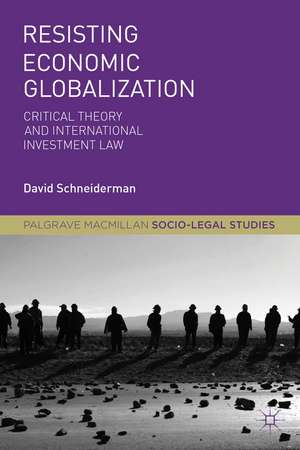
Resisting Economic Globalization
Autor D. Schneidermanen Limba Engleză Hardback – 15 mai 2013
Resisting Economic Globalization explores the magnitude of the legal constraints imposed by these rules and institutions associated with the worldwide spread of neoliberalism. Much contemporary theorizing has given up on national states as a locus for countering the harmful effects of economic globalization. Though states provide critical supports to the construction and ongoing maintenance of transnational legal constraints, David Schneiderman argues that states remain crucial sites for resisting, even rolling back, investment law disciplines. Structured as a series of encounters with selected critical theorists, the book contrasts theoretical diagnoses with recent episodes of resistance impeding investment law edicts.
This novel approach tests contemporary hypotheses offered by leading political and legal theorists about the nature of power and the role of states and social movements in facilitating and undoing neoliberalism's legal edifices. As a consequence, the foundations of transnational legality become more apparent and the mechanisms for change more transparent.
| Toate formatele și edițiile | Preț | Express |
|---|---|---|
| Paperback (1) | 371.04 lei 6-8 săpt. | |
| Palgrave MacMillan – 4 dec 2015 | 371.04 lei 6-8 săpt. | |
| Hardback (1) | 376.75 lei 3-5 săpt. | |
| Palgrave Macmillan UK – 15 mai 2013 | 376.75 lei 3-5 săpt. |
Preț: 376.75 lei
Puncte Express: 565
Preț estimativ în valută:
66.64€ • 79.02$ • 58.06£
66.64€ • 79.02$ • 58.06£
Carte disponibilă
Livrare economică 04-18 martie
Specificații
ISBN-13: 9781137004055
ISBN-10: 1137004053
Pagini: 218
Ilustrații: X, 218 p.
Dimensiuni: 155 x 236 x 18 mm
Greutate: 0.5 kg
Ediția:2013 edition
Editura: Palgrave Macmillan UK
Locul publicării:London, United Kingdom
ISBN-10: 1137004053
Pagini: 218
Ilustrații: X, 218 p.
Dimensiuni: 155 x 236 x 18 mm
Greutate: 0.5 kg
Ediția:2013 edition
Editura: Palgrave Macmillan UK
Locul publicării:London, United Kingdom
Cuprins
Introduction.- 1. Hardt and Negri and the Immobilization of the State.- 2. Teubner and System Liberation.- 3. Habermas and Global Power Policy.- 4. Santos and Difficulty of Sustainable Resistance.- 5. Wolin and Democracy's Debasement.- 6. Foucault, Ecuador and on Being 'Freer Than They Feel'.- Conclusion.
Notă biografică
David Schneiderman is Professor of Law and Political Science at the University of Toronto, Canada.
Textul de pe ultima copertă
There is at present much disenchantment with the rules governing international investment. Conceived as a set of disciplines establishing thresholds of tolerable state behaviour, dissatisfaction has precipitated acts of resistance in various parts of the world.
Resisting Economic Globalization explores the magnitude of the legal constraints imposed by these rules and institutions associated with the worldwide spread of neoliberalism. Much contemporary theorizing has given up on national states as a locus for countering the harmful effects of economic globalization. Though states provide critical supports to the construction and ongoing maintenance of transnational legal constraints, David Schneiderman argues that states remain crucial sites for resisting, even rolling back, investment law disciplines. Structured as a series of encounters with selected critical theorists, the book contrasts theoretical diagnoses with recent episodes of resistance impeding investment law edicts.
This novel approach tests contemporary hypotheses offered by leading political and legal theorists about the nature of power and the role of states and social movements in facilitating and undoing neoliberalism's legal edifices. As a consequence, the foundations of transnational legality become more apparent and the mechanisms for change more transparent.
Resisting Economic Globalization explores the magnitude of the legal constraints imposed by these rules and institutions associated with the worldwide spread of neoliberalism. Much contemporary theorizing has given up on national states as a locus for countering the harmful effects of economic globalization. Though states provide critical supports to the construction and ongoing maintenance of transnational legal constraints, David Schneiderman argues that states remain crucial sites for resisting, even rolling back, investment law disciplines. Structured as a series of encounters with selected critical theorists, the book contrasts theoretical diagnoses with recent episodes of resistance impeding investment law edicts.
This novel approach tests contemporary hypotheses offered by leading political and legal theorists about the nature of power and the role of states and social movements in facilitating and undoing neoliberalism's legal edifices. As a consequence, the foundations of transnational legality become more apparent and the mechanisms for change more transparent.
Caracteristici
Important book from respected author Timely study of the effects of economic globalization Latest in wellregarded Palgrave Macmillan SocioLegal Studies series International relevance