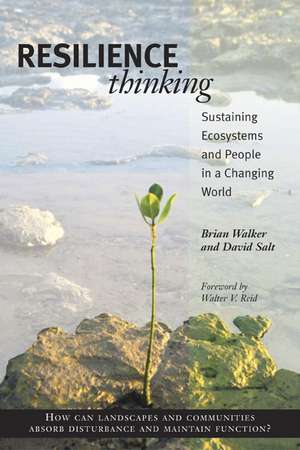
Resilience Thinking
Autor Brian Walker, David Salten Limba Engleză Paperback – aug 2006
Written by scientist Brian Walker and science communicator David Salt, Resilience Thinking explains how human and natural systems operate as dynamic networks shaped by cycles of disturbance, renewal, and evolution. The book explores what qualities make a system resilient—such as diversity, modularity, and the ability to learn—and how these qualities can be nurtured to ensure long-term sustainability.
Clear, concise, and engaging, the book offers more than just theory. Through five real-world case studies, readers see how resilience thinking can be applied across landscapes, communities, and industries to navigate risk, foster innovation, and expand future options. Whether managing a watershed, planning urban growth, or designing policy, this approach equips decision-makers with tools for thinking beyond linear models and toward systems that can absorb shocks and keep functioning.
Resilience Thinking is essential reading for environmental professionals, business leaders, and anyone seeking smarter ways to steward resources in a complex, interconnected world.
Preț: 223.17 lei
Nou
39.49€ • 46.31$ • 34.68£
Carte disponibilă
Livrare economică 15-29 ianuarie 26
Livrare express 31 decembrie 25 - 06 ianuarie 26 pentru 22.72 lei
Specificații
ISBN-10: 1597260932
Pagini: 192
Ilustrații: figures, photos, maps, boxes
Dimensiuni: 153 x 230 x 10 mm
Greutate: 0.27 kg
Ediția:None
Editura: Island Press
V-ar putea interesa
-
 -21%Preț: 48.57 lei61.38 lei
 -
 Preț: 235.06 lei
 -
 Fragile DominionSimon LevinPreț: 114.04 lei
 -
 -8%Preț: 409.29 lei444.88 lei
 -
 Preț: 224.11 lei
 -
 Thinking in SystemsDonella MeadowsPreț: 116.85 lei
 -
 Limits to GrowthDennis Meadows-19%Preț: 96.26 lei118.70 lei
Notă biografică
Brian Walker is a Research Fellow in Australia’s CSIRO Ecosystem Sciences, Visiting Researcher in the Stockholm Resilience Centre, and Chair of the Resilience Alliance.
David Salt is a science and environment writer at the Australian National University, and has more than two decades experience writing and producing popular science magazines and books.
Both authors live in Canberra, Australia.
Cuprins
Preface
Acknowledgments
Chapter 1. Living in a Complex World: An Introduction to Resilience Thinking
-Case Study 1: Carving up a National Icon: The Florida Everglades
Chapter 2. The System Rules: Creating a Mind Space for Resilience Thinking
-Case Study 2: Between a (Salt) Rock and a Hard Place: The Goulburn-Broken Catchment, Australia
Chapter 3. Crossing the Threshold: Be Careful about the Path You Choose—You May Not Be Able to Return
-Case Study 3: Losing the Jewel in the Crown: The Coral Reefs of the Caribbean
Chapter 4. In the Loop: Phases, Cycles, and Scales—Adaptive Cycles and How Systems Change
-Case Study 4: Scenarios on the Lakes: The Northern Highlands Lake District, Wisconsin
Chapter 5. Making Sense of Resilience: How Do You Apply Resilience Thinking?
-Case Study 5: Building Resilience in the Wetlands: The Kristianstads Vattenrike, Sweden
Chapter 6. Creating Space in a Shrinking World: Resilience and Sustainability
Postscript for a Resilient World
Further Reading
References
Glossary
About the Authors
Index
Recenzii
Descriere
Offers a different way of understanding the world and a fresh approach to managing resources. This work embraces human and natural systems as complex entities continually adapting through cycles of change and seeks to understand the qualities of a system that must be maintained or enhanced in order to achieve sustainability.