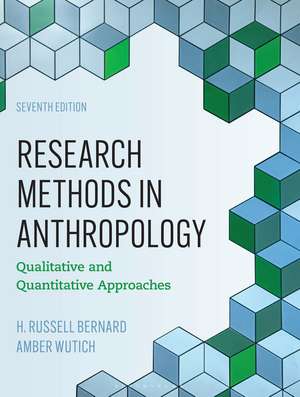
Research Methods in Anthropology: Qualitative and Quantitative Approaches
Autor H. Russell Bernard, Amber Wutichen Limba Engleză Paperback – 15 oct 2026
New to the Seventh Edition:
- New Chapter 6, "Ethics and the Conduct of Anthropology" walks students through the challenges anthropologists face in research and how to deal with them
- New Chapter 25, "On Writing Up" introduces the basics of getting articles published in peer-reviewed journals
- New discussion of "The Art of Proposal Writing" teaches students to write persuasively about the importance, rigor, and creativity of their proposed work
- Expanded Chapters 11 and 12, "Collecting Cultural Domain Data" and "Collecting Social Network Data" offer practical skills in data collection for both cutting-edge and classic anthropological methods
Preț: 451.63 lei
Preț vechi: 579.82 lei
-22% Precomandă
Puncte Express: 677
Carte nepublicată încă
Doresc să fiu notificat când acest titlu va fi disponibil:
Se trimite...
Specificații
ISBN-13: 9781538190937
ISBN-10: 1538190931
Pagini: 744
Ilustrații: 127 bw illustrations, 122 tables
Dimensiuni: 205 x 255 x 25 mm
Greutate: 0.45 kg
Ediția:7th edition
Editura: Bloomsbury Publishing
Colecția Bloomsbury Academic
Locul publicării:New York, United States
ISBN-10: 1538190931
Pagini: 744
Ilustrații: 127 bw illustrations, 122 tables
Dimensiuni: 205 x 255 x 25 mm
Greutate: 0.45 kg
Ediția:7th edition
Editura: Bloomsbury Publishing
Colecția Bloomsbury Academic
Locul publicării:New York, United States
Cuprins
Chapter 1: Anthropology and the Social Sciences
Introduction
Methods Belong to All of Us
The Many Meanings of Method
Rationalism, Empiricism, and Morality
The Norms of Science
The Development of Science-From Democritus to Newton
Exploration, Printing, and Modern Science
Science, Money, and War
The Development of Social Science-From Newton to Rousseau
Early Positivism: Quételet, Saint-Simon, Comte
Great Failures in Science and Social Science
The Varieties of Positivism
Later Positivism: The Vienna Circle
Instrumental Positivism
The Reaction against Positivism
And Finally . The Qualitative/Quantitative Split
Chapter 2: The Foundations of Social Research
Introduction
Variables: The Joy of Measurement
Measurement and Concepts
Conceptual and Operational Definitions
Conceptual Definitions
Operational Definitions
Levels of Measurement
Reliability, Validity, Accuracy, and Precision
Determining Validity
Units of Analysis
Chapter 3: Preparing for Research
Introduction-Setting Things Up
The Ideal Research Process
A Realistic Approach
Alternative Paradigms for Building Theories
Choosing a Research Problem: A Guide to Research Topics, Anyway
Meta-analysis
Chapter 4: Research Design
Introduction: What Is Research Design?
Cause and Effect
Three Decisions in Research Design
The Eight Types of Research Design
The Components of a Research Design
The Art of Proposal Writing
How to Develop Your Proposal with Mentors and Peers
Chapter 5: Experiments and Experimental Thinking
Introduction
Kinds of Confounds: Threats to Internal Validity
Controlling for Threats to Validity
Field Experiments
Are Field Experiments Ethical?
Thought Experiments
Chapter 6: Ethics and the Conduct of Anthropology
Introduction
I: Choosing a Research Problem
II: Making Our Work Less Extractive and Exploitative
Participatory and Action Research
III: Getting Informed Consent
How to Get Your IRB Proposal Approved
IV: Maintaining Confidentiality
Chapter 7: Probability Sampling
Introduction: What Are Samples and Why Do We Need Them?
Sampling Frames
Stratified Sampling
Cluster Sampling and Complex Sampling Designs
Maximizing Between-group Variance: The Wichita Study
How Big Should a Sample Be?
The Normal Distribution and z-scores
The Central Limit Theorem
The Standard Error and Confidence Intervals
Calculating Sample Size for Estimating Means
Calculating Sample Size for Estimating Proportions
Chapter 8: Nonprobability Sampling
Introduction: Reasons to Use a Nonprobability Sample
Four Common and Two Uncommon Types of Nonprobability Samples
Minimum Sizes for Different Types of Nonprobability Samples
Deciding on a Nonprobability Sampling Method and Sample Size
And Finally . . .
Chapter 9: Interviewing and Focus Groups
Introduction-The Big Picture
Interview Control
Unstructured Interviewing
Probing
Learning to Interview
Positionality and Presentation of Self
Using a Voice Recorder
Using Visual Cues, Like Photos in Interviews
Focus Groups
Response Effects
Informant/Respondent Accuracy
Chapter 10: Questionnaires
Introduction
Personal, Face-to-face Interviews
Telephone Interviews
Self-administered Questionnaires
When to Use What
Working with Interviewers
Closed- versus Open-ended Questions
Fourteen Rules for Question Wording and Format
Pretesting and Learning from Mistakes
Translation and Back Translation
The Response Rate Problem
Improving Response Rates: The Legacy of Dillman's Total Design Method
Cross-sectional and Longitudinal Studies
Some Specialized Survey Methods
And Finally
Chapter 11: Collecting Cultural Domain Data
Introduction
It Started with the Domain of Kinship
Free Listing
The True-False/Yes-No and Sentence Frame Techniques
Triad Tests
Free Pile Sorts
Rankings and Paired Comparisons
Chapter 12: Collecting Social Network Data
Introduction-What Is Social Network Analysis?
Anthropology and Social Network Analysis
Whole Networks
Personal Networks
Doing Network Analysis
Collecting Whole (Sociocentric) Network Data
Methods for Finding Network Ties
Collecting Personal (Egocentric) Network Data
Reducing Respondent Burden
Chapter 13: Scales and Scaling
Introduction
Single-question Scales
Indexes
Guttman Scales
Some Examples of a Guttman Scale
Likert Scales
Item Analysis
Testing for Unidimensionality with Factor Analysis
The Semantic Differential
Chapter 14: Participant Observation
Introduction
What Is Participant Observation?
The Stages of Participant Observation
Entering the Field
Fieldwork Roles
The Skills of a Participant Observer
Building Explicit Awareness
Ethically Practicing the Darker Arts of Fieldwork
Objectivity
Studying Your Own Culture
Rapid Assessment
Validity-Again
Surviving Fieldwork
Chapter 15: Field Notes and Data Management
Introduction
How to Write Field Notes
Field Notes
Coding Field Notes
Analyzing Field Notes
Database Management
Chapter 16: Direct Observation
Introduction
CM-Continuous Monitoring
Coding Schemes
Spot Sampling and Time Allocation Studies
Experience Sampling (ES) and Ecological Momentary Assessment (EMA)
Unobtrusive Observation
Indirect Observation
Archival Research
Chapter 17: Introduction to Data Analysis
Introduction: Qualitative, Quantitative
Data Matrices
Presenting Results in Matrices and Tables
Presenting Results: Causal Flow Charts
Chapter 18: Analyzing Cultural Domain Data
Introduction
Analyzing Free Lists
Analyzing Pile Sort Data
How MDS Works
Cluster Analysis and Pile Sort Data
How Cluster Analysis Works
A Real Research Example: Green Behavior and Electric Cars in the United States
Analyzing Triad Data
Analyzing Sentence Frames
Analyzing Paired Comparisons
Cultural Consensus Analysis
Running Consensus Analysis
Cultural Consonance
Cultural Domains and Folk Taxonomies
Chapter 19: Analyzing Network Data
Introduction: A Bit More About Matrices
Analyzing Social Network Data
Analyzing Whole (Sociocentric) Network Data
Analyzing Personal (Egocentric) Network Data
"It's Not What You Know, It's Who You Know"
Adding Network Data to the Classic Recipe
Affiliation Matrices
Semantic Networks
Chapter 20: Analyzing Text I: Theme Coding, Grounded Theory, and Content Analysis
Introduction
Overview of Grounded Theory
Content Analysis
Doing Classical Content Analysis
Intercoder Reliability
AI and Text Analysis
HRAF: Cross-cultural Content Analysis
Doing Cross-cultural Text-based Research
Chapter 21: Analyzing Text II: Discourse Analysis
Introduction
Conversation Analysis
Taking Turns in a Jury
Narrative Analysis
Phenomenological Analysis of Narratives
Language in Use
Critical Discourse Analysis: Language and Power
Chapter 22: Text Analysis III: Analytic Logic
Introduction
Ethnographic Decision Models (EDM)
Representing Complicated Models with Tables and IF?THEN Charts
Schema Analysis
Three Examples of Schema Analysis
Analytic Induction/Qualitative Comparative Analysis
Qualitative Comparative Analysis-QCA
And Finally . . .
Chapter 23: Univariate and Bivariate Analysis
Introduction
Univariate Analysis: Raw Data
Frequency Distributions
Measures of Central Tendency
Visualizing Data
Measures of Variation I: Range and Interquartile Range
Measures of Variation II: Variance and the Standard Deviation
The Logic of Hypothesis Testing
So, What About the Mean of FEMILLIT?
More About z-Scores
The Univariate Chi-square Test
Testing Relations: Bivariate Analysis
The t-Test: Comparing Two Means
ANOVA-Analysis of Variance
Examples of ANOVA
Visualizing the Direction and Shape of Covariations
Crosstabs of Nominal Variables
Correlation and Cause: Antecedent and Intervening Variables
Chi-square for Bivariate Comparisons
Testing the Association Between Ordinal Variables
What to Use for Nominal and Ordinal Variables
Correlation: The Powerhouse Statistic for Covariation
Spearman's r
Pearson's r
Regression
How Regression Works
Testing the Significance of r
Nonlinear Relations
Statistical Significance, the Shotgun Approach, and Other Issues
Chapter 24: Multivariate Analysis
Introduction
Elaboration: Controlling for Independent Variables
Car Wrecks and Teenage Births
The Multiple Regression Equation
Unraveling the Teenage-birth-and-motor-vehicle-death Puzzle
Path Analysis
Factor Analysis
Discriminant Function Analysis (DFA)
And Finally . . .
Chapter 25: On Writing Up
Introduction
Getting Your Article Published
Appendix A: Table of Areas under a Normal Curve
Appendix B: Student's t Distribution
Appendix C: Chi-square Distribution Table
Appendix D: F Table for the .05 Level of Significance
Appendix E: Resources for Fieldworkers
References
Introduction
Methods Belong to All of Us
The Many Meanings of Method
Rationalism, Empiricism, and Morality
The Norms of Science
The Development of Science-From Democritus to Newton
Exploration, Printing, and Modern Science
Science, Money, and War
The Development of Social Science-From Newton to Rousseau
Early Positivism: Quételet, Saint-Simon, Comte
Great Failures in Science and Social Science
The Varieties of Positivism
Later Positivism: The Vienna Circle
Instrumental Positivism
The Reaction against Positivism
And Finally . The Qualitative/Quantitative Split
Chapter 2: The Foundations of Social Research
Introduction
Variables: The Joy of Measurement
Measurement and Concepts
Conceptual and Operational Definitions
Conceptual Definitions
Operational Definitions
Levels of Measurement
Reliability, Validity, Accuracy, and Precision
Determining Validity
Units of Analysis
Chapter 3: Preparing for Research
Introduction-Setting Things Up
The Ideal Research Process
A Realistic Approach
Alternative Paradigms for Building Theories
Choosing a Research Problem: A Guide to Research Topics, Anyway
Meta-analysis
Chapter 4: Research Design
Introduction: What Is Research Design?
Cause and Effect
Three Decisions in Research Design
The Eight Types of Research Design
The Components of a Research Design
The Art of Proposal Writing
How to Develop Your Proposal with Mentors and Peers
Chapter 5: Experiments and Experimental Thinking
Introduction
Kinds of Confounds: Threats to Internal Validity
Controlling for Threats to Validity
Field Experiments
Are Field Experiments Ethical?
Thought Experiments
Chapter 6: Ethics and the Conduct of Anthropology
Introduction
I: Choosing a Research Problem
II: Making Our Work Less Extractive and Exploitative
Participatory and Action Research
III: Getting Informed Consent
How to Get Your IRB Proposal Approved
IV: Maintaining Confidentiality
Chapter 7: Probability Sampling
Introduction: What Are Samples and Why Do We Need Them?
Sampling Frames
Stratified Sampling
Cluster Sampling and Complex Sampling Designs
Maximizing Between-group Variance: The Wichita Study
How Big Should a Sample Be?
The Normal Distribution and z-scores
The Central Limit Theorem
The Standard Error and Confidence Intervals
Calculating Sample Size for Estimating Means
Calculating Sample Size for Estimating Proportions
Chapter 8: Nonprobability Sampling
Introduction: Reasons to Use a Nonprobability Sample
Four Common and Two Uncommon Types of Nonprobability Samples
Minimum Sizes for Different Types of Nonprobability Samples
Deciding on a Nonprobability Sampling Method and Sample Size
And Finally . . .
Chapter 9: Interviewing and Focus Groups
Introduction-The Big Picture
Interview Control
Unstructured Interviewing
Probing
Learning to Interview
Positionality and Presentation of Self
Using a Voice Recorder
Using Visual Cues, Like Photos in Interviews
Focus Groups
Response Effects
Informant/Respondent Accuracy
Chapter 10: Questionnaires
Introduction
Personal, Face-to-face Interviews
Telephone Interviews
Self-administered Questionnaires
When to Use What
Working with Interviewers
Closed- versus Open-ended Questions
Fourteen Rules for Question Wording and Format
Pretesting and Learning from Mistakes
Translation and Back Translation
The Response Rate Problem
Improving Response Rates: The Legacy of Dillman's Total Design Method
Cross-sectional and Longitudinal Studies
Some Specialized Survey Methods
And Finally
Chapter 11: Collecting Cultural Domain Data
Introduction
It Started with the Domain of Kinship
Free Listing
The True-False/Yes-No and Sentence Frame Techniques
Triad Tests
Free Pile Sorts
Rankings and Paired Comparisons
Chapter 12: Collecting Social Network Data
Introduction-What Is Social Network Analysis?
Anthropology and Social Network Analysis
Whole Networks
Personal Networks
Doing Network Analysis
Collecting Whole (Sociocentric) Network Data
Methods for Finding Network Ties
Collecting Personal (Egocentric) Network Data
Reducing Respondent Burden
Chapter 13: Scales and Scaling
Introduction
Single-question Scales
Indexes
Guttman Scales
Some Examples of a Guttman Scale
Likert Scales
Item Analysis
Testing for Unidimensionality with Factor Analysis
The Semantic Differential
Chapter 14: Participant Observation
Introduction
What Is Participant Observation?
The Stages of Participant Observation
Entering the Field
Fieldwork Roles
The Skills of a Participant Observer
Building Explicit Awareness
Ethically Practicing the Darker Arts of Fieldwork
Objectivity
Studying Your Own Culture
Rapid Assessment
Validity-Again
Surviving Fieldwork
Chapter 15: Field Notes and Data Management
Introduction
How to Write Field Notes
Field Notes
Coding Field Notes
Analyzing Field Notes
Database Management
Chapter 16: Direct Observation
Introduction
CM-Continuous Monitoring
Coding Schemes
Spot Sampling and Time Allocation Studies
Experience Sampling (ES) and Ecological Momentary Assessment (EMA)
Unobtrusive Observation
Indirect Observation
Archival Research
Chapter 17: Introduction to Data Analysis
Introduction: Qualitative, Quantitative
Data Matrices
Presenting Results in Matrices and Tables
Presenting Results: Causal Flow Charts
Chapter 18: Analyzing Cultural Domain Data
Introduction
Analyzing Free Lists
Analyzing Pile Sort Data
How MDS Works
Cluster Analysis and Pile Sort Data
How Cluster Analysis Works
A Real Research Example: Green Behavior and Electric Cars in the United States
Analyzing Triad Data
Analyzing Sentence Frames
Analyzing Paired Comparisons
Cultural Consensus Analysis
Running Consensus Analysis
Cultural Consonance
Cultural Domains and Folk Taxonomies
Chapter 19: Analyzing Network Data
Introduction: A Bit More About Matrices
Analyzing Social Network Data
Analyzing Whole (Sociocentric) Network Data
Analyzing Personal (Egocentric) Network Data
"It's Not What You Know, It's Who You Know"
Adding Network Data to the Classic Recipe
Affiliation Matrices
Semantic Networks
Chapter 20: Analyzing Text I: Theme Coding, Grounded Theory, and Content Analysis
Introduction
Overview of Grounded Theory
Content Analysis
Doing Classical Content Analysis
Intercoder Reliability
AI and Text Analysis
HRAF: Cross-cultural Content Analysis
Doing Cross-cultural Text-based Research
Chapter 21: Analyzing Text II: Discourse Analysis
Introduction
Conversation Analysis
Taking Turns in a Jury
Narrative Analysis
Phenomenological Analysis of Narratives
Language in Use
Critical Discourse Analysis: Language and Power
Chapter 22: Text Analysis III: Analytic Logic
Introduction
Ethnographic Decision Models (EDM)
Representing Complicated Models with Tables and IF?THEN Charts
Schema Analysis
Three Examples of Schema Analysis
Analytic Induction/Qualitative Comparative Analysis
Qualitative Comparative Analysis-QCA
And Finally . . .
Chapter 23: Univariate and Bivariate Analysis
Introduction
Univariate Analysis: Raw Data
Frequency Distributions
Measures of Central Tendency
Visualizing Data
Measures of Variation I: Range and Interquartile Range
Measures of Variation II: Variance and the Standard Deviation
The Logic of Hypothesis Testing
So, What About the Mean of FEMILLIT?
More About z-Scores
The Univariate Chi-square Test
Testing Relations: Bivariate Analysis
The t-Test: Comparing Two Means
ANOVA-Analysis of Variance
Examples of ANOVA
Visualizing the Direction and Shape of Covariations
Crosstabs of Nominal Variables
Correlation and Cause: Antecedent and Intervening Variables
Chi-square for Bivariate Comparisons
Testing the Association Between Ordinal Variables
What to Use for Nominal and Ordinal Variables
Correlation: The Powerhouse Statistic for Covariation
Spearman's r
Pearson's r
Regression
How Regression Works
Testing the Significance of r
Nonlinear Relations
Statistical Significance, the Shotgun Approach, and Other Issues
Chapter 24: Multivariate Analysis
Introduction
Elaboration: Controlling for Independent Variables
Car Wrecks and Teenage Births
The Multiple Regression Equation
Unraveling the Teenage-birth-and-motor-vehicle-death Puzzle
Path Analysis
Factor Analysis
Discriminant Function Analysis (DFA)
And Finally . . .
Chapter 25: On Writing Up
Introduction
Getting Your Article Published
Appendix A: Table of Areas under a Normal Curve
Appendix B: Student's t Distribution
Appendix C: Chi-square Distribution Table
Appendix D: F Table for the .05 Level of Significance
Appendix E: Resources for Fieldworkers
References
Recenzii
In my courses on ethnographic methods, I have assigned multiple incarnations of H. Russell Bernard's Research Methods in Anthropology to upper-division undergraduate and graduate students. I also use it as my own go-to guide for planning and implementing anthropological projects. The latest edition, co-authored with Amber Wutich, includes substantial additional guidance on writing proposals and drafting publications. It also contains expanded and updated material on research ethics and clarification on important qualitative methods. I look forward to assigning this updated book in the near future.
This classic textbook, a comprehensive introduction of anthropological research methods with rigor and clarity, has been always the cornerstone of my research and teaching in and beyond this field. The seventh edition keeps that approachable voice while refreshing and enhancing the toolkit. With these updates, the authors make an indispensable text an even stronger bridge between methodological principles and research practice in the fast-changing world today.
A newly-updated classic and comprehensive work, the seventh edition of Research Methods in Anthropology should be required for anyone who calls themselves a social scientist or anthropologist. It is a service to our discipline, setting forth the clearest and most compelling arguments for social science. Bernard and Wutich's contributions have ensured generations of valid and critical research questions, research design, and findings.
Research Methods in Anthropology has earned its place as the field's essential methods reference. Grounded in practical wisdom, it renders the full spectrum of research design accessible without sacrificing depth, showing that rigorous science and deep ethnographic sensitivity are not only compatible but mutually reinforcing. If you only had to read one methods book, this would be the one.
I read this book cover to cover as a graduate student in a hostel in Ho Chi Minh City, Vietnam, waiting to meet my very first research participants. Decades later, it is a true companion to my undergraduate students and me as I teach them the seemingly unteachable in one semester - anthropological research methods. The authors' friendly tone is just right for students encountering field notes, transcripts, coding, and p-values for the first time. The constantly-updated, engaging references to real anthropologists' work fills in the gaps we just can't cover in one semester and helps my students understand the breadth of anthropological fieldwork. The new chapters on proposal writing and writing manuscripts for publication will be invaluable to graduate students and early-career professionals.
Over the last four decades, while many social sciences methods texts have come and gone, Research Methods in Anthropology: Qualitative and Quantitative Approaches enters its seventh edition with a new co-author (Amber Wutich, ASU) and publisher (Bloomsbury Academic). It remains true to its original goal of bringing cultural anthropology methods to the masses. Research Methods in Anthropology is essential reading for anyone undertaking social science research at any level and at any scale. The book teaches readers not just how to do research, but why particular choices matter. Always within arm's reach, Research Methods in Anthropology has been my constant companion, from my first undergraduate project, through my dissertation, and now as the indispensable text I place in the hands of my own students and recommend to colleagues. Bernard and Wutich manage the rare feat of writing a work simultaneously encyclopedic and eminently readable, setting a standard that few texts approach and none surpass. At once a handbook, reference guide, and mentor in print, the book equips readers to validate methodological choices with rigor and confidence. Its thoughtful integration of qualitative and quantitative approaches, ethics, proposal writing, and analysis reflects decades of field-tested wisdom. If I see Research Methods in Anthropology cited in a research proposal, I am immediately reassured that the study rests on sound methodological ground.
Bernard's Research Methods in Anthropology is a trusted, reliable handbook that I have used for over fifteen years of teaching Research Methods to undergraduate students in anthropology. The book is engaging in its coverage of various qualitative and quantitative methodologies employed by social scientists. This new edition has two important new chapters. Chapter six chronicles what has been a shifting landscape of ethical concerns within the field, and the complexity and importance of conducting ethical, non-extractive research. The various real-world examples of ethical challenges previous anthropologists have faced add depth to all of the chapters of this book. Finally, a new chapter on "writing up" research offers a helpful guide for young scholars to prepare manuscripts for publication. While my own students may not need this at this point in their careers, the advice offered is knowledgeable and helpful for any student imagining a career that requires analytical and communication skills.
Research Methods in Anthropology is unique in its helpful, practical, and clearly organized advice on methods that makes it clear not just how to use methods, but also when and why they should be used and what the pros and cons are of each methodological approach. Often when one introduces students to methods, it seems so abstract that they don't really understand what they would do to implement them-but the many anecdotes told by the authors in Research Methods in Anthropology give enough detail and context to overcome this block and make research possible.
This edition is a welcome expansion of a book that defines and explains best practices in anthropology. Long regarded as the "bible" by many scholars, Bernard's critical lessons are expanded and enriched through Wutich's insights. Their engagement with ethics, research writing and the rejection of the qual-quant divide reminds practitioners and students of ethnography's enduring strength and value.
Updated and expanded, Russell Bernard's definitive manual just keeps getting better. The addition of Amber Wutich, a cutting-edge methods scholar in her own right, as co-author adds depth and breadth to the work. Her experience provides new memorable examples of research approaches that went well-and others that did not. Among the helpful and compelling changes in this edition are a new stand-alone chapter on ethics and conduct, a useful explanation of research proposal structure, and expanded discussions on cultural domain analysis, social network data, and focus-group related methods. I've been using earlier editions of Bernard's Research Methods in Anthropology since I was in graduate school. This updated edition will remain my go-to work when I am designing a research project or teaching my mixed-methods ethnographic methods course for graduate students.
This thoughtfully updated and expanded edition of Research Methods in Anthropology affirms its position as an indispensable guide for the design and conduct of anthropological field research. It offers accessible and thorough attention to a vast array of rigorous field methods as well as grounding in the philosophical foundations and principles that undergird systematic research across the social sciences. With welcome new chapters that expand on ethics, analyzing social network data and writing up, as well as attention to the use of AI in text analysis, this edition stays on the forefront of current qualitative and quantitative approaches. The vignettes presented in "Russ's Corner" and "Amber's Corner" offer concrete examples of research experiences and lessons learned. While aimed at emerging researchers, the book is also useful for experienced researchers who aim to increase their repertoire of mixed methods that support holistic investigation of human behavior, lived experiences and societal challenges.
As a standard in the discipline, Research Methods in Anthropology has a keen awareness of the strengths of the anthropological approach to research without leaving the reader alone to figure out some of the potential pitfalls. The new version adds valuable insights from both Wutich and Bernard, which is especially evident when covering the collapsible dichotomy that is the choice between qualitative and quantitative methods.
This classic textbook, a comprehensive introduction of anthropological research methods with rigor and clarity, has been always the cornerstone of my research and teaching in and beyond this field. The seventh edition keeps that approachable voice while refreshing and enhancing the toolkit. With these updates, the authors make an indispensable text an even stronger bridge between methodological principles and research practice in the fast-changing world today.
A newly-updated classic and comprehensive work, the seventh edition of Research Methods in Anthropology should be required for anyone who calls themselves a social scientist or anthropologist. It is a service to our discipline, setting forth the clearest and most compelling arguments for social science. Bernard and Wutich's contributions have ensured generations of valid and critical research questions, research design, and findings.
Research Methods in Anthropology has earned its place as the field's essential methods reference. Grounded in practical wisdom, it renders the full spectrum of research design accessible without sacrificing depth, showing that rigorous science and deep ethnographic sensitivity are not only compatible but mutually reinforcing. If you only had to read one methods book, this would be the one.
I read this book cover to cover as a graduate student in a hostel in Ho Chi Minh City, Vietnam, waiting to meet my very first research participants. Decades later, it is a true companion to my undergraduate students and me as I teach them the seemingly unteachable in one semester - anthropological research methods. The authors' friendly tone is just right for students encountering field notes, transcripts, coding, and p-values for the first time. The constantly-updated, engaging references to real anthropologists' work fills in the gaps we just can't cover in one semester and helps my students understand the breadth of anthropological fieldwork. The new chapters on proposal writing and writing manuscripts for publication will be invaluable to graduate students and early-career professionals.
Over the last four decades, while many social sciences methods texts have come and gone, Research Methods in Anthropology: Qualitative and Quantitative Approaches enters its seventh edition with a new co-author (Amber Wutich, ASU) and publisher (Bloomsbury Academic). It remains true to its original goal of bringing cultural anthropology methods to the masses. Research Methods in Anthropology is essential reading for anyone undertaking social science research at any level and at any scale. The book teaches readers not just how to do research, but why particular choices matter. Always within arm's reach, Research Methods in Anthropology has been my constant companion, from my first undergraduate project, through my dissertation, and now as the indispensable text I place in the hands of my own students and recommend to colleagues. Bernard and Wutich manage the rare feat of writing a work simultaneously encyclopedic and eminently readable, setting a standard that few texts approach and none surpass. At once a handbook, reference guide, and mentor in print, the book equips readers to validate methodological choices with rigor and confidence. Its thoughtful integration of qualitative and quantitative approaches, ethics, proposal writing, and analysis reflects decades of field-tested wisdom. If I see Research Methods in Anthropology cited in a research proposal, I am immediately reassured that the study rests on sound methodological ground.
Bernard's Research Methods in Anthropology is a trusted, reliable handbook that I have used for over fifteen years of teaching Research Methods to undergraduate students in anthropology. The book is engaging in its coverage of various qualitative and quantitative methodologies employed by social scientists. This new edition has two important new chapters. Chapter six chronicles what has been a shifting landscape of ethical concerns within the field, and the complexity and importance of conducting ethical, non-extractive research. The various real-world examples of ethical challenges previous anthropologists have faced add depth to all of the chapters of this book. Finally, a new chapter on "writing up" research offers a helpful guide for young scholars to prepare manuscripts for publication. While my own students may not need this at this point in their careers, the advice offered is knowledgeable and helpful for any student imagining a career that requires analytical and communication skills.
Research Methods in Anthropology is unique in its helpful, practical, and clearly organized advice on methods that makes it clear not just how to use methods, but also when and why they should be used and what the pros and cons are of each methodological approach. Often when one introduces students to methods, it seems so abstract that they don't really understand what they would do to implement them-but the many anecdotes told by the authors in Research Methods in Anthropology give enough detail and context to overcome this block and make research possible.
This edition is a welcome expansion of a book that defines and explains best practices in anthropology. Long regarded as the "bible" by many scholars, Bernard's critical lessons are expanded and enriched through Wutich's insights. Their engagement with ethics, research writing and the rejection of the qual-quant divide reminds practitioners and students of ethnography's enduring strength and value.
Updated and expanded, Russell Bernard's definitive manual just keeps getting better. The addition of Amber Wutich, a cutting-edge methods scholar in her own right, as co-author adds depth and breadth to the work. Her experience provides new memorable examples of research approaches that went well-and others that did not. Among the helpful and compelling changes in this edition are a new stand-alone chapter on ethics and conduct, a useful explanation of research proposal structure, and expanded discussions on cultural domain analysis, social network data, and focus-group related methods. I've been using earlier editions of Bernard's Research Methods in Anthropology since I was in graduate school. This updated edition will remain my go-to work when I am designing a research project or teaching my mixed-methods ethnographic methods course for graduate students.
This thoughtfully updated and expanded edition of Research Methods in Anthropology affirms its position as an indispensable guide for the design and conduct of anthropological field research. It offers accessible and thorough attention to a vast array of rigorous field methods as well as grounding in the philosophical foundations and principles that undergird systematic research across the social sciences. With welcome new chapters that expand on ethics, analyzing social network data and writing up, as well as attention to the use of AI in text analysis, this edition stays on the forefront of current qualitative and quantitative approaches. The vignettes presented in "Russ's Corner" and "Amber's Corner" offer concrete examples of research experiences and lessons learned. While aimed at emerging researchers, the book is also useful for experienced researchers who aim to increase their repertoire of mixed methods that support holistic investigation of human behavior, lived experiences and societal challenges.
As a standard in the discipline, Research Methods in Anthropology has a keen awareness of the strengths of the anthropological approach to research without leaving the reader alone to figure out some of the potential pitfalls. The new version adds valuable insights from both Wutich and Bernard, which is especially evident when covering the collapsible dichotomy that is the choice between qualitative and quantitative methods.