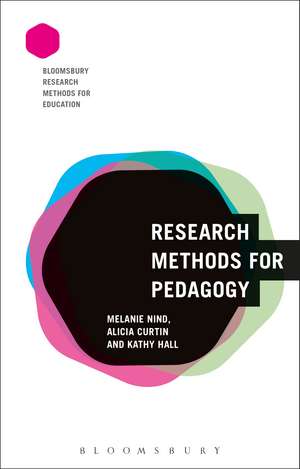
Research Methods for Pedagogy: Bloomsbury Research Methods for Education
Autor Prof. Melanie Nind, Dr Alicia Curtin, Professor Kathy Hallen Limba Engleză Paperback – 6 oct 2016
Research Methods for Pedagogy begins by exploring the different conceptualisations of pedagogy and their implications for how it is researched. The authors reflect on how their sociocultural stance on pedagogy influences the methods they choose to focus on in the book. Moving beyond just schools and formal pedagogies into informal and everyday pedagogies, the authors use a range of case studies across educational sectors and cultures to discuss methods for researching pedagogy. Common approaches such as ethnography and action research are included alongside some quantitative and quasi-experimental methods and often less familiar participatory, multimodal and reflective methods. The authors demonstrate the relationships between theoretical stance, pedagogical context and research approach. Finally, the book addresses the complexity of pedagogy research through discussion of particular ethical and relational aspects as it highlights innovations and developments in research methods for pedagogy.
Boxed case studies, reflections on real research projects, a glossary of key terms and an annotated list of further reading all help to guide students and scholars through their research design and choice of methods in this area.
Preț: 193.96 lei
Preț vechi: 245.98 lei
-21%
Puncte Express: 291
Carte tipărită la comandă
Livrare economică 30 noiembrie-14 decembrie
Livrare prin curier în România Termenul estimat este afișat lângă disponibilitate.
Transport gratuit de la 400.00 lei Plată online sau ramburs, în funcție de opțiunile comenzii.
Retur gratuit în 14 zile Comandă securizată și suport în română.
Specificații
ISBN-13: 9781474242813
ISBN-10: 1474242812
Pagini: 296
Ilustrații: 10 bw illus
Dimensiuni: 136 x 214 x 16 mm
Greutate: 0.39 kg
Editura: Bloomsbury Publishing
Colecția Bloomsbury Academic
Seria Bloomsbury Research Methods for Education
Locul publicării:London, United Kingdom
ISBN-10: 1474242812
Pagini: 296
Ilustrații: 10 bw illus
Dimensiuni: 136 x 214 x 16 mm
Greutate: 0.39 kg
Editura: Bloomsbury Publishing
Colecția Bloomsbury Academic
Seria Bloomsbury Research Methods for Education
Locul publicării:London, United Kingdom
V-ar putea interesa
-
 -17%Preț: 199.83 lei241.69 lei
 -
 -43%Preț: 161.88 lei283.68 lei
 -
 -18%Preț: 142.95 lei173.65 lei
 -
 -18%Preț: 138.65 lei168.07 lei
 -
 -43%Preț: 74.23 lei129.27 lei
 -
 Bloomsbury CPD Library: Mentoring and CoachingMarcella McCarthy-44%Preț: 131.48 lei235.43 lei
 -
 Kumon Grade 1 WritingKumonPreț: 54.03 lei
 -
 Espacios literarios B1. Callejón con salidaElsa OsorioPreț: 87.86 lei
 -
 Burn-out überwinden für DummiesAdrian UrbanPreț: 174.35 lei
 -
 Am AbgrundMaria Regina KaiserPreț: 64.72 lei
Cuprins
Acknowledgements
Series Editor Preface
A Glossary of Research Methods and Approaches
Introduction
Part I: Conceptions of Pedagogy and Implications for Research
Introduction to Part One: Conceptions of Pedagogy and Implications for Research
Chapter 1: Pedagogy - Theoretical Perspectives and Methodological Implications
Chapter 2: Different Pedagogies - Different Research Methods: Values into Practice
Chapter 3: Teasing out Pedagogy: The Art, Craft and Science
Part II: Researching Pedagogy in Context
Introduction to Part Two: Researching Pedagogy in Context
Chapter 4: Researching Pedagogy in Early Childhood Settings: Ethnographic, Multimodal and
Chapter 5: Researching Pedagogy in Schools: Methods Focused on Classroom Interaction,
Chapter 6: Researching the Everyday and Out-of-School: Research Methods and Innovation
Part Three: Researching the Hidden and Hard-to-know
Introduction to Part Three: Researching the Hidden and Hard-to-know
Chapter 7: Pedagogy as Interaction: Methods for Reflecting on Interaction and Methods
Chapter 8: Pedagogy Embodied: Methods of Analysis for Embodied Practice
Chapter 9: Pedagogy as Space: Pushing Methodological Boundaries
Conclusion
References
Index
Series Editor Preface
A Glossary of Research Methods and Approaches
Introduction
Part I: Conceptions of Pedagogy and Implications for Research
Introduction to Part One: Conceptions of Pedagogy and Implications for Research
Chapter 1: Pedagogy - Theoretical Perspectives and Methodological Implications
Chapter 2: Different Pedagogies - Different Research Methods: Values into Practice
Chapter 3: Teasing out Pedagogy: The Art, Craft and Science
Part II: Researching Pedagogy in Context
Introduction to Part Two: Researching Pedagogy in Context
Chapter 4: Researching Pedagogy in Early Childhood Settings: Ethnographic, Multimodal and
Chapter 5: Researching Pedagogy in Schools: Methods Focused on Classroom Interaction,
Chapter 6: Researching the Everyday and Out-of-School: Research Methods and Innovation
Part Three: Researching the Hidden and Hard-to-know
Introduction to Part Three: Researching the Hidden and Hard-to-know
Chapter 7: Pedagogy as Interaction: Methods for Reflecting on Interaction and Methods
Chapter 8: Pedagogy Embodied: Methods of Analysis for Embodied Practice
Chapter 9: Pedagogy as Space: Pushing Methodological Boundaries
Conclusion
References
Index
Recenzii
This is one of the most helpful books for educational researchers that I have seen in some time ... It is complex and multi-layered, but considerate to the reader, accomplishing an ambitious and worthy goal. It is internationally informed, discusses multiple methods and provides clear summaries with great synthesis tables ... I really appreciated this book.
The interaction between what pedagogy does and what pedagogy is appears as the central focus of this book. The approach taken goes beyond a disciplinary or methodological perspective and faces the core of the social context of teaching and learning. In a different direction of recent books and political decisions about how learning should be researched, the authors invite readers to put learning in context and research the experiences of learning from a socio-cultural perspective. Avoiding simplicity and coping with complexity this book encourages us to research pedagogy "incorporating specified, enacted and experienced dimensions in practice". Based on the analysis of several studies readers will find a broad set of insights and suggestions to develop research on the values and ways of knowing mediated by different pedagogies. This is a necessary book to introduce a turn in pedagogical research based on 'what works' in favour of a more inclusive and critical pedagogical research.
I think this book is absolutely excellent. One of the best on this topic that I have seen, very accessibly written and with plenty of practical guidance.
This is a very useful text for students who are taking a more philosophical and theoretical approach to their educational studies rather than a more applied approach. This book usefully defines pedagogy as an acceptable field of study and situates in different domains to psychology, sociology or history of education - this is important when considering education's place in the research landscape.
The interaction between what pedagogy does and what pedagogy is appears as the central focus of this book. The approach taken goes beyond a disciplinary or methodological perspective and faces the core of the social context of teaching and learning. In a different direction of recent books and political decisions about how learning should be researched, the authors invite readers to put learning in context and research the experiences of learning from a socio-cultural perspective. Avoiding simplicity and coping with complexity this book encourages us to research pedagogy "incorporating specified, enacted and experienced dimensions in practice". Based on the analysis of several studies readers will find a broad set of insights and suggestions to develop research on the values and ways of knowing mediated by different pedagogies. This is a necessary book to introduce a turn in pedagogical research based on 'what works' in favour of a more inclusive and critical pedagogical research.
I think this book is absolutely excellent. One of the best on this topic that I have seen, very accessibly written and with plenty of practical guidance.
This is a very useful text for students who are taking a more philosophical and theoretical approach to their educational studies rather than a more applied approach. This book usefully defines pedagogy as an acceptable field of study and situates in different domains to psychology, sociology or history of education - this is important when considering education's place in the research landscape.