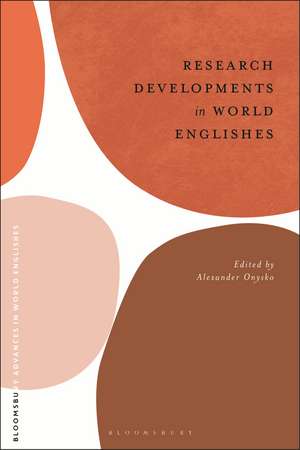
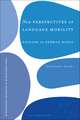
Research Developments in World Englishes: Bloomsbury Advances in World Englishes
Editat de Dr Alexander Onyskoen Limba Engleză Hardback – 15 iul 2021
Discussing key issues of current relevance and setting the tone for future research in world Englishes, this book provides new perspectives on the diverse realities of Englishes around the world. Written by an international team of established and renowned scholars, it is the inaugural volume in the new series Bloomsbury Advances in World Englishes, dedicated to advancing research in the field.
Chapters discuss important topics in contemporary world Englishes research, including de-colonial approaches, emerging varieties in post-protectorates and international uses as communicative events to highlight the globalizing aspect of English as a semiotic code. The book also expands on cultural conceptualizations to investigate the connections between Englishes and localized cultural knowledge and ongoing changes and attitudes towards local forms in multilingual settings. Closing with an examination of how world Englishes and the use of English as a lingua franca could influence the future teaching of Englishes, Research Developments in World Englishes presents a detailed picture of contemporary research approaches and points the way towards exciting future directions.
The ebook editions of this book are available open access under a CC BY-NC-ND 4.0 licence on bloomsburycollections.com. Open access was funded by the University of Klagenfurt, Austria.


Preț: 723.40 lei
Preț vechi: 1071.87 lei
-33%
Puncte Express: 1085
Carte tipărită la comandă
Livrare economică 17 noiembrie-01 decembrie
Livrare prin curier în România Termenul estimat este afișat lângă disponibilitate.
Transport gratuit pentru acest produs Plată online sau ramburs, în funcție de opțiunile comenzii.
Retur gratuit în 14 zile Comandă securizată și suport în română.
Specificații
ISBN-13: 9781350167056
ISBN-10: 1350167053
Pagini: 322
Ilustrații: 28 bw illus
Dimensiuni: 158 x 236 x 22 mm
Greutate: 0.64 kg
Editura: Bloomsbury Publishing
Colecția Bloomsbury Academic
Seria Bloomsbury Advances in World Englishes
Locul publicării:London, United Kingdom
ISBN-10: 1350167053
Pagini: 322
Ilustrații: 28 bw illus
Dimensiuni: 158 x 236 x 22 mm
Greutate: 0.64 kg
Editura: Bloomsbury Publishing
Colecția Bloomsbury Academic
Seria Bloomsbury Advances in World Englishes
Locul publicării:London, United Kingdom
Cuprins
List of Figures
List of Tables
List of Contributors
Acknowledgments
1. Where are WEs Heading to? An Introduction to the Inaugural Volume of Bloomsbury Advances in World Englishes, Alexander Onysko (University of Klagenfurt, Austria)
2. Decolonizing (World) Englishes, Mario Saraceni (University of Portsmouth, UK) and Camille Jacob (University of Portsmouth, UK)
3. "The Communicative Event" in International English(es) as Social Practice: Adducing a Tricodal/Trimodal Theory of the Linguistic Structuring of Social Meaning, Allan James (University of Klagenfurt, Austria)
4. Extending the Scope of World Englishes: Interactions across Englishes in Post-Protectorates and at the Grassroots, Christiane Meierkord (University of Bochum, Germany)
5. Contact, Asia, and the Rethinking of Englishes in Multilingual Ecologies, Lisa Lim (Curtin University, Australia) and Umberto Ansaldo (Curtin University, Australia)
6. Multilingualism and the Role of English in the United Arab Emirates, with views from Singapore and Hong Kong, Peter Siemund (University of Hamburg, Germany), Ahmad Al-Issa (University of Sharjah, United Arab Emirates), Sharareh Rahbari (University of Hamburg, Germany) and Jakob R. E. Leimgruber (University of Basel, Switzerland)
7. The History of English Language Attitudes within the Multilingual Ecology of South Africa, Susan Coetzee-Van Rooy (North West University, South Africa) and Bertus Van Rooy (University of Amsterdam, The Netherlands)
8. Transnational Dialect Contact and Language Variation and Change in World Englishes, Rebecca Lurie Starr (National University of Singapore, Singapore)
9. "I Don't Get It": Researching the Cultural Lexicon of Global Englishes, David Crystal (University of Bangor, UK)
10. Colonial Cultural Conceptualizations and World Englishes, Frank Polzenhagen (University of Koblenz-Landau, Germany), Anna Finzel (University of Potsdam, Germany) and Hans-Georg Wolf (University of Potsdam, Germany)
11. Individual Lives in Collectivist Faces: On Social Norms in a Radio Show, Eric A. Anchimbe (University of Bayreuth, Germany)
12. Teaching (About) World Englishes and English as a Lingua Franca, Andy Kirkpatrick (Griffith University, Australia)
13. Documenting World Englishes in the Oxford English Dictionary: Past Perspectives, Present Developments, and Future Directions, Danica Salazar (Oxford University Press)
Index
List of Tables
List of Contributors
Acknowledgments
1. Where are WEs Heading to? An Introduction to the Inaugural Volume of Bloomsbury Advances in World Englishes, Alexander Onysko (University of Klagenfurt, Austria)
2. Decolonizing (World) Englishes, Mario Saraceni (University of Portsmouth, UK) and Camille Jacob (University of Portsmouth, UK)
3. "The Communicative Event" in International English(es) as Social Practice: Adducing a Tricodal/Trimodal Theory of the Linguistic Structuring of Social Meaning, Allan James (University of Klagenfurt, Austria)
4. Extending the Scope of World Englishes: Interactions across Englishes in Post-Protectorates and at the Grassroots, Christiane Meierkord (University of Bochum, Germany)
5. Contact, Asia, and the Rethinking of Englishes in Multilingual Ecologies, Lisa Lim (Curtin University, Australia) and Umberto Ansaldo (Curtin University, Australia)
6. Multilingualism and the Role of English in the United Arab Emirates, with views from Singapore and Hong Kong, Peter Siemund (University of Hamburg, Germany), Ahmad Al-Issa (University of Sharjah, United Arab Emirates), Sharareh Rahbari (University of Hamburg, Germany) and Jakob R. E. Leimgruber (University of Basel, Switzerland)
7. The History of English Language Attitudes within the Multilingual Ecology of South Africa, Susan Coetzee-Van Rooy (North West University, South Africa) and Bertus Van Rooy (University of Amsterdam, The Netherlands)
8. Transnational Dialect Contact and Language Variation and Change in World Englishes, Rebecca Lurie Starr (National University of Singapore, Singapore)
9. "I Don't Get It": Researching the Cultural Lexicon of Global Englishes, David Crystal (University of Bangor, UK)
10. Colonial Cultural Conceptualizations and World Englishes, Frank Polzenhagen (University of Koblenz-Landau, Germany), Anna Finzel (University of Potsdam, Germany) and Hans-Georg Wolf (University of Potsdam, Germany)
11. Individual Lives in Collectivist Faces: On Social Norms in a Radio Show, Eric A. Anchimbe (University of Bayreuth, Germany)
12. Teaching (About) World Englishes and English as a Lingua Franca, Andy Kirkpatrick (Griffith University, Australia)
13. Documenting World Englishes in the Oxford English Dictionary: Past Perspectives, Present Developments, and Future Directions, Danica Salazar (Oxford University Press)
Index
Recenzii
This timely edited volume provides a much-needed critical reflection on the existing research paradigm and presents future directions in the study of world Englishes. A must-read for scholars who are committed to capturing the complexity of English(es) today at both individual and societal levels.
The contributors, many of them distinguished members of the series' advisory board, put on the agenda fruitful debates of linguistic and wider societal relevance and showcase neglected as well as novel avenues of World Englishes research. This inaugural volume successfully whets the appetite for the future volumes in this series.
This first volume contributes a great deal to getting out of the impasse in which some authors argue the WE paradigm has been locked in recent years, between form and function on the one hand, and social and historical approaches on the other.
The contributors, many of them distinguished members of the series' advisory board, put on the agenda fruitful debates of linguistic and wider societal relevance and showcase neglected as well as novel avenues of World Englishes research. This inaugural volume successfully whets the appetite for the future volumes in this series.
This first volume contributes a great deal to getting out of the impasse in which some authors argue the WE paradigm has been locked in recent years, between form and function on the one hand, and social and historical approaches on the other.