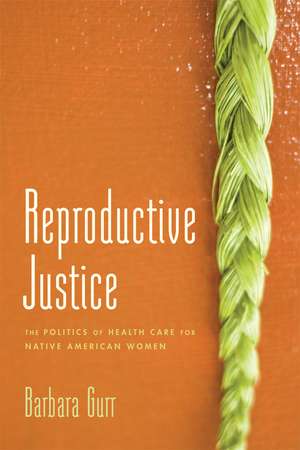
Reproductive Justice: The Politics of Health Care for Native American Women
Autor Barbara Gurren Limba Engleză Paperback – 9 dec 2014
Considerăm că volumul Reproductive Justice reprezintă un instrument esențial pentru înțelegerea modului în care politicile de sănătate publică se intersectează cu suveranitatea tribală și drepturile omului. Aplicabilitatea sa practică rezidă în analiza detaliată a barierelor sistemice pe care femeile Native Americane le întâmpină în accesarea serviciilor de bază, de la îngrijire prenatală la asistență după agresiuni sexuale. Bazându-se pe o cercetare de teren de peste un an în rezervația Pine Ridge, Barbara Gurr nu se limitează la o expunere teoretică, ci oferă o perspectivă sociologică asupra modului în care instituțiile federale eșuează adesea în a respecta nevoile culturale și medicale ale națiunii Oglala Lakota.
Suntem de părere că structura cărții, organizată în trei părți distincte, facilitează o progresie logică de la terminologia academică („Reproductive Oppression”) la realitățile istorice și politice ale „medicinei imperialiste”. Această lucrare acoperă aceeași arie tematică precum Health and Social Issues of Native American Women de Jennie R. Joe, dar cu o abordare mult mai axată pe justiție politică și pe mecanismele de putere ale Indian Health Service (IHS). În timp ce alte titluri se concentrează pe date epidemiologice, Barbara Gurr analizează „discursul dublu” al statului american față de corpul indigen.
În contextul operei sale, Reproductive Justice continuă interesul autoarei pentru metodologiile feministe explorate în Feminist Research in Practice, aplicând acele cadre riguroase de cercetare pe un studiu de caz de o importanță critică. Dacă în lucrările anterioare despre media, precum Race, Gender, and Sexuality in Post-Apocalyptic TV and Film, autoarea analiza reprezentări simbolice, aici se ancorează în realitatea administrativă și socială a sistemului de sănătate american, oferind o critică necesară disparităților de tratament bazate pe rasă și clasă.
Preț: 296.33 lei
Carte tipărită la comandă
Livrare economică 08-22 iunie
Specificații
ISBN-10: 0813564689
Pagini: 192
Dimensiuni: 152 x 229 x 15 mm
Greutate: 0.34 kg
Ediția:None
Editura: Rutgers University Press
Colecția Rutgers University Press
V-ar putea interesa
-
 Autobiography Of A GeishaSayo MasudaPreț: 108.98 lei
 -
 The Woman Reader 1837-1914Kate Flint-14%Preț: 363.65 lei423.79 lei
 -
 Women's Fiction and the Great WarSuzanne Raitt-36%Preț: 270.07 lei421.58 lei
 -
 English Feminism, 1780-1980Barbara Caine-24%Preț: 368.20 lei483.89 lei
 -
 -31%Preț: 510.09 lei743.70 lei
 -
 -29%Preț: 654.91 lei917.46 lei
 -
 -60%Preț: 241.60 lei596.61 lei
 -
 Woman Defamed and Woman Defended: An Anthology of Medieval TextsAlcuin Blamires-11%Preț: 362.10 lei406.86 lei
 -
 Gender and Human RightsKaren Knop-11%Preț: 385.87 lei433.55 lei
 -
 Women at Work: An Economic PerspectiveTito Boeri-24%Preț: 342.76 lei448.45 lei
 -
 Women Who Run with the WolvesClarissa Pinkola EstésPreț: 62.47 lei
 -
 A Jewish Feminine Mystique?: Jewish Women in Postwar AmericaProfessor Hasia R. DinerPreț: 307.76 lei
 -
 Women and the Animal Rights MovementEmily GaarderPreț: 275.89 lei
 -
 Preț: 102.22 lei
 -
 A Suitable Job for a WomanVal McDermidPreț: 106.39 lei
De ce să citești această carte
Recomandăm această carte studenților și profesioniștilor din sociologie, sănătate publică și studii de gen care doresc să înțeleagă complexitatea justiției reproductive dincolo de discursul politic mainstream. Cititorul câștigă o perspectivă documentată asupra modului în care birocrația federală afectează autonomia corporală a femeilor indigene, oferind totodată modele de reziliență și propuneri de parteneriat între agențiile guvernamentale și națiunile native pentru un sistem de îngrijire mai echitabil.
Despre autor
Barbara Gurr este sociolog și profesor, specializată în intersecția dintre rasă, gen și politici publice. Expertiza sa se concentrează pe sănătatea reproductivă și drepturile comunităților marginalizate, teme reflectate în cercetările sale de teren extinse. Pe lângă volumul de față, a editat lucrări despre reprezentarea socială în cultura populară și a publicat ghiduri metodologice despre cercetarea feministă în practică. Activitatea sa academică este recunoscută pentru rigoarea cu care analizează modul în care structurile de putere influențează viața cotidiană și accesul la resurse esențiale precum sănătatea.
Descriere scurtă
The book examines the reproductive healthcare experiences on Pine Ridge Reservation, home of the Oglala Lakota Nation in South Dakota—where Gurr herself lived for more than a year. Gurr paints an insightful portrait of the Indian Health Service (IHS)—the federal agency tasked with providing culturally appropriate, adequate healthcare to Native Americans—shedding much-needed light on Native American women’s efforts to obtain prenatal care, access to contraception, abortion services, and access to care after sexual assault.
Reproductive Justice goes beyond this local story to look more broadly at how race, gender, sex, sexuality, class, and nation inform the ways in which the government understands reproductive healthcare and organizes the delivery of this care. It reveals why the basic experience of reproductive healthcare for most Americans is so different—and better—than for Native American women in general, and women in reservation communities particularly. Finally, Gurr outlines the strengths that these communities can bring to the creation of their own reproductive justice, and considers the role of IHS in fostering these strengths as it moves forward in partnership with Native nations.
Reproductive Justice offers a respectful and informed analysis of the stories Native American women have to tell about their bodies, their lives, and their communities.
Notă biografică
Recenzii
Descriere
Cuprins
Part I Introductions: The Stories We Tell and Why
1 Introducing Our Relatives and Introducing the Story
2 Stories from Indian Country
3 Whose Rights? Whose Justice? Reproductive Oppression, Reproductive Justice, and the Reproductive Body
Part II Tracing the Ruling Relations: Health Care, the Reproductive Body, and Native America
4 The Ruling Relations of Reproductive Health Care
5 Producing the Double Discourse: The History and Politics of Native-U.S. Relations and Imperialist Medicine
6 “To Uphold the Federal Government’s Obligations . . . and to Honor and Protect”: The Double Discourse of the Indian Health Service
Part III Consequences of the Double Discourse: Native Women’s Experiences with the Indian Health Service
7 Resistance and Accommodation: Negotiating Prenatal Care and Childbirth
8 One in Three: Violence against Native Women
9 Genocidal Consequences: Contraception, Sterilization, and Abortion in the Fourth-World Context
Part IV Reproductive Justice for Native Women
10 Community Knowledges, Community Capital, and Cultural Safety
11 Conclusions: Native Women in the Center
Appendix A: Methods and Methodologies
Appendix B: A Brief History of Federal Actions Impacting Native Healthcare
References
Index