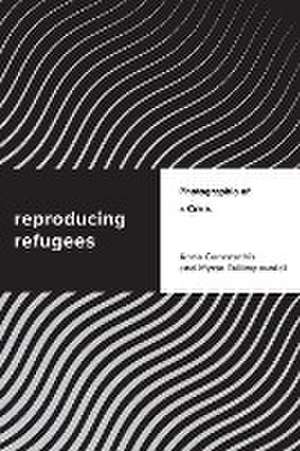
Reproducing Refugees: Photographia of a Crisis: Challenging Migration Studies
Autor Anna Carastathis, Myrto Tsilimpounidien Limba Engleză Paperback – 15 mar 2023
This book goes about synthesising visual studies with queer, feminist, postcolonial, post-structuralist, and post-Marxist theories. Carastathis and Tsilimpounidi offer theoretical frameworks and methodological tools to critically analyse representations, both those circulated through hegemonic institutions, and those generated from 'below'.
They carve a space between logos and praxis, ways of knowing and ways of doing, by offering a new visual language that problematises reified categories such as that of the 'refugee' and makes possible disruptive, alternative, resistant perceptions. The book contributes to the fields of migration and border studies, critically engaging visual narratives drawn from migration movements to question dominant categories and frameworks, from a decolonial, no-borders, queer feminist perspective.
| Toate formatele și edițiile | Preț | Express |
|---|---|---|
| Paperback (1) | 209.27 lei 6-8 săpt. | |
| Bloomsbury Publishing – 15 mar 2023 | 209.27 lei 6-8 săpt. | |
| Hardback (1) | 751.44 lei 6-8 săpt. | |
| Bloomsbury Publishing – 11 feb 2020 | 751.44 lei 6-8 săpt. |










Preț: 209.27 lei
Preț vechi: 278.75 lei
-25%
Puncte Express: 314
Preț estimativ în valută:
37.06€ • 43.28$ • 32.19£
37.06€ • 43.28$ • 32.19£
Carte tipărită la comandă
Livrare economică 21 februarie-07 martie
Preluare comenzi: 021 569.72.76
Specificații
ISBN-13: 9781538148167
ISBN-10: 1538148161
Pagini: 236
Ilustrații: 35 b/w photos;
Dimensiuni: 153 x 227 x 14 mm
Greutate: 0.32 kg
Editura: Bloomsbury Publishing
Colecția Rowman & Littlefield Publishers
Seria Challenging Migration Studies
Locul publicării:New York, United States
ISBN-10: 1538148161
Pagini: 236
Ilustrații: 35 b/w photos;
Dimensiuni: 153 x 227 x 14 mm
Greutate: 0.32 kg
Editura: Bloomsbury Publishing
Colecția Rowman & Littlefield Publishers
Seria Challenging Migration Studies
Locul publicării:New York, United States
Cuprins
Inroduction: Arrivals and Departures
Chapter 1: Crisis and Reproduction
Chapter 2: Photographìa
Chapter 3: Life Jackets
Chapter 4: Containers
Chapter 5: Survival Selfies
Chapter 6: Refugees Welcome
Conclusion: Departures and Arrivals
Bibliography
Chapter 1: Crisis and Reproduction
Chapter 2: Photographìa
Chapter 3: Life Jackets
Chapter 4: Containers
Chapter 5: Survival Selfies
Chapter 6: Refugees Welcome
Conclusion: Departures and Arrivals
Bibliography
Recenzii
[Reproducing Refugees] offers migration scholars, geographers, journalists, sociologists and anthropologists a unique and original lens through which broader political, economic and systemic processes can, and should be, critically interrogated. The book is a must read for those interested in the theory and methos of visual enquiry and in the performative role of images for marginalizes communities and systems of power.
This timely book offers a vivid critical account of the ethics and politics underpinning the visual economy of what has been notoriously called "Europe's refugee crisis". From the standpoint of the borders of postcolonial Mediterranean, it opens compelling terrains of critical engagement with epistemologies and lived experiences of "crisis", tracing how the photographic can become an apparatus of biopoliticized reproduction, visual objectification and epistemic violence, but also, occasionally, comes to articulate transformative solidarity and utopian imaginaries. Reproducing Refugees: Photographìa of a Crisisprovides an engaging meditation on how fraught registers of precarity, displacement, belonging, and national citizenship are embedded in racialized, gendered, and sexualized fields of vision and knowledge production. In thinking of "crisis" as a frame through which subjects and the political are (re)produced and made (in)visible, the book mobilizes queer feminist, antiracist, and decolonial perspectives to test the limits of bringing crisis and reproduction together. In so doing, it offers a valuable lens through which to imagine the possibility of change, whereby photographìa might be repurposed to unsettle normative figurations of the present.
In Reproducing Refugees, Anna Carastathis and Myrto Tsilimpounidi make a compelling case for the central and indispensable role of photography in mediating the spectacle of Europe's "refugee crisis." This book offers a vital critique of the visual economy of objectification by which human subjects crossing state borders are turned into the racialized and gendered objects of other people's pity or protection, or alternately, of their fear and loathing. Meanwhile, the visual discourse of photography propagates an illusion of transparency even as it remains both equivocal and incomplete- lending its imagery to diametrically opposed interpretations, while also framing events and predicaments in ways that conceal far more than they reveal. And by framing "crisis," the authors show that photography's visual economy is indeed an economy of power that inculcates ignorance and cultivates consent and complicity with the border regime's violence.
A significant intervention into the politics of 'crisis' and mobilities, this exciting book foregrounds reproduction, temporalities and the visual. It demonstrates the intensively productive nature of a metaphorical and literal queer lens on human movement. Challenging containment in nations and families in favour of making new connections it offers a guide to thought and action. Read it!
Engaging with the photographic representation of the summer of migration of 2015 through the angle of social reproduction theory, Anna Carastathis and Myrto Tsilimpounidi's book offers an excellent decolonial queer-feminist analysis of the contemporary conjuncture of crisis in the modern-colonial world system.
This timely book offers a vivid critical account of the ethics and politics underpinning the visual economy of what has been notoriously called "Europe's refugee crisis". From the standpoint of the borders of postcolonial Mediterranean, it opens compelling terrains of critical engagement with epistemologies and lived experiences of "crisis", tracing how the photographic can become an apparatus of biopoliticized reproduction, visual objectification and epistemic violence, but also, occasionally, comes to articulate transformative solidarity and utopian imaginaries. Reproducing Refugees: Photographìa of a Crisisprovides an engaging meditation on how fraught registers of precarity, displacement, belonging, and national citizenship are embedded in racialized, gendered, and sexualized fields of vision and knowledge production. In thinking of "crisis" as a frame through which subjects and the political are (re)produced and made (in)visible, the book mobilizes queer feminist, antiracist, and decolonial perspectives to test the limits of bringing crisis and reproduction together. In so doing, it offers a valuable lens through which to imagine the possibility of change, whereby photographìa might be repurposed to unsettle normative figurations of the present.
In Reproducing Refugees, Anna Carastathis and Myrto Tsilimpounidi make a compelling case for the central and indispensable role of photography in mediating the spectacle of Europe's "refugee crisis." This book offers a vital critique of the visual economy of objectification by which human subjects crossing state borders are turned into the racialized and gendered objects of other people's pity or protection, or alternately, of their fear and loathing. Meanwhile, the visual discourse of photography propagates an illusion of transparency even as it remains both equivocal and incomplete- lending its imagery to diametrically opposed interpretations, while also framing events and predicaments in ways that conceal far more than they reveal. And by framing "crisis," the authors show that photography's visual economy is indeed an economy of power that inculcates ignorance and cultivates consent and complicity with the border regime's violence.
A significant intervention into the politics of 'crisis' and mobilities, this exciting book foregrounds reproduction, temporalities and the visual. It demonstrates the intensively productive nature of a metaphorical and literal queer lens on human movement. Challenging containment in nations and families in favour of making new connections it offers a guide to thought and action. Read it!
Engaging with the photographic representation of the summer of migration of 2015 through the angle of social reproduction theory, Anna Carastathis and Myrto Tsilimpounidi's book offers an excellent decolonial queer-feminist analysis of the contemporary conjuncture of crisis in the modern-colonial world system.