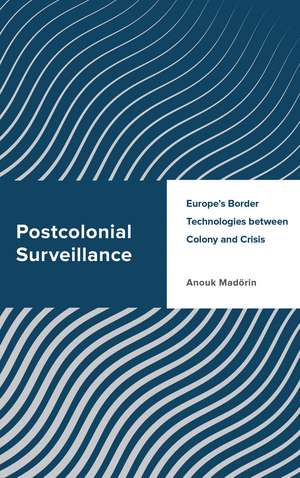
Postcolonial Surveillance: Europe's Border Technologies between Colony and Crisis: Challenging Migration Studies
Autor Anouk Madörinen Limba Engleză Paperback – 15 apr 2024







Preț: 219.54 lei
Puncte Express: 329
Carte tipărită la comandă
Livrare economică 18 noiembrie-02 decembrie
Livrare prin curier în România Termenul estimat este afișat lângă disponibilitate.
Transport gratuit de la 400.00 lei Plată online sau ramburs, în funcție de opțiunile comenzii.
Retur gratuit în 14 zile Comandă securizată și suport în română.
Specificații
ISBN-13: 9781538196250
ISBN-10: 1538196255
Pagini: 188
Dimensiuni: 150 x 228 x 11 mm
Greutate: 0.28 kg
Editura: Bloomsbury Publishing
Colecția Rowman & Littlefield
Seria Challenging Migration Studies
Locul publicării:New York, United States
ISBN-10: 1538196255
Pagini: 188
Dimensiuni: 150 x 228 x 11 mm
Greutate: 0.28 kg
Editura: Bloomsbury Publishing
Colecția Rowman & Littlefield
Seria Challenging Migration Studies
Locul publicării:New York, United States
Cuprins
Acknowledgments
Preface
Chapter 1: The European Border Regime: Conditions of Emergence in a Mediated World
Chapter 2: The View From Above: The Traffic of Non-White Bodies in the Mediterranean World
Chapter 3: Data on Bodies: Colonial Ordering from Windhoek to Lesbos
Chapter 4: Bodies of Data: (Early) Biometrics from the Colony to the Border
Chapter 5: Viral Deterrence: Sex, Risk, and Contagion ca. 1920 and 2015
Chapter 6: A Thousand Crises: Notes on the State of Exception
Works Cited
About the Author
Preface
Chapter 1: The European Border Regime: Conditions of Emergence in a Mediated World
Chapter 2: The View From Above: The Traffic of Non-White Bodies in the Mediterranean World
Chapter 3: Data on Bodies: Colonial Ordering from Windhoek to Lesbos
Chapter 4: Bodies of Data: (Early) Biometrics from the Colony to the Border
Chapter 5: Viral Deterrence: Sex, Risk, and Contagion ca. 1920 and 2015
Chapter 6: A Thousand Crises: Notes on the State of Exception
Works Cited
About the Author
Recenzii
Postcolonial Surveillance considers the long history of European border regimes, focusing on the colonial predecessors of today's border technologies. Undertaking a longue durée approach to uncover how Europe's pre-digital colonial history continues to shape the high-tech political present, Madörin shows how colonial practices live on in the European Union's border migration policies, border security, and surveillance apparatuses. She exposes the consistent racial hierarchies and power relations that form these systems, highlighting key moments when the past and present interact and collide, such as in panoptic surveillance, biopolitical registers, and biometric sorting. This specialized work will appeal strongly to those researching surveillance regimes, racism, migration, and postcolonialism more generally. Highly recommended. Faculty, researchers, and professionals.
The multilayered, high-tech surveillance systems that guard Europe's borders appear instrumental in facilitating the orderly and efficient movement of bona fide passengers and denying entry to 'problematic populations.' However, Anouk Madörin argues that beneath this façade lies appalling neocolonial policies and racist sorting principles that European governments, colonial companies, and elites have developed over centuries of colonialism and the trade of enslaved populations. The author argues her case forcefully and passionately. It is essential reading for those interested in critical surveillance studies, racism, migration studies, and colonialism.
Colonial history and racial domination have often been the open secrets of border and migration scholarship, seen but not seen. Postcolonial Surveillance treats these absent presences as its most central and pressing questions, making this book a vital intervention in debates and struggles about borders today.
This is an urgent and a much-needed book to help us think about the issue of migration beyond crisis and Europe's technologized borders in relation to its colonial past. Analyzing contemporary cases, Anouk Madörin masterfully unravels the colonial fabric of contemporary surveillance technologies, underscoring the chronicity of what we call 'crisis.'
The multilayered, high-tech surveillance systems that guard Europe's borders appear instrumental in facilitating the orderly and efficient movement of bona fide passengers and denying entry to 'problematic populations.' However, Anouk Madörin argues that beneath this façade lies appalling neocolonial policies and racist sorting principles that European governments, colonial companies, and elites have developed over centuries of colonialism and the trade of enslaved populations. The author argues her case forcefully and passionately. It is essential reading for those interested in critical surveillance studies, racism, migration studies, and colonialism.
Colonial history and racial domination have often been the open secrets of border and migration scholarship, seen but not seen. Postcolonial Surveillance treats these absent presences as its most central and pressing questions, making this book a vital intervention in debates and struggles about borders today.
This is an urgent and a much-needed book to help us think about the issue of migration beyond crisis and Europe's technologized borders in relation to its colonial past. Analyzing contemporary cases, Anouk Madörin masterfully unravels the colonial fabric of contemporary surveillance technologies, underscoring the chronicity of what we call 'crisis.'