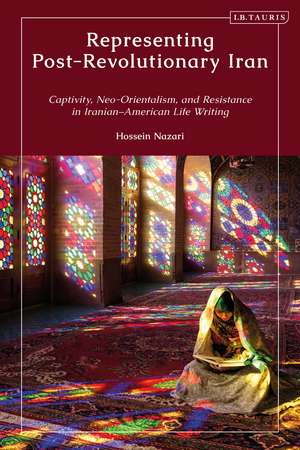
Representing Post-Revolutionary Iran: Captivity, Neo-Orientalism, and Resistance in Iranian–American Life Writing
Autor Hossein Nazarien Limba Engleză Paperback – 25 ian 2024
Memoirs of diasporic Iranian-American authors are a unique and culturally powerful way in which Iran, its politics, and people are understood in the USA and the rest of the world. This book offers an analysis of the processes of production, promotion, and reception of the representations of post-revolutionary Iran.
The book provides new perspectives on some of the most famous examples of the genre such as Betty Mahmoody's Not Without My Daughter, Azar Nafisi's Reading Lolita in Tehran: A Memoir in Books, and Fatemeh Keshavarz's Jasmine and Stars: Reading More Than Lolita in Tehran. Hossein Nazari places these texts in their social, historical, and political contexts, tracing their origins within the trope of the American captivity narrative, teasing out and critiquing neo-Orientalist tendencies within, and finally focusing on modes of discursive resistance to neo-Orientalist narratives. The book analyzes the structural means by which stereotypes about Islam and women in the Islamic Republic in these narratives are privileged by news media and the creative industries, while also charting a growing number of 'counterhegemonic' memoirs which challenge these narratives by representing more nuanced accounts of life in Iran after 1979.
Preț: 198.39 lei
Preț vechi: 270.16 lei
-27%
Puncte Express: 298
Carte tipărită la comandă
Livrare economică 02-16 decembrie
Livrare prin curier în România Termenul estimat este afișat lângă disponibilitate.
Transport gratuit de la 400.00 lei Plată online sau ramburs, în funcție de opțiunile comenzii.
Retur gratuit în 14 zile Comandă securizată și suport în română.
Specificații
ISBN-13: 9780755648085
ISBN-10: 0755648080
Pagini: 232
Dimensiuni: 152 x 234 x 16 mm
Greutate: 0.36 kg
Editura: Bloomsbury Publishing
Colecția I.B.Tauris
Locul publicării:London, United Kingdom
ISBN-10: 0755648080
Pagini: 232
Dimensiuni: 152 x 234 x 16 mm
Greutate: 0.36 kg
Editura: Bloomsbury Publishing
Colecția I.B.Tauris
Locul publicării:London, United Kingdom
Cuprins
Chapter 1: Introduction: Inscribing Iran in the West
Historical Significance and Earliest Figurations
Fabricating an "Axis of Evil"
Constructing the Iranian Other
Iranian Others in Others' Literature
Chapter 2: Not Without My Daughter: The Mother of Neo-Orientalist Best-sellers
Resurrecting the American Captivity Narrative
Tales of Caution and Mixed Marriage Menace
Ghosting Ghastly Narratives
West Meets East: Clash of Civilization and Un-Civilization
Writing Iranians Colonially
Defilement and Contamination
The Cult of Iranian Domesticity
Affirmation, Negation, and Bestialization
Multitudinous Others
Linguistic Sovereignty
The Mad Muslim Man
Going Native: From American Gentleman to Iranian Brute
"Veiled Humanity": The Oriental Accomplice
Willing Convicts Vs. Western Rebels
The Villain Writes Back
Chapter 3: Damsels in Distress: Writing Muslim "Lolitas" in the West
Reading Azar Nafisi in the U.S.
The Front Cover Controversy
Behind the Veil: The Topos Obligé of Feminist Orientalism
Bridging the "Oriental Harem" to the "Free World"
From Neo-Orientalism to Neo-Conservatism
From the Western Canon to the West's Cannons
Curricular and Minority Questions
The Western Novel
Ahistorical Historicism and Learned Amnesia
Chapter 4: Strains of Dissent and a Fledgling Alternative Discourse
Jasmine and Stars: Cracking the Orientalist Monolith
The Rebellious Bard
Reinscribing Iranian Masculinity
The Latter-Day Persian Scheherazade
Unmasking Lolita in the West
Humanizing the Persian Patriarch
Reading Beyond Jasmine and Stars
Historical Significance and Earliest Figurations
Fabricating an "Axis of Evil"
Constructing the Iranian Other
Iranian Others in Others' Literature
Chapter 2: Not Without My Daughter: The Mother of Neo-Orientalist Best-sellers
Resurrecting the American Captivity Narrative
Tales of Caution and Mixed Marriage Menace
Ghosting Ghastly Narratives
West Meets East: Clash of Civilization and Un-Civilization
Writing Iranians Colonially
Defilement and Contamination
The Cult of Iranian Domesticity
Affirmation, Negation, and Bestialization
Multitudinous Others
Linguistic Sovereignty
The Mad Muslim Man
Going Native: From American Gentleman to Iranian Brute
"Veiled Humanity": The Oriental Accomplice
Willing Convicts Vs. Western Rebels
The Villain Writes Back
Chapter 3: Damsels in Distress: Writing Muslim "Lolitas" in the West
Reading Azar Nafisi in the U.S.
The Front Cover Controversy
Behind the Veil: The Topos Obligé of Feminist Orientalism
Bridging the "Oriental Harem" to the "Free World"
From Neo-Orientalism to Neo-Conservatism
From the Western Canon to the West's Cannons
Curricular and Minority Questions
The Western Novel
Ahistorical Historicism and Learned Amnesia
Chapter 4: Strains of Dissent and a Fledgling Alternative Discourse
Jasmine and Stars: Cracking the Orientalist Monolith
The Rebellious Bard
Reinscribing Iranian Masculinity
The Latter-Day Persian Scheherazade
Unmasking Lolita in the West
Humanizing the Persian Patriarch
Reading Beyond Jasmine and Stars
Recenzii
A fruitful introductory guide for the reading and discussing of diaspora literature.
A thoughtful and detailed analysis of the social, political, and historical context of three popular Iranian-American memoirs.
Hossein Nazari's critical account of three Iranian-American women's memoirs is an important study of neo-Orientalism and its negative consequences for geopolitics, feminism, and comparative religions. Until we stop using Islamic cultures for our own Western purposes, there will be little mutual understanding. More than an astute work of literary criticism, this book is also a lesson in political wisdom.
Representing Post-Revolutionary Iran is a critical study of Iranian-American memoirs, highlighting the importance of paying attention to representation, and to the enduring nature of Orientalist stereotypes. Thorough, nuanced, and timely, Nazari's work directs our gaze to the interwoven nature of memory and culture and reminds us of the work memoirs do in constructing our understandings of place.
Iranian-American women who write memoirs are doing much more than writing self-narratives, argues Hossein Nazari in his illuminating analyses that take up some of the most urgent questions about the fraught relations between Iran and the United States. As his astute and timely study indicates, these women are (un)wittingly engaging in political work that is co-opted for promoting Western interventionist agendas.
His exploration of three paradigmatic memoirs penned by Iranian-American women unveils their political implications and the mechanism behind keeping conscious the collective Western memory that renders Iran the greatest threat to democracy and Islam the root of all evil. Deployed in the post-9/11 milieu, neo-Orientalist discourse has perpetuated misrepresentations of this Middle-Eastern country. Nazari addresses how Not Without My Daughter and Reading Lolita in Tehran owe their popularity to their alignment with the grand narratives promoted by Western governments and expected by mass markets. Bringing a new reading to Jasmine and Stars, Nazari argues that its attention to cultural complexities offers an alternative, resistant narrative.
Nazari's work is important for not just literary studies but for all who care about the troubled history of Iran and the US. It points the way to future studies on this exigent topic.
A thoughtful and detailed analysis of the social, political, and historical context of three popular Iranian-American memoirs.
Hossein Nazari's critical account of three Iranian-American women's memoirs is an important study of neo-Orientalism and its negative consequences for geopolitics, feminism, and comparative religions. Until we stop using Islamic cultures for our own Western purposes, there will be little mutual understanding. More than an astute work of literary criticism, this book is also a lesson in political wisdom.
Representing Post-Revolutionary Iran is a critical study of Iranian-American memoirs, highlighting the importance of paying attention to representation, and to the enduring nature of Orientalist stereotypes. Thorough, nuanced, and timely, Nazari's work directs our gaze to the interwoven nature of memory and culture and reminds us of the work memoirs do in constructing our understandings of place.
Iranian-American women who write memoirs are doing much more than writing self-narratives, argues Hossein Nazari in his illuminating analyses that take up some of the most urgent questions about the fraught relations between Iran and the United States. As his astute and timely study indicates, these women are (un)wittingly engaging in political work that is co-opted for promoting Western interventionist agendas.
His exploration of three paradigmatic memoirs penned by Iranian-American women unveils their political implications and the mechanism behind keeping conscious the collective Western memory that renders Iran the greatest threat to democracy and Islam the root of all evil. Deployed in the post-9/11 milieu, neo-Orientalist discourse has perpetuated misrepresentations of this Middle-Eastern country. Nazari addresses how Not Without My Daughter and Reading Lolita in Tehran owe their popularity to their alignment with the grand narratives promoted by Western governments and expected by mass markets. Bringing a new reading to Jasmine and Stars, Nazari argues that its attention to cultural complexities offers an alternative, resistant narrative.
Nazari's work is important for not just literary studies but for all who care about the troubled history of Iran and the US. It points the way to future studies on this exigent topic.