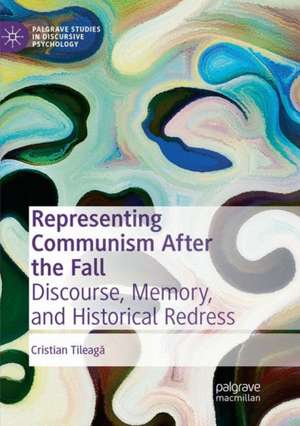
Representing Communism After the Fall: Palgrave Studies in Discursive Psychology
Autor Cristian Tileag¿en Limba Engleză Paperback – 14 dec 2018
This book explores the contribution of discursive psychology and discourse analysis to researching the relationship between history and collective memory. Analysing significant manifestations of the moral vocabulary of the Romanian transition from communism to democracy, the author demonstrates how discursive psychology can be used to understand some of the enduring and persistent dilemmas around the legacy of communism. This book argues that an understanding of language as an action-oriented, world-building resource can fill an important gap in the theorizing of public controversies over individual and collective meaning of the recent (communist) past. The author posits that discursive social psychology can serve as an intellectual and empirical bridge that can overcome several of the difficulties faced by researchers working in transitional justice studies and cognate fields. This reflective book will appeal to students and scholars of transitional justice, discursive psychology, memory studies, and the sociology of change.

Preț: 375.64 lei
Puncte Express: 563
Carte tipărită la comandă
Livrare economică 03-09 decembrie
Livrare prin curier în România Termenul estimat este afișat lângă disponibilitate.
Transport gratuit de la 400.00 lei Plată online sau ramburs, în funcție de opțiunile comenzii.
Retur gratuit în 14 zile Comandă securizată și suport în română.
Specificații
ISBN-13: 9783030073497
ISBN-10: 3030073491
Pagini: 272
Ilustrații: X, 262 p.
Dimensiuni: 148 x 210 x 15 mm
Greutate: 0.36 kg
Ediția:Softcover reprint of the original 1st ed. 2018
Editura: Palgrave MacMillan
Colecția Palgrave Studies in Discursive Psychology
Seria Palgrave Studies in Discursive Psychology
Locul publicării:Cham, Switzerland
ISBN-10: 3030073491
Pagini: 272
Ilustrații: X, 262 p.
Dimensiuni: 148 x 210 x 15 mm
Greutate: 0.36 kg
Ediția:Softcover reprint of the original 1st ed. 2018
Editura: Palgrave MacMillan
Colecția Palgrave Studies in Discursive Psychology
Seria Palgrave Studies in Discursive Psychology
Locul publicării:Cham, Switzerland
Cuprins
Preface.- Introduction: what does coming to terms with the past mean?.- 1. Transitional justice as situated practices.- 2. Collective and cultural memory: ethics, politics, and avoidance in remembering communism.- 3. Communism as moral problem.- 4. Communism as Other.- 5. Mea culpa.- 6. Remembering with and through archives.- 7. Transgression and the social construction of moral meanings.- 8. Using discursive psychology to explore contested and troubled pasts.
Textul de pe ultima copertă
This book explores the contribution of discursive psychology and discourse analysis to researching the relationship between history and collective memory. Analysing significant manifestations of the moral vocabulary of the Romanian transition from communism to democracy, the author demonstrates how discursive psychology can be used to understand some of the enduring and persistent dilemmas around the legacy of communism. This book argues that the understanding of language according to discursive psychology – as an action-oriented, world-building resource – can fill an important gap in the theorizing of public controversies over individual and collective meaning of the recent (communist) past. Tileagă maintains that discursive social psychology can serve as an intellectual and empirical bridge that can overcome several of the difficulties faced by researchers working in transitional justice studies and cognate fields. Examining eastern European communism in general and Romanian communism in particular, this reflective book will appeal to students and scholars of transitional justice, discursive psychology and memory.
Cristian Tileagă is Senior Lecturer in Social Psychology at the School of Social Sciences at Loughborough University, UK. His research interests include discursive psychology, prejudice, political discourse and interdisciplinarity, and he has published widely on these topics.
Caracteristici
Offers a new and innovative research agenda for exploring the relationship between discourse, history, and social memory Extends the analysis of personal and social memory to wider societal issues and social problems Considers cultural and political contexts of social change