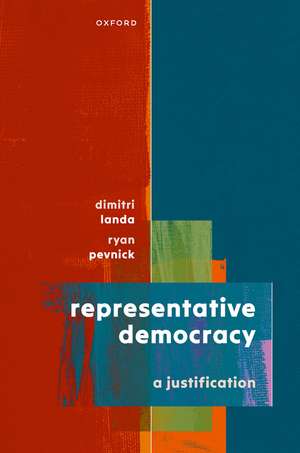
Representative Democracy: A Justification
Autor Dimitri Landa, Ryan Pevnicken Limba Engleză Hardback – 19 mar 2025
Preț: 679.68 lei
Preț vechi: 1007.07 lei
-33%
Puncte Express: 1020
Carte disponibilă
Livrare economică 06-17 noiembrie
Livrare prin curier în România Termenul estimat este afișat lângă disponibilitate.
Transport gratuit pentru acest produs Plată online sau ramburs, în funcție de opțiunile comenzii.
Retur gratuit în 14 zile Comandă securizată și suport în română.
Specificații
ISBN-13: 9780198897538
ISBN-10: 0198897537
Pagini: 304
Dimensiuni: 165 x 240 x 20 mm
Greutate: 0.61 kg
Editura: OUP OXFORD
Colecția OUP Oxford
Locul publicării:Oxford, United Kingdom
ISBN-10: 0198897537
Pagini: 304
Dimensiuni: 165 x 240 x 20 mm
Greutate: 0.61 kg
Editura: OUP OXFORD
Colecția OUP Oxford
Locul publicării:Oxford, United Kingdom
Recenzii
In their new book Dimitri Landa and Ryan Pevnick offer a highly original defense of representative democracy. Through a systematic comparative analysis of different political regime types, they carefully identify the various ways in which representative democracy is superior to the available alternatives. The depth and quality of their analysis is first rate. And their conclusions are very compelling. This is a book that anyone interested in the debates over the best way to institutionalize democracy should read. It is an important addition to this debate.
This thought-provoking book offers an original justification of the superiority of representative democracy vis-à-vis alternatives such as meritocracy, lottocracy, and direct democracy. Widespread perception of a “crisis of democracy” fuels skepticism about the ability of democracy to deliver on its promise. At such a critical time, a comparative analysis of the relative strengths and weaknesses of representative democracy vis-à-vis alternative regime types could not be timelier. The analysis offered in the book is careful and insightful but also challenging. The case for democracy that it articulates questions deep-seated assumptions of defenders and critics of democracy alike. It is a must read for anyone interested in the normative foundations of democracy.
Really good books ask important questions and offer creative, plausible answers. By this measure, Dimitri Landa and Ryan Pevnick have written a really good book. Representative democracy is under attack as a scheme of political domination by corrupt and incompetent elites. What could justify it? The answer-a full-throated defense-is that representative democracy better serves some fundamental political values than direct democracies, lottocracies, and non-electoral meritocracies. Their case for this conclusion is carefully argued, clearly written, and deeply considered-the best treatment I have read of this essential question.
This thought-provoking book offers an original justification of the superiority of representative democracy vis-à-vis alternatives such as meritocracy, lottocracy, and direct democracy. Widespread perception of a “crisis of democracy” fuels skepticism about the ability of democracy to deliver on its promise. At such a critical time, a comparative analysis of the relative strengths and weaknesses of representative democracy vis-à-vis alternative regime types could not be timelier. The analysis offered in the book is careful and insightful but also challenging. The case for democracy that it articulates questions deep-seated assumptions of defenders and critics of democracy alike. It is a must read for anyone interested in the normative foundations of democracy.
Really good books ask important questions and offer creative, plausible answers. By this measure, Dimitri Landa and Ryan Pevnick have written a really good book. Representative democracy is under attack as a scheme of political domination by corrupt and incompetent elites. What could justify it? The answer-a full-throated defense-is that representative democracy better serves some fundamental political values than direct democracies, lottocracies, and non-electoral meritocracies. Their case for this conclusion is carefully argued, clearly written, and deeply considered-the best treatment I have read of this essential question.
Notă biografică
Dimitri Landa is a Professor of Politics at New York University. He has written on a broad range of topics in political economy, democratic theory, philosophy, and law.Ryan Pevnick is an Associate Professor of Politics at New York University. He is the author of Immigration and the Constraints of Justice (Cambridge University Press, 2011), as well as articles on a broad range of topics in political theory.