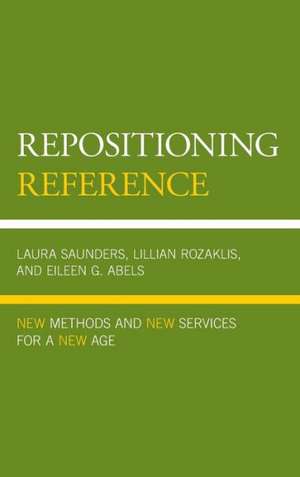
Repositioning Reference: New Methods and New Services for a New Age
Autor Laura Saunders, Lillian Rozaklis, Eileen G. Abelsen Limba Engleză Hardback – 20 noi 2014
Preț: 624.43 lei
Preț vechi: 912.41 lei
-32%
Puncte Express: 937
Carte tipărită la comandă
Livrare economică 21 noiembrie-05 decembrie
Livrare prin curier în România Termenul estimat este afișat lângă disponibilitate.
Transport gratuit pentru acest produs Plată online sau ramburs, în funcție de opțiunile comenzii.
Retur gratuit în 14 zile Comandă securizată și suport în română.
Specificații
ISBN-13: 9780810893221
ISBN-10: 0810893223
Pagini: 170
Ilustrații: black & white illustrations
Dimensiuni: 162 x 235 x 18 mm
Greutate: 0.37 kg
Editura: Bloomsbury Publishing
Colecția Rowman & Littlefield
Locul publicării:New York, United States
ISBN-10: 0810893223
Pagini: 170
Ilustrații: black & white illustrations
Dimensiuni: 162 x 235 x 18 mm
Greutate: 0.37 kg
Editura: Bloomsbury Publishing
Colecția Rowman & Littlefield
Locul publicării:New York, United States
V-ar putea interesa
-
 The Intellectual Foundation of Information OrganizationElaine Svenonius-20%Preț: 213.68 lei267.10 lei
 -
 Preț: 380.40 lei
 -
 Less Is More: A Practical Guide to Weeding School Library CollectionsDonna J. BaumbachPreț: 321.78 lei
 -
 RDA and Cartographic ResourcesPaige G. AndrewPreț: 442.19 lei
 -
 Diversity in Youth Literature: Opening Doors Through ReadingJamie Campbell NaidooPreț: 373.86 lei
 -
 Library Management 101: A Practical GuideDiane L. VelasquezPreț: 487.99 lei
 -
 -21%Preț: 283.48 lei357.64 lei
 -
 -26%Preț: 265.87 lei358.27 lei
Descriere
To compete today, librarians need to not only provide old services in new ways but also to provide new services. Repositioning Reference: New Methods and New Services for a New Age re-imagines reference services in libraries and information organizations and the role of reference librarians, taking into account rapid developments in technology and information-specific services in non-library sectors. It traces the history of technology adoption for reference services, describes competitive pressures facing reference services, identifies untapped opportunities for reference services and librarians, details innovative and creative solutions for energizing the profession and engaging library user communities, and prescribes means to evaluating technologies for reference services.
This book:
. Includes current and unique examples of innovative reference services to serve as inspiration and launching points for readers.
. Offers contemporary management theory and practice from outside of the field of LIS to offer readers a guide for initiating, leading, and managing change in their organizations.
. Outlines the processes of environmental scanning and SWOT analysis, which are important practices for keeping abreast of changes in the field and positioning an organization to make the most of their opportunities and to minimize threats.
Repositioning Reference may be used as a textbook by LIS educators whose courses and learning experiences prepare aspiring librarians to lead the reference revolution and by practicing librarians in diverse settings who want to be change agents.
This book:
. Includes current and unique examples of innovative reference services to serve as inspiration and launching points for readers.
. Offers contemporary management theory and practice from outside of the field of LIS to offer readers a guide for initiating, leading, and managing change in their organizations.
. Outlines the processes of environmental scanning and SWOT analysis, which are important practices for keeping abreast of changes in the field and positioning an organization to make the most of their opportunities and to minimize threats.
Repositioning Reference may be used as a textbook by LIS educators whose courses and learning experiences prepare aspiring librarians to lead the reference revolution and by practicing librarians in diverse settings who want to be change agents.
Cuprins
Preface
Chapter 1: Evolution of Reference Services
Chapter 2: Competitive Pressures Facing Reference
Chapter 3: Implications of Change: Competencies and Philosophies
Chapter 4: Thinking Outside the Box: Entrepreneurship in Reference Service Provision
Chapter 5: Leveraging Environmental Scanning for Repositioning
Chapter 6: Leading and Managing Change for Organizational Renewal
Index
Chapter 1: Evolution of Reference Services
Chapter 2: Competitive Pressures Facing Reference
Chapter 3: Implications of Change: Competencies and Philosophies
Chapter 4: Thinking Outside the Box: Entrepreneurship in Reference Service Provision
Chapter 5: Leveraging Environmental Scanning for Repositioning
Chapter 6: Leading and Managing Change for Organizational Renewal
Index
Recenzii
There have been many books published in the last few years aimed at those who are rethinking, reimagining, rebooting, and now repositioning reference service. These books all take the approach that reference service needs to be redesigned if it is to survive as a service in modern libraries. This version is somewhat different than the rest of the pack. Rather than consisting of a collection of articles from a range of contributors, this work is the product of three educators at Simmons College. These authors take a research-based approach and include extensive references from the literature to support their ideas. Topics covered include the evolution of reference service, competitive pressures facing the field, implications for change, entrepreneurship, and leading and managing change. This slim volume will be very helpful for any librarians seeking ideas and methods for evolving their existing reference services.
This well-researched and wise book is essential reading for library and information studies faculty and students, current reference librarians, and administrators of academic, public, and special libraries.
This well-referenced, clearly written, concise book by two library faculty from Simmons College and an independent library consult does an excellent job explaining the changes impacting reference services and reference librarians.... This book is recommended reading for reference librarians, and library administrators in all types of libraries. It is also a helpful reference for LIS faculty and their students.
In Repositioning Reference: New Methods and New Services for a New Age, co-authors Laura Saunders, Lillian Rozaklis, and Eileen G. Abels respond to concerns about the future of reference services, given changes in technology and user behavior. In three well-documented chapters they explore the evolution of reference services, new services introduced in response to competitive pressures, and needed competencies and philosophies of service to accomplish a paradigm shift in reference services. This is followed by chapters highlighting specific examples of innovative services, the use of environmental scanning to identify opportunities for innovation, and models for change management and change leadership. The book will be a valuable resource for practitioners, educators, and students seeking to shape the future of reference services.
This well-researched and wise book is essential reading for library and information studies faculty and students, current reference librarians, and administrators of academic, public, and special libraries.
This well-referenced, clearly written, concise book by two library faculty from Simmons College and an independent library consult does an excellent job explaining the changes impacting reference services and reference librarians.... This book is recommended reading for reference librarians, and library administrators in all types of libraries. It is also a helpful reference for LIS faculty and their students.
In Repositioning Reference: New Methods and New Services for a New Age, co-authors Laura Saunders, Lillian Rozaklis, and Eileen G. Abels respond to concerns about the future of reference services, given changes in technology and user behavior. In three well-documented chapters they explore the evolution of reference services, new services introduced in response to competitive pressures, and needed competencies and philosophies of service to accomplish a paradigm shift in reference services. This is followed by chapters highlighting specific examples of innovative services, the use of environmental scanning to identify opportunities for innovation, and models for change management and change leadership. The book will be a valuable resource for practitioners, educators, and students seeking to shape the future of reference services.