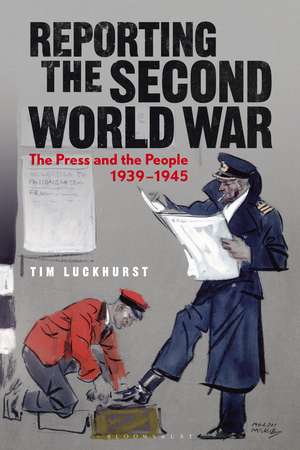
Reporting the Second World War: The Press and the People 1939-1945
Autor Prof. Tim Luckhursten Limba Engleză Paperback – 9 feb 2023
Reporting the Second World War is a timely and important intervention that duly recognises the place of national, regional and specialist titles in speaking truth to power in a democracy at war.
Preț: 179.99 lei
Preț vechi: 245.73 lei
-27%
Puncte Express: 270
Carte disponibilă
Livrare economică 02-16 noiembrie
Livrare express 16-22 octombrie pentru 94.18 lei
Livrare prin curier în România Termenul estimat este afișat lângă disponibilitate.
Transport gratuit de la 400.00 lei Plată online sau ramburs, în funcție de opțiunile comenzii.
Retur gratuit în 14 zile Comandă securizată și suport în română.
Specificații
ISBN-13: 9781350149489
ISBN-10: 1350149489
Pagini: 264
Ilustrații: 20 bw illus
Dimensiuni: 156 x 232 x 22 mm
Greutate: 0.38 kg
Editura: Bloomsbury Publishing
Colecția Bloomsbury Academic
Locul publicării:London, United Kingdom
ISBN-10: 1350149489
Pagini: 264
Ilustrații: 20 bw illus
Dimensiuni: 156 x 232 x 22 mm
Greutate: 0.38 kg
Editura: Bloomsbury Publishing
Colecția Bloomsbury Academic
Locul publicării:London, United Kingdom
Cuprins
List of Illustrations
1. Introduction
2. A Very Brief History of Newspapers
3. The Press Barons, the Abdication of Edward VIII and the Era of Appeasement
4. Newspapers in the Phoney War
5. Churchill, Norway and Dunkirk
6. Overseas Evacuation
7. Battle of Britain
8. The Blitz
9. Morale, Intimidation and Censorship
10. Britain and Russia: 'One Touch of Hitler Makes the Whole World Kin'
11. Banishing Want from Cradle to Grave: A Symbol of a New Britain
12. Peculiar Problems: Reporting the American Presence
13. 'Bomb Back and Bomb Hard': Allied Bombing of Germany
14. Auschwitz, Belsen and Buchenwald
15. 'What a hair-trigger business the world has become':Victory in Europe, a General Election, Atomic Bombs and VJ Day
Conclusion
Bibliography
Index
1. Introduction
2. A Very Brief History of Newspapers
3. The Press Barons, the Abdication of Edward VIII and the Era of Appeasement
4. Newspapers in the Phoney War
5. Churchill, Norway and Dunkirk
6. Overseas Evacuation
7. Battle of Britain
8. The Blitz
9. Morale, Intimidation and Censorship
10. Britain and Russia: 'One Touch of Hitler Makes the Whole World Kin'
11. Banishing Want from Cradle to Grave: A Symbol of a New Britain
12. Peculiar Problems: Reporting the American Presence
13. 'Bomb Back and Bomb Hard': Allied Bombing of Germany
14. Auschwitz, Belsen and Buchenwald
15. 'What a hair-trigger business the world has become':Victory in Europe, a General Election, Atomic Bombs and VJ Day
Conclusion
Bibliography
Index
Recenzii
Tim Luckhurst's magisterial Reporting the Second World War: The Press and the People 1939-1945 does two things: It provides a scholarly, deeply-researched account of how British journalists reported the Second World War, and, in doing so, it shines a light on the practices of journalism. That a history book should succeed in doing both things is a mighty achievement.
Reporting the Second World War is a book which makes you feel good and proud to be a journalist and leaves you with the feeling that the history of journalism itself can be written with so much more optimism, truth and inspiration.
Reporting the Second World War: The Press and the People, 1939-1945 is an impressive and important contribution to media studies of the Second World War. It is well-organized, researched, and engaging. Luckhurst has made excellent use of his research of national newspapers for this study. This work is highly recommended for media historians as well as World War II scholars.
One of the very best journalism history books ever written. Outstanding research into the story of the Second World War through a critical, inspirational and brilliant study of the newspaper reporting by courageous British journalists still holding power to account while fighting to protect their country's democracy and freedoms.
Tim Luckhurst is that rare creature, a Professor of Journalism who actually believes in a free press. He charts with brilliant clarity how, after abdication and appeasement, it was the radical and irreverent tabloids, led by the Mirror, which reminded ordinary Britons that freedom means a press which serves its readers, not their rulers.
An engrossing critical history of journalism through one of the most profound periods of the 20th Century. Addressing contentious issues of the time, Tim Luckhurst provides original insight and compelling evidence into how our wartime newspapers shaped readers' opinions and challenged government.
Reporting the Second World War is a book which makes you feel good and proud to be a journalist and leaves you with the feeling that the history of journalism itself can be written with so much more optimism, truth and inspiration.
Reporting the Second World War: The Press and the People, 1939-1945 is an impressive and important contribution to media studies of the Second World War. It is well-organized, researched, and engaging. Luckhurst has made excellent use of his research of national newspapers for this study. This work is highly recommended for media historians as well as World War II scholars.
One of the very best journalism history books ever written. Outstanding research into the story of the Second World War through a critical, inspirational and brilliant study of the newspaper reporting by courageous British journalists still holding power to account while fighting to protect their country's democracy and freedoms.
Tim Luckhurst is that rare creature, a Professor of Journalism who actually believes in a free press. He charts with brilliant clarity how, after abdication and appeasement, it was the radical and irreverent tabloids, led by the Mirror, which reminded ordinary Britons that freedom means a press which serves its readers, not their rulers.
An engrossing critical history of journalism through one of the most profound periods of the 20th Century. Addressing contentious issues of the time, Tim Luckhurst provides original insight and compelling evidence into how our wartime newspapers shaped readers' opinions and challenged government.