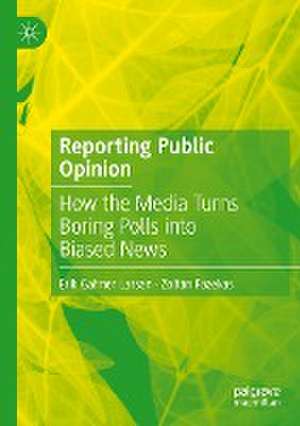
Reporting Public Opinion: How the Media Turns Boring Polls into Biased News
Autor Erik Gahner Larsen, Zoltán Fazekasen Limba Engleză Paperback – 2 aug 2022
Preț: 743.17 lei
Preț vechi: 906.30 lei
-18%
Puncte Express: 1115
Carte tipărită la comandă
Livrare economică 03-17 decembrie
Livrare prin curier în România Termenul estimat este afișat lângă disponibilitate.
Transport gratuit pentru acest produs Plată online sau ramburs, în funcție de opțiunile comenzii.
Retur gratuit în 14 zile Comandă securizată și suport în română.
Specificații
ISBN-13: 9783030753528
ISBN-10: 3030753522
Pagini: 134
Ilustrații: XIV, 134 p. 21 illus., 4 illus. in color.
Dimensiuni: 148 x 210 mm
Greutate: 0.19 kg
Ediția:1st ed. 2021
Editura: Springer International Publishing
Colecția Palgrave Macmillan
Locul publicării:Cham, Switzerland
ISBN-10: 3030753522
Pagini: 134
Ilustrații: XIV, 134 p. 21 illus., 4 illus. in color.
Dimensiuni: 148 x 210 mm
Greutate: 0.19 kg
Ediția:1st ed. 2021
Editura: Springer International Publishing
Colecția Palgrave Macmillan
Locul publicării:Cham, Switzerland
Cuprins
1. Bringing public opinion to the public: from polls to media coverage.- 2. The four steps of poll coverage: creating, selecting, reporting, and responding.- 3. Explaining how media outlets select opinion polls: the role of change.- 4. Characteristics of opinion poll reporting: creating the change narrative.- 5. Reactions and implications: how do the elite and the public respond to polls?.- 6. Alternatives to opinion polls: no polls, vox pop, poll aggregators and social media.- 7. Conclusion: How the media could report opinion polls.
Notă biografică
Erik Gahner Larsen is Senior Scientific Adviser at the Conflict Analysis Research Centre, University of Kent, UK. He has conducted multiple research projects on the coverage of opinion polls in the media, and his research has been published in journals such as the British Journal of Political Science and The International Journal of Press/Politics.
Zoltán Fazekas is Associate Professor of Business and Politics, with focus on quantitative methods in the Department of International Economics, Government and Business at the Copenhagen Business School, Denmark. His research is at the intersection of electoral behavior, psychology, and communication; it has been published in the American Journal of Political Science, Political Communication, and the Journal of Communication, among others.
Zoltán Fazekas is Associate Professor of Business and Politics, with focus on quantitative methods in the Department of International Economics, Government and Business at the Copenhagen Business School, Denmark. His research is at the intersection of electoral behavior, psychology, and communication; it has been published in the American Journal of Political Science, Political Communication, and the Journal of Communication, among others.
Textul de pe ultima copertă
This book is about how opinion polls are reported in the media. Opinions polls are not reported in the media as unfiltered numbers, and some opinion polls are not reported at all. This volume demonstrates how opinion polls travel through several stages that eventually turn boring numbers into biased news in the media. The framework offered in this book helps to understand how some polls end up in the news coverage, and which systemic biases abound in the news media reports of opinion polls. In the end, a change narrative will be prominent in the reporting of opinion polls which contributes to what the general public sees and shares. The findings cover journalists, politicians, experts and the public, and how they all share a strong preference for change.
Erik Gahner Larsen is Senior Scientific Adviser at the Conflict Analysis Research Centre, University of Kent, UK.
Zoltán Fazekas is Associate Professor of Business and Politics, with focus on quantitative methods in the Department of International Economics, Government and Business at the Copenhagen Business School, Denmark.
Erik Gahner Larsen is Senior Scientific Adviser at the Conflict Analysis Research Centre, University of Kent, UK.
Zoltán Fazekas is Associate Professor of Business and Politics, with focus on quantitative methods in the Department of International Economics, Government and Business at the Copenhagen Business School, Denmark.
Caracteristici
Explores the practice and politics of polling Develops a model to portray the selection and use of opinion polls in the media Focuses on the process of bringing polls to the public, rather than the polls themselves