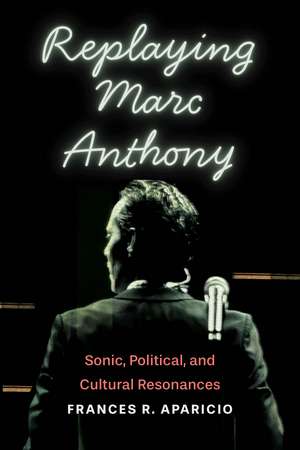
Replaying Marc Anthony: Sonic, Political, and Cultural Resonances: Global Latin/o Americas
Autor Frances R. Aparicioen Limba Engleză Paperback – 4 sep 2025
Replaying Marc Anthony is the first book-length study of Marc Anthony’s cultural, aesthetic, and political contributions to Latinx popular music and Latinx communities. Despite the trivializing label of “Latino pop,” Anthony’s repertoire has had a tremendous impact on his audience, particularly within the US Latinx community. Considering his music outside of limiting frameworks imposed by the music industry, Frances R. Aparicio situates Anthony’s songs within specific musical genealogies and histories, demonstrating that his songs not only foster healing from colonial violence but also produce, textually and sonically, multiple identities that resonate with his listeners. Relistening to five of Anthony’s most canonical songs—“Preciosa,” “Hasta Que Te Conocí,” “I Need to Know,” “Aguanile,” and “Vivir Mi Vida”—Aparicio traces the circulation of these sonic texts, examining their social, cultural, gender, and political meanings. Among the myriad topics Marc Anthony’s music critically reflects on are Puerto Rican and Diasporican itinerant subjectivities, Blackness, environmental crises, MexiRican sonic exchanges, Latinidad, masculinities, struggles with belonging as an “American,” and Global South solidarities.















Preț: 256.48 lei
Puncte Express: 385
Carte tipărită la comandă
Livrare economică 01-15 decembrie
Livrare prin curier în România Termenul estimat este afișat lângă disponibilitate.
Transport gratuit de la 400.00 lei Plată online sau ramburs, în funcție de opțiunile comenzii.
Retur gratuit în 14 zile Comandă securizată și suport în română.
Specificații
ISBN-13: 9780814259573
ISBN-10: 081425957X
Pagini: 194
Ilustrații: 8 b&w images
Dimensiuni: 152 x 229 x 15 mm
Greutate: 0.27 kg
Editura: Ohio State University Press
Colecția Ohio State University Press
Seria Global Latin/o Americas
ISBN-10: 081425957X
Pagini: 194
Ilustrații: 8 b&w images
Dimensiuni: 152 x 229 x 15 mm
Greutate: 0.27 kg
Editura: Ohio State University Press
Colecția Ohio State University Press
Seria Global Latin/o Americas
Recenzii
“Aparicio builds cultural bridges across the diasporas of the Americas, offering readers new methods of interpretations for voices that go unnoticed and/or unheard. Replaying Marc Anthony will serve as a model to other authors who write on the relationship between song and identity politics.” —Jacqueline Avila, author of Cinesonidos: Film Music and National Identity during Mexico’s Época de Oro
“Aparicio makes a case for pop music studies to be taken seriously as a form of politics, linking Anthony’s songs to broader issues within Latinx and Puerto Rican studies—homeland and diaspora, gender and racial politics, cultural links between Latinxs and other groups, and more.” —Petra Rivera-Rideau, author of Remixing Reggaetón: The Cultural Politics of Race in Puerto Rico
“[Replaying Marc Anthony] is an example of how personal, critical reflection works as research and can be embraced in scholarly publications....This work is a valuable contribution for scholars and students in ethnomusicology, musicology, communication studies, and studies of rhetoric.” —Triauna Carey, Critical Studies in Media Communication
Notă biografică
Frances R. Aparicio is Professor Emerita in the Department of Spanish and Portuguese at Northwestern University. She is the author of Negotiating Latinidad: Intralatina/o Lives in Chicago and Listening to Salsa: Gender, Latin Popular Music, and Puerto Rican Cultures, among other books, and coeditor of various critical anthologies.
Extras
I thus open this book around the significance of songs, as I aim to unsettle commonsense notions about popular music and about Marc Anthony as a Latin pop singer. Despite the impressive critical scholarship that has examined the functions of popular music in the Western world, lingering public perceptions tend to trivialize the serious value of Latino pop songs in our lives because of their formulaic or repetitious nature or because of how popular songs are produced and circulated by the industry. Despite the fact that popular singers in salsa, hip hop and reggaetón today are having a profound impact on their listeners’ awareness of social and political issues—and here I highlight Bad Bunny as the epitome of this power—many scholars still tend to bracket these voices as secondary to more serious and established music, whether it is classical music, opera, or even folklore music from around the world. The commercialized structures of Latino pop music and the celebrity status of many of its interpreters somehow diminish the authenticity of pop songs in the eyes of many scholars. For instance, I was told by a colleague that Marc Anthony cannot be listened to as a political singer given his celebrity status and his financial wealth, thus foreclosing any possible approach to understanding the social, cultural, and political meanings behind his repertoire. For many, then, Latino pop music continues to be deemed mere entertainment, void of powerful meanings for its audiences.
In this book, I exhort readers to “replay” and critically listen to Marc Anthony’s songs not exclusively as texts but with an approach that recognizes and legitimates the even more serious work of sonic aesthetics, intimate listening, musical genealogies, and cultural resonance. Entertainment journalists write that Marc Anthony’s key musical formula is “infusing slow, romantic ballads with the fast-driving energy of salsa.” These statements tend to reify el Marc’s repertoire as a formulaic salsa romántica, which it is not; they dangerously elide the very sophisticated and dynamic arrangements that have made his music resonate with such a vast and heterogeneous community of listeners. Initially curious as to Marc Anthony’s immense impact on his community of listeners, fans, and followers, and the public love that he receives from his adoring fans, I embarked on this research to understand more fully the power of some of his songs on us, the Latinx community in the US and in the hemispheric Americas. Despite the general perception against him for inserting salsa music into pop arrangements, the fact is that his selection of songs and his talent in curating his repertoire have truly resonated with the historical and political moments that have affected Latinx communities, both in the United States as well as throughout Latin America. This book, then, repositions Marc Anthony as a listener himself, a singer who has listened to a rich, heterogeneous archive of musical traditions, from boleros to salsa, from R&B to hip hop, from rock to Algerian raï music, and who integrates and proposes a dialogue with these otherwise disparate sounds in his arrangements. Approaching Marc Anthony not exclusively as a singer but as a “listener” reimagines him as a public figure who acknowledges the sonic artistry and craft of others, finds inspiration in them, and thus positions himself within the longer genealogies of US, Puerto Rican, Latin American, and Algerian musics, engaging in sonic and musical dialogues and exchanges through his creative arrangements and performances. Ultimately, my purpose in the reflections that follow is to share my personal critical listenings about how five of his songs have strongly resonated with me and with so many of his listeners and fans. When songs “resonate,” “they are connected to audiences’ socially situated conditions or to broader cultural themes and narratives that they recognize.” Resonance also involves the possibility of “revising people’s desires and imagining of what is possible.” I also examine how the songs have circulated and accrued a history of their own as cultural texts and how they have become canonical among US Latinx communities, hemispherically throughout Latin America and globally as well. I hope that these personal, critical reflections about his songs may help to explain Marc Anthony’s status as a musical phenomenon, a superstar, yet one whose status as a celebrity does not preclude his songs from functioning as serious sonic labor, that is, as social spaces shaped through his sounds, which produce the intimacy of listening that blends the book across autohistory, musical analysis, and aesthetic political critique.
In this book, I exhort readers to “replay” and critically listen to Marc Anthony’s songs not exclusively as texts but with an approach that recognizes and legitimates the even more serious work of sonic aesthetics, intimate listening, musical genealogies, and cultural resonance. Entertainment journalists write that Marc Anthony’s key musical formula is “infusing slow, romantic ballads with the fast-driving energy of salsa.” These statements tend to reify el Marc’s repertoire as a formulaic salsa romántica, which it is not; they dangerously elide the very sophisticated and dynamic arrangements that have made his music resonate with such a vast and heterogeneous community of listeners. Initially curious as to Marc Anthony’s immense impact on his community of listeners, fans, and followers, and the public love that he receives from his adoring fans, I embarked on this research to understand more fully the power of some of his songs on us, the Latinx community in the US and in the hemispheric Americas. Despite the general perception against him for inserting salsa music into pop arrangements, the fact is that his selection of songs and his talent in curating his repertoire have truly resonated with the historical and political moments that have affected Latinx communities, both in the United States as well as throughout Latin America. This book, then, repositions Marc Anthony as a listener himself, a singer who has listened to a rich, heterogeneous archive of musical traditions, from boleros to salsa, from R&B to hip hop, from rock to Algerian raï music, and who integrates and proposes a dialogue with these otherwise disparate sounds in his arrangements. Approaching Marc Anthony not exclusively as a singer but as a “listener” reimagines him as a public figure who acknowledges the sonic artistry and craft of others, finds inspiration in them, and thus positions himself within the longer genealogies of US, Puerto Rican, Latin American, and Algerian musics, engaging in sonic and musical dialogues and exchanges through his creative arrangements and performances. Ultimately, my purpose in the reflections that follow is to share my personal critical listenings about how five of his songs have strongly resonated with me and with so many of his listeners and fans. When songs “resonate,” “they are connected to audiences’ socially situated conditions or to broader cultural themes and narratives that they recognize.” Resonance also involves the possibility of “revising people’s desires and imagining of what is possible.” I also examine how the songs have circulated and accrued a history of their own as cultural texts and how they have become canonical among US Latinx communities, hemispherically throughout Latin America and globally as well. I hope that these personal, critical reflections about his songs may help to explain Marc Anthony’s status as a musical phenomenon, a superstar, yet one whose status as a celebrity does not preclude his songs from functioning as serious sonic labor, that is, as social spaces shaped through his sounds, which produce the intimacy of listening that blends the book across autohistory, musical analysis, and aesthetic political critique.
Cuprins
Contents
List of Illustrations
Introduction The Singer as Listener
Chapter 1 “Preciosa” (1998): Diasporican Subjectivities and the Sounds of Itinerancy
Chapter 2 “Hasta Que Te Conocí” (1993): Latinidad as Suffering
Chapter 3 “I Need to Know” (1999): Singing in English and the Sonic Struggles for Americanness
Chapter 4 “Aguanile” (2007): Critical Listening, Mourning, and Decolonial Healing
Chapter 5 “Vivir Mi Vida” (2013): Toward a Critical Salsa Romántica and a Global South Brownness
Coda Listening as Struggle
Acknowledgments
References
Index
List of Illustrations
Introduction The Singer as Listener
Chapter 1 “Preciosa” (1998): Diasporican Subjectivities and the Sounds of Itinerancy
Chapter 2 “Hasta Que Te Conocí” (1993): Latinidad as Suffering
Chapter 3 “I Need to Know” (1999): Singing in English and the Sonic Struggles for Americanness
Chapter 4 “Aguanile” (2007): Critical Listening, Mourning, and Decolonial Healing
Chapter 5 “Vivir Mi Vida” (2013): Toward a Critical Salsa Romántica and a Global South Brownness
Coda Listening as Struggle
Acknowledgments
References
Index
Descriere
The first book-length study of Marc Anthony’s cultural, aesthetic, and political contributions to Latinx popular music, Latinx communities, and Global South solidarities.