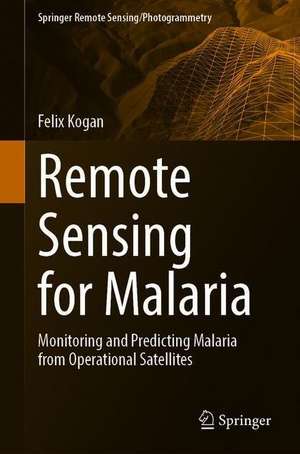
Remote Sensing for Malaria: Springer Remote Sensing/Photogrammetry
Autor Felix Koganen Limba Engleză Hardback – 21 iul 2020
In-depth information in monitoring signs of malaria from operational polar-orbiting satellites
Examples of country-specific models for predicting malaria area (1 and 4 km2 resolution) and intensity
Information on the how the effects of climate change on malaria outbreak area and intensity can be monitored
A new Vegetation Health (VH) methodology to estimate vegetation moisture, temperature and moisture/temperature conditions as indicators of malaria vector activity
Advice to userson the application of VH technology for early assessments of malaria area, intensity and risk level
Remote Sensing for Malaria is intended for an audience of public health practitioners, environmentalists, and students and researchers working in spatial epidemiology and disease prevention.
Din seria Springer Remote Sensing/Photogrammetry
- 24%
 Preț: 970.86 lei
 - 15%
 Preț: 666.74 lei
 - 18%
 Preț: 813.09 lei
 - 18%
 Preț: 984.66 lei
 - 18%
 Preț: 927.75 lei
 - 18%
 Preț: 1152.85 lei
 - 18%
 Preț: 730.56 lei
 - 18%
 Preț: 980.83 lei
 - 18%
 Preț: 1291.39 lei
 - 18%
 Preț: 1154.31 lei
 - 24%
 Preț: 825.37 lei
 - 24%
 Preț: 1022.88 lei
 - 18%
 Preț: 1148.61 lei
 - 20%
 Preț: 614.43 lei
 - 18%
 Preț: 1047.06 lei
 - 24%
 Preț: 1010.19 lei
 - 18%
 Preț: 948.87 lei
 - 18%
 Preț: 858.07 lei
 - 18%
 Preț: 861.03 lei
 - 18%
 Preț: 1041.97 lei
 - 24%
 Preț: 909.79 lei
 - 24%
 Preț: 862.78 lei
 - 24%
 Preț: 926.77 lei
Preț: 651.74 lei
Preț vechi: 814.67 lei
-20%
Puncte Express: 978
Carte tipărită la comandă
Livrare economică 23-28 noiembrie
Livrare prin curier în România Termenul estimat este afișat lângă disponibilitate.
Transport gratuit pentru acest produs Plată online sau ramburs, în funcție de opțiunile comenzii.
Retur gratuit în 14 zile Comandă securizată și suport în română.
Specificații
ISBN-13: 9783030460198
ISBN-10: 3030460193
Pagini: 304
Ilustrații: XVI, 286 p. 89 illus., 76 illus. in color.
Dimensiuni: 160 x 241 x 21 mm
Greutate: 0.63 kg
Ediția:1st ed. 2020
Editura: Springer
Colecția Springer Remote Sensing/Photogrammetry
Seria Springer Remote Sensing/Photogrammetry
Locul publicării:Cham, Switzerland
ISBN-10: 3030460193
Pagini: 304
Ilustrații: XVI, 286 p. 89 illus., 76 illus. in color.
Dimensiuni: 160 x 241 x 21 mm
Greutate: 0.63 kg
Ediția:1st ed. 2020
Editura: Springer
Colecția Springer Remote Sensing/Photogrammetry
Seria Springer Remote Sensing/Photogrammetry
Locul publicării:Cham, Switzerland
Cuprins
Chapter 1-Introduction. Chapter 2-Malaria burden. Chapter 3-Malaria vector and environment. Chapter 4-Satellite sensors. Chapter 5-Vegetation health technology. Chapter 6-Modeling malaria vector and disease. Chapter 7-Climate warming and changes in malaria tendencies and distribution. Chapter 8-Malaria monitoring and prediction.
Notă biografică
Dr. Felix Kogan is a physical scientist at NOAA/NESDIS, Center for Satellite Application and Research (STAR). He is a developer of satellite-based Vegetation Health (VH) method and VH applications. His research interests include drought detection and monitoring, VH-yield modeling, fire risk, malaria monitoring, vegetation stress assessment, climate and land cover change, VH data distribution, etc. He has authored around 170 publications including three books. He received his MS degree from USSR’s Odessa Hydrometeorological Institute and his PhD from USSR’s Hydrometeorological Center in Moscow.
Textul de pe ultima copertă
This book presents research using high-resolution operational satellite data for monitoring and assessing numerically how to reduce the area and intensity of malaria outbreaks. Satellite data and imageries a powerful and effective tool for malaria monitoring and reduction of the number of affected people as it bypasses the limitations imposed by the dearth of near-the-ground weather data in many malaria-prone areas. With this in mind, this volume provides readers with:
In-depth information in monitoring signs of malaria from operational polar-orbiting satellites
Examples of country-specific models for predicting malaria area (1 and 4 km2 resolution) and intensity
Information on the how the effects of climate change on malaria outbreak area and intensity can be monitored
A new Vegetation Health (VH) methodology to estimate vegetation moisture, temperature and moisture/temperature conditions as indicators of malaria vector activity
Advice to users on theapplication of VH technology for early assessments of malaria area, intensity and risk level
Remote Sensing for Malaria is intended for an audience of public health practitioners, environmentalists, and students and researchers working in spatial epidemiology and disease prevention.
In-depth information in monitoring signs of malaria from operational polar-orbiting satellites
Examples of country-specific models for predicting malaria area (1 and 4 km2 resolution) and intensity
Information on the how the effects of climate change on malaria outbreak area and intensity can be monitored
A new Vegetation Health (VH) methodology to estimate vegetation moisture, temperature and moisture/temperature conditions as indicators of malaria vector activity
Advice to users on theapplication of VH technology for early assessments of malaria area, intensity and risk level
Remote Sensing for Malaria is intended for an audience of public health practitioners, environmentalists, and students and researchers working in spatial epidemiology and disease prevention.