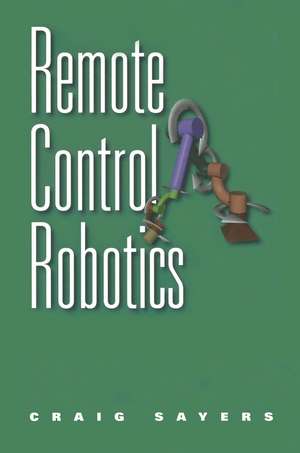
Remote Control Robotics
Autor Craig Sayersen Limba Engleză Paperback – 23 oct 2012
Preț: 617.26 lei
Preț vechi: 726.18 lei
-15%
Puncte Express: 926
Carte tipărită la comandă
Livrare economică 07-21 decembrie
Livrare prin curier în România Termenul estimat este afișat lângă disponibilitate.
Transport gratuit pentru acest produs Plată online sau ramburs, în funcție de opțiunile comenzii.
Retur gratuit în 14 zile Comandă securizată și suport în română.
Specificații
ISBN-13: 9781461271406
ISBN-10: 1461271401
Pagini: 256
Ilustrații: XIX, 224 p.
Dimensiuni: 155 x 235 x 15 mm
Greutate: 0.39 kg
Ediția:Softcover reprint of the original 1st ed. 1999
Editura: Springer
Locul publicării:New York, NY, United States
ISBN-10: 1461271401
Pagini: 256
Ilustrații: XIX, 224 p.
Dimensiuni: 155 x 235 x 15 mm
Greutate: 0.39 kg
Ediția:Softcover reprint of the original 1st ed. 1999
Editura: Springer
Locul publicării:New York, NY, United States
V-ar putea interesa
-
 Piping Systems ManualBrian Silowash-40%Preț: 720.29 lei1202.98 lei
 -
 A Guide to the Collision Avoidance RulesA. N. Cockcroft-29%Preț: 423.12 lei598.89 lei
 -
 Sensors for MechatronicsPaul P.L. Regtien-24%Preț: 458.73 lei604.92 lei
 -
 An Introduction to Mechanical Engineering: Part 2Michael Clifford-8%Preț: 468.83 lei509.60 lei
 -
 Implicit Large Eddy SimulationGrinstein Fernando F.-11%Preț: 450.44 lei506.10 lei
 -
 Production Planning and ControlW. Bolton-14%Preț: 457.30 lei531.75 lei
 -
 CNC Control Setup for Milling and TurningPeter Smid-20%Preț: 651.03 lei813.79 lei
 -
 Mechanical Engineers¿ HandbookMyer Kutz-23%Preț: 4181.75 lei5430.84 lei
 -
 Race Car DesignDerek Seward-23%Preț: 419.81 lei542.71 lei
 -
 Stirling Engine Design ManualWilliam R. MartiniPreț: 279.96 lei
 -
 Degradation of Implant MaterialsNoam Eliaz-18%Preț: 918.47 lei1120.08 lei
 -
 An Introduction to Design of Solar Water Heating SystemsJ. Paul GuyerPreț: 170.74 lei
 -
 Nonlinear Oscillations in Mechanical EngineeringAlexander Fidlin-15%Preț: 625.57 lei735.96 lei
 -
 Mechatronic Control of Distributed Noise and Vibration: A Lyapunov ApproachChristopher D. Rahn-15%Preț: 618.83 lei728.03 lei
 -
 Micromechanics of Contact and Interphase LayersS. Stupkiewicz-15%Preț: 664.79 lei782.11 lei
 -
 Grundlagen des LeichtbausHorst Kossira-18%Preț: 889.98 lei1085.34 lei
 -
 Thermal Stress Resistance of MaterialsAnatoly Lanin-18%Preț: 977.52 lei1192.10 lei
 -
 Torsion and Shear Stresses in ShipsMohamed Shama-18%Preț: 914.06 lei1114.71 lei
 -
 -15%Preț: 667.23 lei784.98 lei
 -
 Distributed Autonomous Robotic Systems 7Maria Gini-18%Preț: 983.39 lei1199.26 lei
 -
 Distributed Autonomous Robotic Systems 4L. E. Parker-15%Preț: 680.99 lei801.16 lei
 -
 -15%Preț: 671.53 lei790.03 lei
 -
 Automotive Mechatronics: Operational and Practical IssuesB. T. Fijalkowski-18%Preț: 1194.66 lei1456.91 lei
Public țintă
ResearchCuprins
1 Introduction.- 1.1 The fundamental tradeoff.- 1.2 Automation.- 1.3 Subsea robotics.- 1.4 Chapter overview.- 2 Basics.- 2.1 Single link robot.- 2.2 Two-link toy.- 2.3 Two-link robot.- 2.4 Forward and inverse kinematics.- 2.5 Redundancy.- 2.6 Moving out of the page.- 2.7 Input devices.- 2.8 Summary.- 3 Historical Perspective.- 3.1 Traditional bilateral teleoperation systems.- 3.2 Giving up force feedback.- 3.3 Other teleoperation systems.- 3.4 Operator aids.- 3.5 Increasingly inter-site distances.- 3.6 Summary.- 4 Remote Control.- 4.1 Control of remote cameras.- 4.2 Controlling a remote machine.- 4.3 Summary.- 5 Teleprogramming.- 5.1 Background.- 5.2 Operation.- 5.3 The fundamental tradeoff.- 5.4 Caches.- 5.5 Summary.- 6 A Natural Operator Interface.- 6.1 The teleprogramming operator interface.- 6.2 Creating a natural interface.- 6.3 The degree-of-freedom problem.- 6.4 Summary.- 7 Synthetic Fixtures.- 7.1 Overview.- 7.2 Operation.- 7.3 Terminology.- 7.4 Command fixtures.- 7.5 Example applications.- 7.6 Algorithm.- 7.7 Application to teleprogramming.- 7.8 Application to conventional teleoperation.- 7.9 Application to virtual reality.- 7.10 Alternative input devices.- 7.11 Summary.- 8 Visual Imagery.- 8.1 Camera calibration.- 8.2 Updating the world model.- 8.3 Real-time visual imagery.- 8.4 Intelligent fragmentation.- 8.5 Intelligent frame rate.- 8.6 Intelligent task rate.- 8.7 Compression algorithms.- 8.8 Other sensory modalities.- 8.9 Future implementations.- 8.10 Summary.- 9 Expecting the Unexpected.- 9.1 Definition.- 9.2 Avoiding operator error.- 9.3 Avoiding interpretation errors.- 9.4 Predicting errors.- 9.5 Error detection and diagnosis.- 9.6 Error recovery.- 9.7 Summary.- 10 Command Generation and Interpretation.- 10.1 Master-to-slave teleprogramming language.- 10.2 Slave-to-master teleprogramming language.- 10.3 Delaying command execution.- 10.4 Adding additional sensory feedback.- 10.5 Summary.- 11 Results and Observations.- 11.1 Laboratory trials.- 11.2 Test-tank trials.- 11.3 Migrating to a subsea system.- 11.4 The October experiments.- 11.5 The November experiments.- 11.6 Future implementations.- 12 Discussion.- 12.1 Bandwidth considerations.- 12.2 Programming by demonstration.- 12.3 Learning experience.- 12.4 Interacting with uncertainty.- 12.5 The virtual reality mirage.- 12.6 Future interfaces.- 12.7 The distant future.- 13 Conclusions.- A.1 Operator interaction with the master station.- A.1.1 The user interface.- A.1.2 The world model.- A.1.3 Interpreting operator action.- A.2 Master-to-slave communication.- A.2.1 Basic definitions.- A.2.2 The command stream.- A.2.3 Pre-motion commands.- A.2.4 Motion commands.- A.2.5 Post-motion commands.- A.2.6 Example command stream.- A.2.7 Telemetry.- A.3 Command execution at the slave site.- A.4 Slave-to-master communication.- A.4.1 The state message.- A.4.2 The reply stream.- A.4.3 The environment reply.- A.4.4 The error reply.- A.4.5 Example reply stream.- A.4.6 Telemetry.- A.5 Interpreting slave replies.- A.6 Maintaining and reviewing the historical record.- References.
Caracteristici
Begins with a basic introduction to the fundamentals of robot control Considers the important problems to be overcome: delays or noisy control lines, feedback and response information, and predictive displays Readers are assumed to have a basic understanding of robotics though this may be their first exposure to the subject of telerobotics