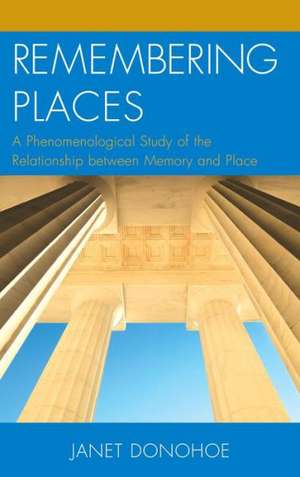
Remembering Places: A Phenomenological Study of the Relationship between Memory and Place: Toposophia: Thinking Place/Making Space
Autor Janet Donohoeen Limba Engleză Hardback – 18 iun 2014








Preț: 593.88 lei
Preț vechi: 910.19 lei
-35%
Puncte Express: 891
Carte tipărită la comandă
Livrare economică 08-22 decembrie
Livrare prin curier în România Termenul estimat este afișat lângă disponibilitate.
Transport gratuit pentru acest produs Plată online sau ramburs, în funcție de opțiunile comenzii.
Retur gratuit în 14 zile Comandă securizată și suport în română.
Specificații
ISBN-13: 9780739187166
ISBN-10: 0739187163
Pagini: 159
Ilustrații: 4 b/w illustrations;
Dimensiuni: 160 x 232 x 18 mm
Greutate: 0.42 kg
Editura: Bloomsbury Publishing
Colecția Lexington Books
Seria Toposophia: Thinking Place/Making Space
Locul publicării:New York, United States
ISBN-10: 0739187163
Pagini: 159
Ilustrații: 4 b/w illustrations;
Dimensiuni: 160 x 232 x 18 mm
Greutate: 0.42 kg
Editura: Bloomsbury Publishing
Colecția Lexington Books
Seria Toposophia: Thinking Place/Making Space
Locul publicării:New York, United States
V-ar putea interesa
-
 NauseaJean-Paul SartrePreț: 78.69 lei
 -
 Existentialism: A Very Short IntroductionThomas Flynn-19%Preț: 57.46 lei71.12 lei
 -
 The Measure of Things: Humanism, Humility, and MysteryDavid E. Cooper-11%Preț: 364.12 lei408.17 lei
 -
 Thomas Hobbes: Writings on Common Law and Hereditary RightAlan Cromartie-22%Preț: 381.20 lei491.33 lei
 -
 Objectivity and InsightMark Sacks-27%Preț: 360.56 lei492.55 lei
 -
 Phenomenology and Philosophy of MindDavid Woodruff Smith-28%Preț: 394.33 lei548.70 lei
 -
 Irrational ManWilliam BarrettPreț: 100.30 lei
 -
 Existentialism and HumanismJean-Paul SartrePreț: 75.97 lei
 -
 Introduction to PhenomenologyDermont MoranPreț: 387.08 lei
 -
 Between Man and ManMartin BuberPreț: 141.66 lei
 -
 The Jargon of AuthenticityTheodor AdornoPreț: 139.94 lei
 -
 Body Images: Embodiment as IntercorporealityGail WeissPreț: 409.25 lei
 -
 Essays on Heidegger and OthersRichard RortyPreț: 203.14 lei
 -
 PathmarksMartin HeideggerPreț: 214.93 lei
 -
 Heidegger Being and TimePaul GornerPreț: 360.83 lei
 -
 Introduction to PhenomenologyRobert SokolowskiPreț: 195.48 lei
 -
 Genesis and Structure of Hegel's "Phenomenology of Spirit"Jean HyppolitePreț: 244.23 lei
Cuprins
Chapter One: A Phenomenology of Memory and Place
Chapter Two: From Individual to Collective Memory
Chapter Three: Collective Memory, Place, and Mourning
Chapter Four: A Hermeneutics of Monuments
Chapter Five: Conclusions
Chapter Two: From Individual to Collective Memory
Chapter Three: Collective Memory, Place, and Mourning
Chapter Four: A Hermeneutics of Monuments
Chapter Five: Conclusions
Recenzii
Phenomenology is distinctive in that it attends not only to the everyday, ordinary, and mundane dimensions of existence, but also specifically considers such dimensions as they are experienced. Donohoe argues that the complicated relationship between memory, tradition, and place is fundamentally important to all lived experience. Place is what allows for collective memory, and such memory is what constitutes the traditions by which one finds oneself attached to specific places. Working in light of Edmund Husserl, Martin Heidegger, and Maurice Merleau-Ponty, and in conversation with the phenomenological accounts of place and memory offered by Ed Casey and Gaston Bachelard, Donohoe offers a compelling account of place as a palimpsest-a form of writing that allows what has been erased to remain visible. Suggesting that memory works in the same way, Donohoe opens productive ways to think about lived experience by considering how such experience always occurs somewhere. By focusing on location and then reflecting on the meaning generated by it, Donohoe enables phenomenology to be even more careful concerning the task of philosophizing. Summing Up: Recommended. Upper-level undergraduates through researchers/faculty.
The book offers a couple of original insights to the field. . . . [and] succeeds in shedding light on a number of important questions that still remain unresolved in the field.
True to its title, Janet Donohoe's Remembering Places, is an eloquent and evocative recollection of the intimate connection of place with memory and of memory with place. Beginning with the phenomenon of home, and moving on to explore questions concerning tradition, mourning, forgetting, memorial and monument, and even contemporary virtuality, Donohoe deftly combines phenomenological and hermeneutic analysis with personal experience and reflection. Perhaps the most intriguing element in the work is the implicit suggestion that time is itself only to be found in place and in our engagement with place. This is a book that will reward careful and thoughtful reading. It makes a significant contribution to contemporary philosophical topography at the same time as it also enacts the very task that it enjoins us towards.
Janet Donohoe's reflections on collective memory and tradition bring an important new dimension to discussions of the phenomenology of place. Thoughtful and readable, the work reminds us that places are more than static containers but themselves are the material embodiment and conditions of the possibility of experience.
Focusing largely on the lived dimensions of monuments and memorials, Janet Donohoe draws on phenomenological and hermeneutic perspectives to explore the complex relationship between place, memory, and history. The study includes a helpful overview of phenomenological research on place; particularly valuable is Donohoe's perceptive clarification of phenomenologist Edmund Husserl's co-constituted concepts of homeworld and alienworld. She examines how places provide not only settings for human life but also help shape memory, tradition, and a lived sense of history. Lastly, Donohoe offers a thoughtful philosophical discussion of the personal and collective value of monuments and memorials as they evoke existential and historical meanings through an intensified ambience of place. Donohoe's book is an important phenomenological contribution to the growing interdisciplinary literature on place studies.
The book offers a couple of original insights to the field. . . . [and] succeeds in shedding light on a number of important questions that still remain unresolved in the field.
True to its title, Janet Donohoe's Remembering Places, is an eloquent and evocative recollection of the intimate connection of place with memory and of memory with place. Beginning with the phenomenon of home, and moving on to explore questions concerning tradition, mourning, forgetting, memorial and monument, and even contemporary virtuality, Donohoe deftly combines phenomenological and hermeneutic analysis with personal experience and reflection. Perhaps the most intriguing element in the work is the implicit suggestion that time is itself only to be found in place and in our engagement with place. This is a book that will reward careful and thoughtful reading. It makes a significant contribution to contemporary philosophical topography at the same time as it also enacts the very task that it enjoins us towards.
Janet Donohoe's reflections on collective memory and tradition bring an important new dimension to discussions of the phenomenology of place. Thoughtful and readable, the work reminds us that places are more than static containers but themselves are the material embodiment and conditions of the possibility of experience.
Focusing largely on the lived dimensions of monuments and memorials, Janet Donohoe draws on phenomenological and hermeneutic perspectives to explore the complex relationship between place, memory, and history. The study includes a helpful overview of phenomenological research on place; particularly valuable is Donohoe's perceptive clarification of phenomenologist Edmund Husserl's co-constituted concepts of homeworld and alienworld. She examines how places provide not only settings for human life but also help shape memory, tradition, and a lived sense of history. Lastly, Donohoe offers a thoughtful philosophical discussion of the personal and collective value of monuments and memorials as they evoke existential and historical meanings through an intensified ambience of place. Donohoe's book is an important phenomenological contribution to the growing interdisciplinary literature on place studies.