
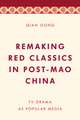
Remaking Red Classics in Post-Mao China: TV Drama as Popular Media: Media, Culture and Communication in Asia-Pacific Societies
Autor Qian Gongen Limba Engleză Hardback – 22 mar 2021



Preț: 607.53 lei
Preț vechi: 910.79 lei
-33%
Puncte Express: 911
Carte tipărită la comandă
Livrare economică 02-16 decembrie
Livrare prin curier în România Termenul estimat este afișat lângă disponibilitate.
Transport gratuit pentru acest produs Plată online sau ramburs, în funcție de opțiunile comenzii.
Retur gratuit în 14 zile Comandă securizată și suport în română.
Specificații
ISBN-13: 9781786609250
ISBN-10: 1786609258
Pagini: 176
Dimensiuni: 162 x 227 x 21 mm
Greutate: 0.47 kg
Editura: Bloomsbury Publishing
Colecția Rowman & Littlefield
Seria Media, Culture and Communication in Asia-Pacific Societies
Locul publicării:New York, United States
ISBN-10: 1786609258
Pagini: 176
Dimensiuni: 162 x 227 x 21 mm
Greutate: 0.47 kg
Editura: Bloomsbury Publishing
Colecția Rowman & Littlefield
Seria Media, Culture and Communication in Asia-Pacific Societies
Locul publicării:New York, United States
Cuprins
Acknowledgements
Introduction: Revolution and TV Drama: The Uneasy Bedfellows in the Reform Era
Chapter 1: TV Dramas as Market Commodities, Cultural Artifacts and Social Practices
Chapter 2: Hybridising the Red Classics in Post-Mao China: The Production and Consumption Context
Chapter 3: From Chief to Chef: Remoulding Heroes
Chapter 4: Getting the Right Mix: Revolutionary Women and Contemporary Femininity
Chapter 5: Living Red: Production, Consumption and Local Memory of Revolutionary Culture in Linyi
Chapter 6 The Question of Faith in TV Drama Series
Conclusion
Filmography
Bibliography
Introduction: Revolution and TV Drama: The Uneasy Bedfellows in the Reform Era
Chapter 1: TV Dramas as Market Commodities, Cultural Artifacts and Social Practices
Chapter 2: Hybridising the Red Classics in Post-Mao China: The Production and Consumption Context
Chapter 3: From Chief to Chef: Remoulding Heroes
Chapter 4: Getting the Right Mix: Revolutionary Women and Contemporary Femininity
Chapter 5: Living Red: Production, Consumption and Local Memory of Revolutionary Culture in Linyi
Chapter 6 The Question of Faith in TV Drama Series
Conclusion
Filmography
Bibliography
Recenzii
Stories of the Chinese revolution are deeply ingrained in the collective memories of the Chinese nation, and TV drama has turned out to be the most effective and affective cultural form in retelling these stories. This engaging and nuanced book offers a fascinating window on this highly dynamic and very intriguing facet of contemporary Chinese cultural politics.
Rigorously researched, highly informative, and convincingly argued, Qian Gong's study of Red Classic adaptations is a compelling examination of the key role played by TV drama in the formation of social identities. Through attentive recourse to textual analyses and interviews, Remaking Red Classics in Post-Mao China situates its case studies within broad historical, economic, social and cultural contexts, offering an original and thought-provoking analysis of the permutations of socialist culture in contemporary China.
Gong's book is a theoretically sophisticated and engaging study on a significant phenomenon - the revival of Red Classics through the highly commercialized genre of TV drama in today's China. No other scholar has previously surveyed this phenomenon in such detail. With rich data and insight, the book shows how legacies of revolution become cultural capital, intertwined with nostalgia, commercial drive, and identity construction, in post-socialist China.
What Gong has achieved, in fact, is a study that fully appreciates Chinese exceptionalism while revealing more universal, or at least anthropological, processes that the Chinese state and its popular drama share with others and with the past.
Remaking Red Classics in Post-Mao China makes a signi?cant contribution to existing scholarship in Chinese television studies and on the Red Classics and their remakes. The book's literature review is extensive, and Gong's analysis of earlier works is frequently both incisive and informative. Gong provides comprehensive examination of works by notable scholars in the ?eld of Red Classic remakes, such as Li Yang, Richard King and Rosemary Roberts. Additionally, she analyzes relevant television and cultural studies theories, notably Althusser and his theory of interpellation, which is applied to her discussion of the TV dramas. The need for interpellation to be a primary theory applied to the Red Classic TV remakes is explained well. Gong's book is also useful not only for Chinese scholars but also for outsiders looking to learn more about contemporary culture and society in the People's Republic.
Rigorously researched, highly informative, and convincingly argued, Qian Gong's study of Red Classic adaptations is a compelling examination of the key role played by TV drama in the formation of social identities. Through attentive recourse to textual analyses and interviews, Remaking Red Classics in Post-Mao China situates its case studies within broad historical, economic, social and cultural contexts, offering an original and thought-provoking analysis of the permutations of socialist culture in contemporary China.
Gong's book is a theoretically sophisticated and engaging study on a significant phenomenon - the revival of Red Classics through the highly commercialized genre of TV drama in today's China. No other scholar has previously surveyed this phenomenon in such detail. With rich data and insight, the book shows how legacies of revolution become cultural capital, intertwined with nostalgia, commercial drive, and identity construction, in post-socialist China.
What Gong has achieved, in fact, is a study that fully appreciates Chinese exceptionalism while revealing more universal, or at least anthropological, processes that the Chinese state and its popular drama share with others and with the past.
Remaking Red Classics in Post-Mao China makes a signi?cant contribution to existing scholarship in Chinese television studies and on the Red Classics and their remakes. The book's literature review is extensive, and Gong's analysis of earlier works is frequently both incisive and informative. Gong provides comprehensive examination of works by notable scholars in the ?eld of Red Classic remakes, such as Li Yang, Richard King and Rosemary Roberts. Additionally, she analyzes relevant television and cultural studies theories, notably Althusser and his theory of interpellation, which is applied to her discussion of the TV dramas. The need for interpellation to be a primary theory applied to the Red Classic TV remakes is explained well. Gong's book is also useful not only for Chinese scholars but also for outsiders looking to learn more about contemporary culture and society in the People's Republic.