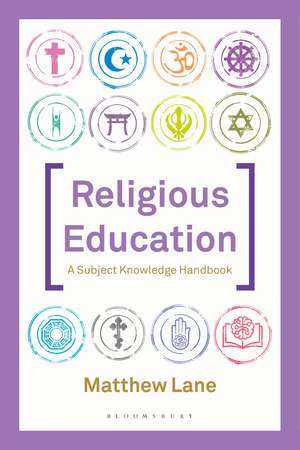
Religious Education: A Subject Knowledge Handbook
Autor Matthew Laneen Limba Engleză Paperback – 3 apr 2027
Spanning creation myths, ethical frameworks, denominations and scriptures, knowledge is fully cross-referenced and organised by theme, making it equally useful whatever your curriculum or syllabus. This unique format asks the same questions of each religion and worldview: who or what is God? Where do we come from? How do we know? How do we live? What is the goal of life? What is the path to reach the goal? Each religion's section of abstract knowledge is accompanied by teaching suggestions that bring its ideas off the page and into the classroom. Accessible and comprehensive, this is an indispensable guide for every teacher of Religious Education.
Preț: 185.66 lei
Preț vechi: 205.43 lei
-10% Precomandă
Puncte Express: 278
Carte nepublicată încă
Livrare prin curier în România Precomanda se expediază când titlul devine disponibil.
Transport gratuit de la 400.00 lei Plată online sau ramburs, în funcție de opțiunile comenzii.
Retur gratuit în 14 zile Comandă securizată și suport în română.
Doresc să fiu notificat când acest titlu va fi disponibil:
Se trimite...
Specificații
ISBN-13: 9781350570276
ISBN-10: 1350570273
Pagini: 240
Dimensiuni: 156 x 234 x 28 mm
Greutate: 0.5 kg
Editura: Bloomsbury Publishing
Colecția Bloomsbury Academic
Locul publicării:London, United Kingdom
ISBN-10: 1350570273
Pagini: 240
Dimensiuni: 156 x 234 x 28 mm
Greutate: 0.5 kg
Editura: Bloomsbury Publishing
Colecția Bloomsbury Academic
Locul publicării:London, United Kingdom
Cuprins
Section 1 Who or what is the ultimate reality?
1.1 Structure of god(s)
1.2 Types of Theism
1.3 Nature of god(s)
Section 2 Where did we come from?
2.1 Creation Stories
2.2 The purpose of existence
2.3 Afterlife
Section 3 How do we know?
3.1 Scripture
3.2 Revelation
3.3 Authority of Religious leaders
Section 4 Who are we? How do we live?
4.1 Nature of humans
4.2 The problem of evil and suffering
4.3 The role of the planet
4.4 Religious denominations
Section 5 What is the Goal?
5.1 What is the ultimate state?
5.2 Why do we need this ultimate state?
Section 6 What is the Path to achieve the Goal?
6.1 Rules and Rituals
6.1.1 Ethics and Rules
6.1.2 Rituals and Disciplines
6.2 Practices: Milestones, Festivals and Worship
6.2.1 Birth & Initiation
6.2.2 Death & Funerary Rites
6.2.3 Festivals & Holy days
6.2.4 Collective worship & Pilgrimage
1.1 Structure of god(s)
1.2 Types of Theism
1.3 Nature of god(s)
Section 2 Where did we come from?
2.1 Creation Stories
2.2 The purpose of existence
2.3 Afterlife
Section 3 How do we know?
3.1 Scripture
3.2 Revelation
3.3 Authority of Religious leaders
Section 4 Who are we? How do we live?
4.1 Nature of humans
4.2 The problem of evil and suffering
4.3 The role of the planet
4.4 Religious denominations
Section 5 What is the Goal?
5.1 What is the ultimate state?
5.2 Why do we need this ultimate state?
Section 6 What is the Path to achieve the Goal?
6.1 Rules and Rituals
6.1.1 Ethics and Rules
6.1.2 Rituals and Disciplines
6.2 Practices: Milestones, Festivals and Worship
6.2.1 Birth & Initiation
6.2.2 Death & Funerary Rites
6.2.3 Festivals & Holy days
6.2.4 Collective worship & Pilgrimage
Recenzii
'Matthew Lane has written a generous, thoughtful and eminently enjoyable handbook for a subject that matters deeply. Religious Education asks some of the biggest questions in human life: who we are, where we come from, how we know, and how we live well together. This book helps teachers approach those questions with confidence, clarity and care. This elegant book is rich in subject knowledge, attentive to complexity, and rooted in respect for religions and worldviews as living traditions. I can see it becoming the standard text to support the teaching of RE: for initial teacher training programmes, early career teachers, classroom teachers and curriculum leaders alike. It has all the hallmarks of a classic.'
'This is a must-have resource for any primary school teacher seeking a concise and accessible reference guide to a wide range of religious beliefs and worldviews. Each clearly structured section centres on a core question about belief and life, thoughtfully explored through both religious and non-religious perspectives. User-friendly and easy to navigate, this book is an excellent tool for building a comprehensive understanding of RE, especially for non-specialist teachers. Its clarity and structure make it an indispensable addition to any teacher's professional library.'
'Subject knowledge development for teachers is so often neglected. This is a tragedy because greater confidence in the substance of our subject leads to more passionate teaching, better questions, clearer answers, and inspires a love of the subject. Religious Education is a serious, well- structured, delicious companion for teachers getting ready to tackle a subject that can feel intimidating. The structure of Professor Ann Taves's 'six questions' makes this book feel approachable, comprehensive and coherent. I taught RE in both primary schools and at secondary, and if I'd had this book I would have done a much better job of it, and had few late nights at the laptop.'
'This is a must-have resource for any primary school teacher seeking a concise and accessible reference guide to a wide range of religious beliefs and worldviews. Each clearly structured section centres on a core question about belief and life, thoughtfully explored through both religious and non-religious perspectives. User-friendly and easy to navigate, this book is an excellent tool for building a comprehensive understanding of RE, especially for non-specialist teachers. Its clarity and structure make it an indispensable addition to any teacher's professional library.'
'Subject knowledge development for teachers is so often neglected. This is a tragedy because greater confidence in the substance of our subject leads to more passionate teaching, better questions, clearer answers, and inspires a love of the subject. Religious Education is a serious, well- structured, delicious companion for teachers getting ready to tackle a subject that can feel intimidating. The structure of Professor Ann Taves's 'six questions' makes this book feel approachable, comprehensive and coherent. I taught RE in both primary schools and at secondary, and if I'd had this book I would have done a much better job of it, and had few late nights at the laptop.'