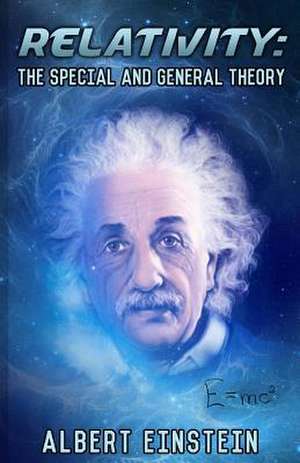
Relativity
Autor Albert Einstein Traducere de Robert W. Lawsonen Limba Engleză Paperback
. . . an exact insight into the theory of relativity to those readers who, from a general scientific and philosophical point of view, are interested in the theory, but who are not conversant with the mathematical apparatus of theoretical physics.
- from the Preface
It was first published in German in 1916 and later translated into English in 1920. It is divided into 3 parts, the first dealing with special relativity, the second dealing with general relativity and the third dealing with considerations on the universe as a whole. There have been many versions published since the original in 1916, the latest in December, 2011. The work has been labeled by whom?] unique in that it gives readers an insight into the thought processes of one of the greatest minds of the 20th century.
Preț: 68.21 lei
Carte disponibilă
Livrare economică 05-19 noiembrie
Specificații
ISBN-10: 1494944790
Pagini: 198
Dimensiuni: 140 x 216 x 11 mm
Greutate: 0.26 kg
Editura: CreateSpace Independent Publishing Platform
V-ar putea interesa
-
 The Origin of SpeciesCharles DarwinPreț: 28.01 lei
 -
 Asimov's New Guide to ScienceIsaac Asimov-22%Preț: 112.76 lei143.69 lei
 -
 Letters from a StoicSeneca-18%Preț: 59.56 lei72.56 lei
 -
 The Communist ManifestoFriedrich Engels-39%Preț: 17.49 lei28.48 lei
 -
 Classical MechanicsGeorge Hrabovsky-32%Preț: 63.31 lei92.54 lei
 -
 Quantum MechanicsLeonard Susskind-30%Preț: 65.63 lei93.77 lei
 -
 Special Relativity and Classical Field TheoryLeonard Susskind-29%Preț: 66.68 lei94.39 lei
 -
 The Story of SpinSin-itiro TomonagaPreț: 279.41 lei
 -
 -30%Preț: 742.06 lei1061.78 lei
 -
 Theoretical MinimumLeonard SusskindPreț: 104.70 lei
 -
 Lectures on Quantum MechanicsPaul A M Dirac-20%Preț: 56.47 lei70.70 lei
 -
 Mathematics for Quantum ChemistryJay Martin AndersonPreț: 79.59 lei
 -
 -32%Preț: 104.78 lei153.19 lei
 -
 The Final EmpireBrandon Sanderson-25%Preț: 82.91 lei109.86 lei
 -
 The Road to RealityRoger PenrosePreț: 199.59 lei
 -
 General Theory of RelativityP. A. M. DiracPreț: 259.95 lei
 -
 William Shakespeare's Hamlet: With sound!Anita Sipala-26%Preț: 45.63 lei61.69 lei
 -
 Nuclear PhysicsW. HeisenbergPreț: 106.94 lei
 -
 MeditationsMarcus AureliusPreț: 62.66 lei
 -
 Paths to GodRam Dass-19%Preț: 87.73 lei107.87 lei
 -
 The Book of Five RingsMiyamoto Musashi-20%Preț: 50.60 lei63.53 lei
 -
 The Principles of Quantum MechanicsP. A. M. DiracPreț: 238.63 lei
 -
 Lectures on Quantum Mechanics and Relativistic Field TheoryP. A. M. DiracPreț: 70.47 lei
 -
 Introduction to Contextual Maths in ChemistryFiona DickinsonPreț: 179.20 lei
 -
 Three Lectures on Complexity and Black HolesLeonard Susskind-15%Preț: 401.71 lei472.59 lei
 -
 General Principles of Quantum MechanicsWolfgang Pauli-18%Preț: 853.85 lei1041.28 lei
Notă biografică
Descriere
2010 Reprint of 1920 First English Edition. First English translation of Einstein's theory of relativity. In this work Einstein intended, as far as possible, to give an exact insight into the theory of Relativity to those readers who, from a general and scientific philosophical point of view, are interested in the theory, but who are not conversant with the mathematical apparatus of theoretical physics. The theory of relativity enriched physics and astronomy during the 20th century. When first published, relativity superseded a 200-year-old theory of mechanics elucidated by Isaac Newton. It changed perceptions. For example, it overturned the concept of motion from Newton's day, into all motion is relative. Time was no longer uniform and absolute, as related to everyday experience. Furthermore, no longer could physics be understood as space by itself, and time by itself. Instead, an added dimension had to be taken into account with curved space-time. Time now depended on velocity, and contraction became a fundamental consequence at appropriate speeds.
Cuprins
Recenzii
'Much of the book is a delight.' - Stephen Battersby, New Scientist
'[Einstein] is a far better populariser of science than Stephen Hawking ... you'll feel as though you have a ringside seat at a revolution in human understanding.' - Guardian