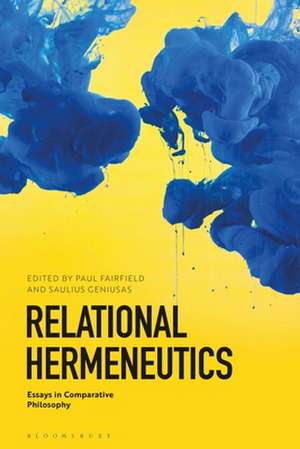
Relational Hermeneutics: Essays in Comparative Philosophy
Editat de Professor Paul Fairfield, Saulius Geniusasen Limba Engleză Paperback – 30 apr 2020
The traditions covered in this volume-existentialism, pragmatism, poststructuralism, Eastern philosophy, and hermeneutics itself-are all characterized by significant internal diversity, adding to the difficulty in reaching an interpretation that is at once comparative and critical. None of these traditions represent a unified system of belief; all are umbrella terms which are at once useful and imprecise, and the differences internal to each must not to be understated.
An innovative work of comparative philosophy, this volume avoids oversimplification and offers specific analyses that treat hermeneutics in relation to particular themes and key figures in each of these traditions of thought. Philosophical hermeneutics is explicitly dialogical, and it is in this spirit that the authors of this book approach their subjects, revealing the important affinities and opportunities for mutually enriching conversations which have until now been overlooked.
Preț: 243.01 lei
Preț vechi: 322.49 lei
-25%
Puncte Express: 365
Carte tipărită la comandă
Livrare economică 30 noiembrie-14 decembrie
Livrare prin curier în România Termenul estimat este afișat lângă disponibilitate.
Transport gratuit de la 400.00 lei Plată online sau ramburs, în funcție de opțiunile comenzii.
Retur gratuit în 14 zile Comandă securizată și suport în română.
Specificații
ISBN-13: 9781350161696
ISBN-10: 1350161691
Pagini: 272
Dimensiuni: 156 x 234 x 18 mm
Greutate: 0.38 kg
Editura: Bloomsbury Publishing
Colecția Bloomsbury Academic
Locul publicării:London, United Kingdom
ISBN-10: 1350161691
Pagini: 272
Dimensiuni: 156 x 234 x 18 mm
Greutate: 0.38 kg
Editura: Bloomsbury Publishing
Colecția Bloomsbury Academic
Locul publicării:London, United Kingdom
V-ar putea interesa
-
 Emotions in Indian Thought-SystemsPurushottama Bilimoria-15%Preț: 426.80 lei502.11 lei
 -
 -49%Preț: 748.45 lei1458.44 lei
 -
 Comparative Studies in Asian and Latin American Philosophies: Cross-Cultural Theories and MethodologiesDr Stephanie Rivera Berruz-33%Preț: 772.95 lei1148.22 lei
 -
 The Public Sphere From Outside the WestDivya Dwivedi-24%Preț: 281.35 lei371.33 lei
 -
 Imagination: Cross-Cultural Philosophical AnalysesProfessor Hans-Georg Moeller-34%Preț: 791.20 lei1205.79 lei
 -
 The Philosophical Influences of Mao Zedong: Notations, Reflections and InsightsRobert Elliott Allinson-27%Preț: 180.92 lei247.25 lei
 -
 Hermeneutics and Phenomenology: Figures and ThemesSaulius Geniusas-33%Preț: 785.33 lei1166.75 lei
 -
 Preț: 195.12 lei
 -
 Indian Epistemology and MetaphysicsJoerg TuskePreț: 684.55 lei
 -
 -45%Preț: 901.25 lei1650.73 lei
 -
 Confucian Ethics in Western DiscourseWai-ying Wong-38%Preț: 766.92 lei1245.74 lei
 -
 Sri Krishna's CommandmentsVinayak RaghuvamshiPreț: 43.79 lei
 -
 El camino del SufiIdries ShahPreț: 113.29 lei
 -
 Agni YogaAgni Yoga SocietyPreț: 125.40 lei
 -
 Letters of Helena Roerich IIHelena RoerichPreț: 126.70 lei
 -
 Hinter den SchneebergenUlli OlvediPreț: 128.65 lei
 -
 The Origins of the Horizon in Husserl's PhenomenologySaulius Geniusas-15%Preț: 667.41 lei785.19 lei
 -
 The Disbelief HabitYong Kang ChanPreț: 82.74 lei
Cuprins
Editors' Introduction: Relational Hermeneutics
Part 1: Hermeneutics and Philosophies of Existence
1. Babette Babich, "Solicitude: Heideggerian Care and Assistance"
2. Thomas W. Busch, "Sartre: From Hyperbolic Existentialism to Crypto-Hermeneutics"
3. Antonio Calcagno, "The Existentialist Reworking of Hermeneutics: Heidegger, Sartre, and de Beauvoir"
4. Andrew Wiercinski, "The Hermeneutics of Lived Time"
Part 2: Hermeneutics and Pragmatism
5. Paul Fairfield, "Hermeneutical Pragmatism"
6. Vincent Colapietro, "The Pragmatic Spiral"
7. Ramsey Eric Ramsey and Raelynn Gosse, "A Poet on Each Side of the Poem: A Hermeneutic and Democratic Demand for Engaging Tradition"
8. Saulius Geniusas, "Things as they are / Are changed upon the blue guitar: Self-Realization and Productive Imagination"
Part 3: Hermeneutics and Poststructuralism
9. Carlos Prado, "Foucault and Hermeneutics"
10. Pol Vandevelde, "Dialogue or Drama? The Role of Language as Seen by Gadamer and Foucault"
11. Marc-Antoine Vallee, "Understanding: A Violent Aim?"
12. Lisa Watrous, "Hermeneutics as Loving Understanding: Toward a Feminist Poststructuralist Hermeneutics"
Part 4: Hermeneutics and Eastern Thought
13. Nicholas Davey, "The Turning Word: Relational Hermeneutics and Aspects of Buddhist Thought"
14. Eric S. Nelson, "Confucian Relational Hermeneutics, the Emotions, and Ethical Life"
15. David Chai, "Daoist Existential Hermeneutics and the Art of World-Making"
Index
Part 1: Hermeneutics and Philosophies of Existence
1. Babette Babich, "Solicitude: Heideggerian Care and Assistance"
2. Thomas W. Busch, "Sartre: From Hyperbolic Existentialism to Crypto-Hermeneutics"
3. Antonio Calcagno, "The Existentialist Reworking of Hermeneutics: Heidegger, Sartre, and de Beauvoir"
4. Andrew Wiercinski, "The Hermeneutics of Lived Time"
Part 2: Hermeneutics and Pragmatism
5. Paul Fairfield, "Hermeneutical Pragmatism"
6. Vincent Colapietro, "The Pragmatic Spiral"
7. Ramsey Eric Ramsey and Raelynn Gosse, "A Poet on Each Side of the Poem: A Hermeneutic and Democratic Demand for Engaging Tradition"
8. Saulius Geniusas, "Things as they are / Are changed upon the blue guitar: Self-Realization and Productive Imagination"
Part 3: Hermeneutics and Poststructuralism
9. Carlos Prado, "Foucault and Hermeneutics"
10. Pol Vandevelde, "Dialogue or Drama? The Role of Language as Seen by Gadamer and Foucault"
11. Marc-Antoine Vallee, "Understanding: A Violent Aim?"
12. Lisa Watrous, "Hermeneutics as Loving Understanding: Toward a Feminist Poststructuralist Hermeneutics"
Part 4: Hermeneutics and Eastern Thought
13. Nicholas Davey, "The Turning Word: Relational Hermeneutics and Aspects of Buddhist Thought"
14. Eric S. Nelson, "Confucian Relational Hermeneutics, the Emotions, and Ethical Life"
15. David Chai, "Daoist Existential Hermeneutics and the Art of World-Making"
Index
Recenzii
To find "oneself as another" (Ricoeur) - surely a great motto for unfettered minds. By exploring the role of interpretive understanding in numerous fields, Relational Hermeneutics offers convincing proof of Gadamer's claim of the differential "universality" of hermeneutical inquiry. In a time ravaged by deception and fake news, the book strikes a blow for genuine understanding across borders, thus providing a sheet anchor against myopic positivism, ethnocentrism, and arid conceptualism. One can only wish the book a broad readership, in the West and the East.
To investigate what is involved in interpreting and understanding things- literary works, sacred scripture, cryptic memos, recipes, other people, anything at all-is the task of philosophical hermeneutics. The essays collected in this volume assume this task but redirect the inquiry in a novel manner. Each essay addresses one of four traditions-existentialism, pragmatism, poststructuralism or Eastern philosophy-and discusses particular themes as they have been treated by authors belonging to that tradition. The result of this 'relational hermeneutics' is far more than just another volume of comparative philosophy. It is an unexpected new insight into how we understand ourselves.
Bringing hermeneutic philosophy into conversation with other Western and Eastern philosophical traditions, the contributors to Relational Hermeneutics track illuminating affinities and differences between hermeneutic figures such as Heidegger, Gadamer and Ricouer and existentialist, pragmatist, post-structuralist, Buddhist, Daoist and Confucian figures such as Dewey, De Beauvoir, Foucault, Irigaray and Zhuangzi. In so doing the contributors provide new insights into issues of time, the body, experience, understanding, poetry, ethics, power, emotion and "the turning word." The result is a very welcome and important volume.
To investigate what is involved in interpreting and understanding things- literary works, sacred scripture, cryptic memos, recipes, other people, anything at all-is the task of philosophical hermeneutics. The essays collected in this volume assume this task but redirect the inquiry in a novel manner. Each essay addresses one of four traditions-existentialism, pragmatism, poststructuralism or Eastern philosophy-and discusses particular themes as they have been treated by authors belonging to that tradition. The result of this 'relational hermeneutics' is far more than just another volume of comparative philosophy. It is an unexpected new insight into how we understand ourselves.
Bringing hermeneutic philosophy into conversation with other Western and Eastern philosophical traditions, the contributors to Relational Hermeneutics track illuminating affinities and differences between hermeneutic figures such as Heidegger, Gadamer and Ricouer and existentialist, pragmatist, post-structuralist, Buddhist, Daoist and Confucian figures such as Dewey, De Beauvoir, Foucault, Irigaray and Zhuangzi. In so doing the contributors provide new insights into issues of time, the body, experience, understanding, poetry, ethics, power, emotion and "the turning word." The result is a very welcome and important volume.