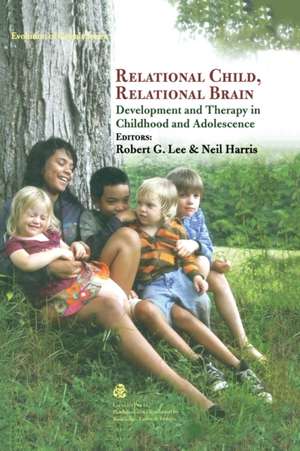
Relational Child, Relational Brain: Development and Therapy in Childhood and Adolescence
Editat de Robert G. Lee, Neil Harrisen Limba Engleză Paperback – 27 sep 2011
It builds on the foundation of contemporary views of relational neurodevelopment and the profound influence of relationship on brain growth. It shows how, particularly in the first two years of life, but continuing across the whole of childhood and adolescence into early adulthood, the relational field is the context of child development. The focus then broadens out to examine the intersubjective influence of community, culture, and social and physical support. Backed by neurobiological and related research, it offers many examples of relational Gestalt practice with children, adolescents, and their families, with stories of loss, trauma, isolation, and other adversities.
Not just an invaluable resource for child and adolescent therapists, Relational Child, Relational Brain goes beyond the Esalen Study Conference from which it emerged and is a further invitation and challenge to apply relational Gestalt practice as a coherent and effective way forward in the troubled world of today.
Preț: 292.65 lei
Carte în stoc
Livrare din stoc 21 octombrie
Specificații
ISBN-10: 041580776X
Pagini: 380
Dimensiuni: 152 x 229 x 25 mm
Greutate: 0.7 kg
Ediția:1
Editura: Taylor & Francis
Colecția Gestalt Press
Locul publicării:Oxford, United Kingdom
V-ar putea interesa
-
 A General Theory of LoveThomas LewisPreț: 101.14 lei
 -
 The Science of the Art of PsychotherapyAllan Schore-5%Preț: 365.89 lei385.15 lei
 -
 Attachment-Focused EMDRLaurel Parnell-5%Preț: 332.40 lei349.89 lei
 -
 The Interpersonal Neurobiology of PlayTheresa A. Kestly-5%Preț: 250.23 lei263.39 lei
 -
 Interpersonal Neurobiology and Clinical PracticeAllan SchorePreț: 241.60 lei
 -
 Parenting from the Inside OutDaniel J. SiegelPreț: 127.67 lei
 -
 Preț: 257.81 lei
 -
 Healing Relational Trauma WorkbookDaniel A HughesPreț: 268.78 lei
 -
 The Neuroscience of PsychotherapyLouis CozolinoPreț: 396.23 lei
 -
 Attachment in PsychotherapyDavid J. Wallin-5%Preț: 333.68 lei351.24 lei
 -
 -5%Preț: 325.23 lei342.35 lei
 -
 -5%Preț: 245.23 lei258.14 lei
 -
 The Developing Mind: The Developing MindDaniel J. Siegel-5%Preț: 530.14 lei558.04 lei
 -
 Child Development, Fourth Edition: A Practitioner's GuideDouglas Davies-15%Preț: 517.05 lei608.29 lei
 -
 Preț: 122.07 lei
 -
 -25%Preț: 149.56 lei198.99 lei
 -
 -28%Preț: 141.11 lei197.20 lei
 -
 -25%Preț: 203.77 lei272.96 lei
 -
 No-Drama DisciplineDaniel J. SiegelPreț: 122.89 lei
Public țintă
Postgraduate, Professional, and Professional Practice & DevelopmentCuprins
Part I: Theory. Wheeler, Who Are We? Narrative, Evolution, and Deployment: Our Stories and Ourselves. Lee, Shame and Belonging in Childhood: The Interaction between Relationship and Neurobiological Development in the Early Years of Life. Siegel, Attachment and Mindfulness: Paths of the Developing Brain. Part II: Support. Harris, Something in the Air: Conditions that Promote Contact when Meeting Young People Who Have Stories of Early Trauma and Loss. Norén, The Tiger Girl: A Story of Committed, Coordinated, Multilevel Support. Starrs, The Adolescent Male: Shame, Support, and Developmentally Effective Psychotherapy. McConville, Relational Modes and the Evolving Field of Parent-child Contact: A Contribution to a Gestalt Theory of Development. Part III: Applications. Tervo, Zig Zag Flop and Roll: Creating an Embodied Field for Healing and Awareness when Working with Children. Mortola, Hiton, Grant, A Different Kind of Contact for Boys: Understanding the Influences of Nature and Nurture on a Boy's Relational Style. Starrs, Working with Adolescents from a Catholic Background in Northern Ireland: A Generation's Long Accumulation of Shame. Blumenthal, Disordered Eating: A Tapestry of Relational Themes and Creative Adjustment. Blend, Am I Bovvered? A Gestalt Approach to Working with Adolescents. Mortola, You, Me, and Parts of Myself I'm Still Getting to Know: An Interview with Violet Oaklander on the Role of the Relational Triangle in Her Approach to Therapeutic Work with Children and Adolescents.
Notă biografică
Robert G. Lee, Ph.D., is a faculty member for the Advanced Child and Adolescent Program at the Gestalt Institute of Cleveland, Ohio, USA, and a visiting faculty member of a number of Gestalt training programs worldwide. An editor at Gestalt Press, he is the author of The Voice of Shame (1996), The Values of Connection (2004), and The Secret Language of Intimacy (2008). He maintains a private practice in Newton, Massachusetts, USA
Neil Harris, M.A., is a Consultant Child Psychiatrist for Family Futures Consortium, London, UK, and works with the Child and Adolescent Mental Health Service on Guernsey in the Channel Islands. He maintains a private psychotherapy and supervision practice in Bransgore, Dorset, UK
Recenzii
"Not just an invaluable resource for child and adolescent therapists and a delightful narrative, this book sets a new foundation for what it means to be a relational Gestalt psychotherapist today. It connects relationships and brain growth, in the process providing the neurobiological underpinnings of the organism/environment's ability to cope with the complexity of social life, which is the heart of the Gestalt model." - Margherita Spagnuolo Lobb, Director, Istituto di Gestalt HCC, Italy
"This book sets a milestone in the advancement of Gestalt therapy thinking and practice in the 21st century. It is a finely woven tapestry of current advances in child development, relationships, and neurobiology, all held within the integrative framework of Gestalt therapy." - Brian O'Neill, Director, Illawarra Gestalt Centre, Australia
Descriere
Volume II in the Evolution of Gestalt series, Relational Child, Relational Brain continues the development of the paradigm shift that places human development in a field that is deeply complex and fundamentally one of interconnection, taking us away from the limiting view of us as separate individuals.
It builds on the foundation of contemporary views of relational neurodevelopment and the profound influence of relationship on brain growth. It shows how, particularly in the first two years of life, but continuing across the whole of childhood and adolescence into early adulthood, the relational field is the context of child development. The focus then broadens out to examine the intersubjective influence of community, culture, and social and physical support. Backed by neurobiological and related research, it offers many examples of relational Gestalt practice with children, adolescents, and their families, with stories of loss, trauma, isolation, and other adversities.
Not just an invaluable resource for child and adolescent therapists, Relational Child, Relational Brain goes beyond the Esalen Study Conference from which it emerged and is a further invitation and challenge to apply relational Gestalt practice as a coherent and effective way forward in the troubled world of today.