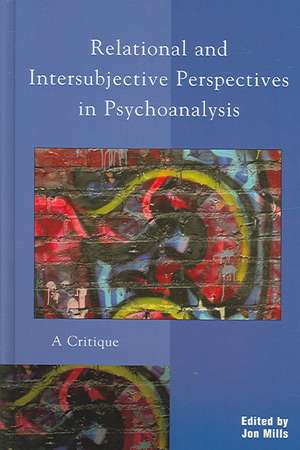
Relational and Intersubjective Perspectives in Psychoanalysis: A Critique
Editat de Jon Mills Contribuţii de Roger Frie, Bruce Ries, M Guy Thompson, Jon Frederickson, Peter L. Giovacchini, Philip Giovacchini, Frank Summers, Timothy J. Zeddies, David L. Downing, Marilyn Nissim-Sabat, Robert Langs, Gershon J. Molad, Judith E. Vida, Robert S. Wallersteinen Limba Engleză Hardback – 20 mai 2005
Preț: 673.65 lei
Preț vechi: 1007.68 lei
-33%
Puncte Express: 1010
Carte tipărită la comandă
Livrare economică 20 noiembrie-04 decembrie
Livrare prin curier în România Termenul estimat este afișat lângă disponibilitate.
Transport gratuit pentru acest produs Plată online sau ramburs, în funcție de opțiunile comenzii.
Retur gratuit în 14 zile Comandă securizată și suport în română.
Specificații
ISBN-13: 9780765701084
ISBN-10: 0765701081
Pagini: 382
Dimensiuni: 173 x 236 x 27 mm
Greutate: 0.61 kg
Editura: Bloomsbury Publishing
Colecția Jason Aronson Inc
Locul publicării:New York, United States
ISBN-10: 0765701081
Pagini: 382
Dimensiuni: 173 x 236 x 27 mm
Greutate: 0.61 kg
Editura: Bloomsbury Publishing
Colecția Jason Aronson Inc
Locul publicării:New York, United States
V-ar putea interesa
-
 Great Ideas Civilization and Its DiscontentsSigmund Freud-21%Preț: 43.93 lei55.48 lei
 -
 WinnicottAdam Phillips-32%Preț: 62.58 lei92.11 lei
 -
 Interpreting DreamsSigmund Freud-27%Preț: 80.49 lei110.21 lei
 -
 Freud: A Very Short IntroductionAnthony Storr-20%Preț: 56.99 lei71.20 lei
 -
 Divine Therapy: Love, Mysticism and PsychoanalysisJanet Sayers-26%Preț: 942.43 lei1279.81 lei
 -
 The Portable Kristeva 2eJulia KristevaPreț: 297.31 lei
 -
 Transference And ProjectionJan Grant-28%Preț: 191.11 lei264.34 lei
 -
 Gandhi's TruthErik Homburger EriksonPreț: 200.10 lei
 -
 A Critical Dictionary of Jungian AnalysisAndrew SamuelsPreț: 403.95 lei
 -
 When the Body Speaks: The Archetypes in the BodyMara Sidoli-5%Preț: 332.03 lei349.51 lei
 -
 Answer to JobC. G. JungPreț: 136.75 lei
 -
 Preț: 209.76 lei
 -
 The Cambridge Companion to JungPolly Young-EisendrathPreț: 282.14 lei
 -
 A Life of JungRonald Hayman-29%Preț: 99.22 lei139.85 lei
 -
 Melanie KleinMeira Likierman-11%Preț: 165.57 lei185.80 lei
 -
 Jung & the Alchemical ImaginationJeffrey RaffPreț: 121.56 lei
 -
 How To Read LacanSlavoj ZizekPreț: 76.41 lei
Cuprins
Chapter 1 Intersubjectivity: From Theory Through Practice
Chapter 2 Phenomenology of Intersubjectivity: An Historical Overview and its Clinical Implications
Chapter 3 The Problem of Relationality
Chapter 4 Subjectivity and the Ephemeral Mind
Chapter 5 Object Relations and Intersubjectivity
Chapter 6 Creation and Discovery in the Psychoanalytic Process
Chapter 7 Moral Deliberation and Relationality in the Analytic Dyad
Chapter 8 Somnolence in the Therapeutic Encounter
Chapter 9 Where Do We Go From Here? Relational Psychoanalysis, Intersubjectivity, and the Struggle Against Positivism
Chapter 10 Relational Perspectives and the Strong Adaptive Paradigm of Communicative Psychoanalysis
Chapter 11 The Autobiographical Dialogue in the Dialogue Between Analysts
Chapter 12 Process Psychology
Chapter 13 Psychoanalysis the Relational Turn and Philosophy
Chapter 2 Phenomenology of Intersubjectivity: An Historical Overview and its Clinical Implications
Chapter 3 The Problem of Relationality
Chapter 4 Subjectivity and the Ephemeral Mind
Chapter 5 Object Relations and Intersubjectivity
Chapter 6 Creation and Discovery in the Psychoanalytic Process
Chapter 7 Moral Deliberation and Relationality in the Analytic Dyad
Chapter 8 Somnolence in the Therapeutic Encounter
Chapter 9 Where Do We Go From Here? Relational Psychoanalysis, Intersubjectivity, and the Struggle Against Positivism
Chapter 10 Relational Perspectives and the Strong Adaptive Paradigm of Communicative Psychoanalysis
Chapter 11 The Autobiographical Dialogue in the Dialogue Between Analysts
Chapter 12 Process Psychology
Chapter 13 Psychoanalysis the Relational Turn and Philosophy
Recenzii
All those with an interest in the philosophical underpinnings of current psychoanalytic debates and controversies will want to read Relational and Intersubjective Perspectives in Psychoanalysis. These papers are often tendentious and contentious, but perhaps just on this account they provoke thought and force a clarification of fundamental assumptions and a confrontation with key questions in our field.
...contains much thoughtful and provocative writing. This book will be of interest to mental health professionals who want detailed explanations of the theoretical, particularly philosophical basis for contemporary psychoanalysis, and to academic psychotherapists and philosophers with a direct interest in the subject.
This book is a superb indictment of the philosophical pretensions of relational and intersubjective theory. Well written and carefully edited, Jon Mills manages what no one else has done: to place contemporary psychoanalytic theory in historical and intellectual context. The papers are informed, fair where appropriate, and stinging in their criticism where needed.
...contains much thoughtful and provocative writing. This book will be of interest to mental health professionals who want detailed explanations of the theoretical, particularly philosophical basis for contemporary psychoanalysis, and to academic psychotherapists and philosophers with a direct interest in the subject.
This book is a superb indictment of the philosophical pretensions of relational and intersubjective theory. Well written and carefully edited, Jon Mills manages what no one else has done: to place contemporary psychoanalytic theory in historical and intellectual context. The papers are informed, fair where appropriate, and stinging in their criticism where needed.