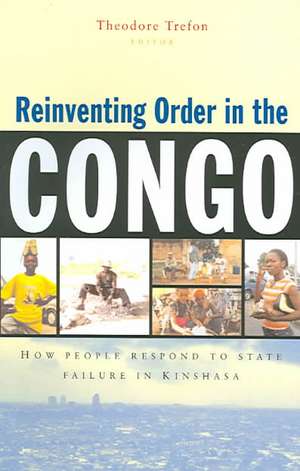
Reinventing Order in the Congo: How People Respond to State Failure in Kinshasa
Editat de Theodore Trefonen Limba Engleză Paperback – dec 2004
This book describes how ordinary people, in the absence of formal sector jobs, hustle for a modest living; the famous 'bargaining' system ordinary Kinois have developed; and how they access food, water supplies, health and education. The NGO-ization of service provision is analysed, as is the quite rare incidence of urban riots. The contributors also look at popular discourses, including street rumor, witchcraft, and attitudes to 'big men' such as musicians and preachers. This is urban sociology at its best - richly empirical, unjargonized, descriptive of the lives of ordinary people, and weaving into its analysis how they see and experience life.
Preț: 212.90 lei
Preț vechi: 256.05 lei
-17%
Puncte Express: 319
Carte tipărită la comandă
Livrare economică 20 noiembrie-04 decembrie
Livrare prin curier în România Termenul estimat este afișat lângă disponibilitate.
Transport gratuit de la 400.00 lei Plată online sau ramburs, în funcție de opțiunile comenzii.
Retur gratuit în 14 zile Comandă securizată și suport în română.
Specificații
ISBN-13: 9781842774915
ISBN-10: 1842774913
Pagini: 236
Dimensiuni: 138 x 216 x 14 mm
Greutate: 0.3 kg
Ediția:New.
Editura: Bloomsbury Publishing
Colecția Zed Books
Locul publicării:London, United Kingdom
ISBN-10: 1842774913
Pagini: 236
Dimensiuni: 138 x 216 x 14 mm
Greutate: 0.3 kg
Ediția:New.
Editura: Bloomsbury Publishing
Colecția Zed Books
Locul publicării:London, United Kingdom
V-ar putea interesa
-
 GoebbelsPeter Longerich-17%Preț: 104.12 lei124.80 lei
 -
 German WarNicholas Stargardt-25%Preț: 93.70 lei125.32 lei
 -
 Decolonization: A Very Short IntroductionDane Kennedy-20%Preț: 56.15 lei70.53 lei
 -
 KL: A History of the Nazi Concentration CampsNikolaus Wachsmann-24%Preț: 95.44 lei125.50 lei
 -
 The Long Sixties – America, 1955–1973CB StrainPreț: 273.03 lei
 -
 Red PlentyFrancis SpuffordPreț: 94.61 lei
 -
 Preț: 278.95 lei
 -
 The Invention of RussiaArkady Ostrovsky-29%Preț: 66.21 lei93.51 lei
 -
 -25%Preț: 172.25 lei229.95 lei
 -
 Guerrillas: War and Peace in Central AmericaDirk Kruijt-17%Preț: 245.73 lei295.09 lei
 -
 -16%Preț: 259.42 lei308.38 lei
 -
 Thabo Mbeki and the Battle for the Soul of the ANCWilliam Mervin Gumede-14%Preț: 286.80 lei334.27 lei
 -
 Berlin 1936Oliver HilmesPreț: 153.27 lei
Recenzii
The contributors provide multiple perspectives through which to theorize African urbanization.
This is a pioneering work whose relevance extends well beyond the confines of Kinshasa, and applies not only to Africa, but also to other so-called "developing" areas.
This is an outstanding social anthropology of Kinshasa in the context of state collapse, the development of numerous survival strategies for food, water, healthcare and dealing with the sickness and death of loved ones, together with the mushrooming of NGOs dependent on external assistance for coping with the tragedy.
A superb contribution to our understanding of the informal economy of sub-Saharan Africa's second largest city.
This is a pioneering work whose relevance extends well beyond the confines of Kinshasa, and applies not only to Africa, but also to other so-called "developing" areas.
This is an outstanding social anthropology of Kinshasa in the context of state collapse, the development of numerous survival strategies for food, water, healthcare and dealing with the sickness and death of loved ones, together with the mushrooming of NGOs dependent on external assistance for coping with the tragedy.
A superb contribution to our understanding of the informal economy of sub-Saharan Africa's second largest city.