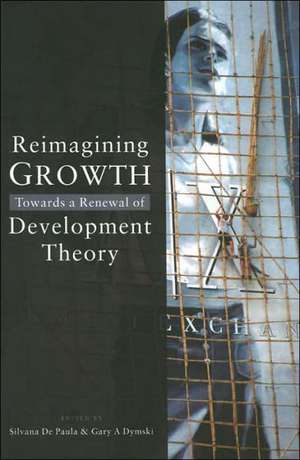
Reimagining Growth: Towards a Renewal of Development Theory
Editat de Silvana De Paula, Gary A. Dymskien Limba Engleză Paperback – 17 mai 2005
The contributors want to rethink economics as a discipline and development as a process. Economics needs to redefine many of its concepts to reflect the complex realities of functioning economies. And development needs to be reconceived as a process of social change, in which each country's particular history and institutional workings take centre stage. They point the way to a much more sophisticated understanding of economic development. The ultimate prize, if theory can be grounded in a more accurate analysis of social change, is policies that really will deliver higher economic growth and greater social justice worldwide.
Preț: 259.41 lei
Preț vechi: 336.64 lei
-23%
Puncte Express: 389
Carte tipărită la comandă
Livrare economică 21 noiembrie-05 decembrie
Livrare prin curier în România Termenul estimat este afișat lângă disponibilitate.
Transport gratuit de la 400.00 lei Plată online sau ramburs, în funcție de opțiunile comenzii.
Retur gratuit în 14 zile Comandă securizată și suport în română.
Specificații
ISBN-13: 9781842775851
ISBN-10: 1842775855
Pagini: 320
Dimensiuni: 150 x 232 x 20 mm
Greutate: 0.48 kg
Editura: Bloomsbury Publishing
Colecția Zed Books
Locul publicării:London, United Kingdom
ISBN-10: 1842775855
Pagini: 320
Dimensiuni: 150 x 232 x 20 mm
Greutate: 0.48 kg
Editura: Bloomsbury Publishing
Colecția Zed Books
Locul publicării:London, United Kingdom
V-ar putea interesa
-
 -18%Preț: 490.29 lei600.47 lei
 -
 Development Policy of the European UnionMartin HollandPreț: 292.29 lei
 -
 Preț: 390.30 lei
 -
 Preț: 284.78 lei
 -
 BangladeshDavid LewisPreț: 294.84 lei
 -
 Key Concepts in Development GeographyRob PotterPreț: 388.57 lei
 -
 -16%Preț: 175.86 lei209.71 lei
 -
 -21%Preț: 136.49 lei172.61 lei
 -
 -22%Preț: 217.37 lei278.49 lei
 -
 -20%Preț: 171.51 lei213.92 lei
 -
 -10%Preț: 141.47 lei157.44 lei
 -
 -5%Preț: 115.35 lei120.79 lei
 -
 -22%Preț: 148.60 lei189.63 lei
 -
 A New Blueprint for a Green EconomyEdward B. BarbierPreț: 402.79 lei
 -
 Innovation in Seed Potato Systems in Eastern AfricaPeter Gildemacher-12%Preț: 184.73 lei208.80 lei
Cuprins
Part I: Framing the Problem
1. Introduction - Silvana De Paula and Gary A. Dymski
2. The Planned Development of Latin America: A Rhetorical Analysis of Three Documents from the 1950s - Ana Maria Bianchi
3. The Other Canon and Uneven Growth : The Activity-specifc Elements of Economic Development - Erik S. Reinert
Part II: Rethinking the Role of Institutions and Macrostructures in Development
4. Institutions and Economic Development: Constraining, Enabling and Reconstituting - Geoffrey M. Hodgson
5. The Role of Institutions in Economic Change - Ha-Joon Chang and Peter Evans
6. Banking and Financing of Development: A Schumpeterian and Minskyian Perspective - Jan Kregel and Leonardo Burlamaqui
Part III: Rethinking the Microstructure of Development: Individuals and Communities in Global and Local Spaces
7. Consumer Society: What Opportunities for New Expressions of Citizenship and Control? - John Wilkinson
8. Society, Community, and Economic Development - Michael Storper
9. Poverty and Social Discrimination: A Spatial Keynesian Approach - Gary A. Dymski
Part IV: Rethinking the Participatory Process: Local and Global Connections
10. The World Social Forum: A Space for the Translation of Diversity in Social Mobilization - Nelson Giordano Delgado and Jorge O. Romano
1. Introduction - Silvana De Paula and Gary A. Dymski
2. The Planned Development of Latin America: A Rhetorical Analysis of Three Documents from the 1950s - Ana Maria Bianchi
3. The Other Canon and Uneven Growth : The Activity-specifc Elements of Economic Development - Erik S. Reinert
Part II: Rethinking the Role of Institutions and Macrostructures in Development
4. Institutions and Economic Development: Constraining, Enabling and Reconstituting - Geoffrey M. Hodgson
5. The Role of Institutions in Economic Change - Ha-Joon Chang and Peter Evans
6. Banking and Financing of Development: A Schumpeterian and Minskyian Perspective - Jan Kregel and Leonardo Burlamaqui
Part III: Rethinking the Microstructure of Development: Individuals and Communities in Global and Local Spaces
7. Consumer Society: What Opportunities for New Expressions of Citizenship and Control? - John Wilkinson
8. Society, Community, and Economic Development - Michael Storper
9. Poverty and Social Discrimination: A Spatial Keynesian Approach - Gary A. Dymski
Part IV: Rethinking the Participatory Process: Local and Global Connections
10. The World Social Forum: A Space for the Translation of Diversity in Social Mobilization - Nelson Giordano Delgado and Jorge O. Romano
Recenzii
Reimagining Growth is a collection of interesting and provocative pieces in that they renew development schemas, models and theories. Historical experience, political conflicts and other development perspectives are part of the analyses presented. This book's new visions, interpretations and language allow us to better understand development.
Reimagining Growth excavates and restores the rich traditions of Prebisch, Keynes, Minsky, Schumpeter and Veblen and applies them to problems of economic development in the rubble left by the Washington Consensus. These subtle papers find unity in commitment to robust institutions, anchored in democratic legitimacy and in respect for the diversity of needs, conditions, and policies arising around the world. In giving this commitment new theoretical form, Reimagining Growth goes far toward emancipating development economics from the straitjackets of neoclassical thought.
This book is essential reading for those who care about the future of economic development. For the past quarter-century, development policy was put at the service of orthodox economic theory. The results have been poor: inequality has increased in a large number of countries, the rate of growth has been frustrating in most of the developing world and macroeconomic crises have been frequent. Now development theory must be put at the service of equity and development. Reimagining Growth takes up this challenge, addressing such major issues as national and intra-national power relations, social inequality and discrimination, innovation, and financial fragility. Some of the chapters introduce the reader to new ways of understanding democracy from below, while inviting the reader to find new arenas and ways of creating it. This book moves us closer to a new, broader conceptual basis for economic development.
Reimagining Growth excavates and restores the rich traditions of Prebisch, Keynes, Minsky, Schumpeter and Veblen and applies them to problems of economic development in the rubble left by the Washington Consensus. These subtle papers find unity in commitment to robust institutions, anchored in democratic legitimacy and in respect for the diversity of needs, conditions, and policies arising around the world. In giving this commitment new theoretical form, Reimagining Growth goes far toward emancipating development economics from the straitjackets of neoclassical thought.
This book is essential reading for those who care about the future of economic development. For the past quarter-century, development policy was put at the service of orthodox economic theory. The results have been poor: inequality has increased in a large number of countries, the rate of growth has been frustrating in most of the developing world and macroeconomic crises have been frequent. Now development theory must be put at the service of equity and development. Reimagining Growth takes up this challenge, addressing such major issues as national and intra-national power relations, social inequality and discrimination, innovation, and financial fragility. Some of the chapters introduce the reader to new ways of understanding democracy from below, while inviting the reader to find new arenas and ways of creating it. This book moves us closer to a new, broader conceptual basis for economic development.