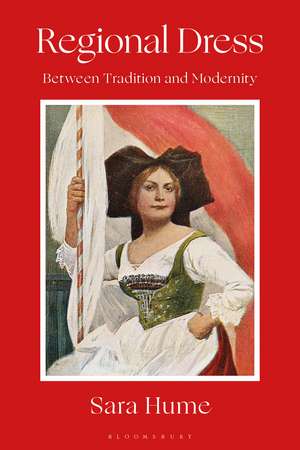
Regional Dress: Between Tradition and Modernity
Autor Sara Humeen Limba Engleză Paperback – 28 dec 2023
Specifically, Sara Hume unpacks why Alsatian dress was adopted as a symbol of loyalty to France despite being closer in style to German dress practices. She explores the impact of political and geographical tensions on the appearance and function of traditional clothing, for example in Alsace's situation at the border between France and Germany and in its transformation from disputed territory into capital of a united Europe. Logically progressing chapters reveal how modernity did not drive out tradition in rural communities but rather led to processes of adaption, preservation and re-evaluation.
Through a rich variety of primary sources including costumes, illustrations, political cartoons, legal documents and oral histories, Regional Dress sheds light on the little known and rarely documented experiences of rural Europeans. Its material culture approach to the study of regionalism is essential to students of traditional and folk dress history, European history and design history.
Preț: 198.97 lei
Preț vechi: 271.06 lei
-27%
Puncte Express: 298
Carte tipărită la comandă
Livrare economică 11-17 iunie
Specificații
ISBN-13: 9781350327733
ISBN-10: 1350327735
Pagini: 304
Ilustrații: 22 color and 63 bw illus
Dimensiuni: 152 x 232 x 20 mm
Greutate: 0.44 kg
Editura: Bloomsbury Publishing
Colecția Bloomsbury Visual Arts
Locul publicării:London, United Kingdom
ISBN-10: 1350327735
Pagini: 304
Ilustrații: 22 color and 63 bw illus
Dimensiuni: 152 x 232 x 20 mm
Greutate: 0.44 kg
Editura: Bloomsbury Publishing
Colecția Bloomsbury Visual Arts
Locul publicării:London, United Kingdom
V-ar putea interesa
-
 Fashioning Inland Communities: Trade and Popular Culture in Central East AfricaYaari Felber-Seligman-19%Preț: 470.84 lei581.28 lei
 -
 Preț: 306.38 lei
 -
 The New Taste: Fashion and Art in the 1820s and 1830sSusan L. Siegfried-17%Preț: 454.88 lei548.05 lei
 -
 Rethinking Modern Austrian Art Beyond the MetropolisJulia Secklehner-9%Preț: 1200.05 lei1318.74 lei
 -
 Carnival to Catwalk: Global Reflections on Fancy Dress CostumeBenjamin Linley Wild-19%Preț: 190.74 lei236.72 lei
 -
 Colors in FashionProfessor Jonathan Faiers-27%Preț: 237.68 lei324.75 lei
 -
 A Cultural History of Dress and Fashion in the Modern AgeProfessor Alexandra Palmer-25%Preț: 195.85 lei260.85 lei
 -
 -33%Preț: 530.99 lei793.55 lei
 -
 Lineages of ModernityEmmanuel ToddPreț: 155.43 lei
 -
 Kin, People or Nation?Victor Neumann-19%Preț: 101.51 lei124.65 lei
 -
 The SuitChristopher Breward-13%Preț: 115.38 lei132.99 lei
 -
 UnsuitableEleanor Medhurst-22%Preț: 165.16 lei212.47 lei
 -
 Street Style: Art and Dress in the Time of CaravaggioElizabeth CurriePreț: 252.95 lei
 -
 Fifty Dresses that Changed the World: Design Museum FiftyDESIGN MUSEUM ENTERPRISE LTDPreț: 116.78 lei
 -
 The Thoughtful DresserLinda Grant-26%Preț: 52.01 lei69.96 lei
 -
 Conflict and Costume: The Herero Tribe of NamibiaJim NaughtenPreț: 223.84 lei
 -
 AppearancesCarol DyhousePreț: 183.19 lei
 -
 Seasonal Matters Rural Relations (ENG edition)Seasonal Neighbours-23%Preț: 163.26 lei211.22 lei
Cuprins
List of Plates
List of Figures
List of Maps
Acknowledgements
Maps
Introduction
1. Religious Performance
Relationship between religion and dress
Processions and the performance of Catholicism
Performance of Protestantism
Other minority religious groups
Exclusion of minority religions from public spaces
Dress as ritual
Declining link between regional dress and religious observance
2. Visual Representation
Field guide to the folk
Photography of regional dress
Realism and regional dress
Book illustrations
Art Nouveau and the Alsatian Awakening
Spindler as photographer and ethnologue
Development of l'Alsacienne as a symbol of Alsace
3. Material Goods
Basic components of rural Alsatian wardrobes
Shift to coordinating outfits
Quantity and value of clothing
Evolution of special occasion wear
Development of retail in Alsace
Introduction of department stores
Home based industrial production
Education and apprenticeship for craftspeople
Apprenticeships in the interwar period
Tailoring and dressmaking in literature
4. Museum Objects
Roots of folk museums
Founding of the Musée alsacien
The collection and its acquisition
Nature of the early displays
Producing and reproducing the image of regional culture
Kermesse: masquerade and commerce
5. Living History
Non-religious festivals
Wedding processions
Turn-of-the-century festivals
Folklorization of Fête-Dieu
Folk dress in political rallies
Organization of folk groups
Nazi influence on folklore
Re-emergence of interest in folklore
Conclusion
Bibliography
Index
List of Figures
List of Maps
Acknowledgements
Maps
Introduction
1. Religious Performance
Relationship between religion and dress
Processions and the performance of Catholicism
Performance of Protestantism
Other minority religious groups
Exclusion of minority religions from public spaces
Dress as ritual
Declining link between regional dress and religious observance
2. Visual Representation
Field guide to the folk
Photography of regional dress
Realism and regional dress
Book illustrations
Art Nouveau and the Alsatian Awakening
Spindler as photographer and ethnologue
Development of l'Alsacienne as a symbol of Alsace
3. Material Goods
Basic components of rural Alsatian wardrobes
Shift to coordinating outfits
Quantity and value of clothing
Evolution of special occasion wear
Development of retail in Alsace
Introduction of department stores
Home based industrial production
Education and apprenticeship for craftspeople
Apprenticeships in the interwar period
Tailoring and dressmaking in literature
4. Museum Objects
Roots of folk museums
Founding of the Musée alsacien
The collection and its acquisition
Nature of the early displays
Producing and reproducing the image of regional culture
Kermesse: masquerade and commerce
5. Living History
Non-religious festivals
Wedding processions
Turn-of-the-century festivals
Folklorization of Fête-Dieu
Folk dress in political rallies
Organization of folk groups
Nazi influence on folklore
Re-emergence of interest in folklore
Conclusion
Bibliography
Index
Recenzii
A brilliant book that sheds new light on the history of regional dress. It is a welcome addition to fashion, costume studies and material culture with their implications with history (local and international), society, gender and politics.
Brilliantly traces the evolution of Alsatian regional dress across the 19th and 20th centuries. Sara Hume offers vivid descriptions of costume in contexts from images to museums to material culture, and uncovers regional dress as a living object which complicates our assumptions about the meanings of tradition and modernity in contemporary Europe.
Brilliantly traces the evolution of Alsatian regional dress across the 19th and 20th centuries. Sara Hume offers vivid descriptions of costume in contexts from images to museums to material culture, and uncovers regional dress as a living object which complicates our assumptions about the meanings of tradition and modernity in contemporary Europe.
Caracteristici
100 illustrations and a range of primary material are closely anaylsed giving the reader a firm grounding in Alsatian dress and the author's methodologies
Notă biografică
Sara Hume is Professor and Curator at Kent State University Museum, USA.