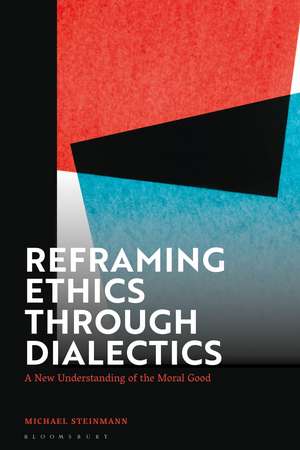
Reframing Ethics Through Dialectics: A New Understanding of the Moral Good
Autor Michael Steinmannen Limba Engleză Hardback – 23 feb 2023
As moral claims lead in various ways to contradictions, the history of morality presents itself as an endless series of controversies. By using dialectical thinking, which has gone out of favour in current philosophy, Steinmann shows how we can capture the limitations of moral theories in a more holistic way. Without embracing skepticism about moral claims, a non-naturalistic and non-relativistic understanding of the good emerges as the fundamental notion of moral thought.
Reframing Ethics Through Dialectics reinvigorates the classical notion of "the absolute good" as a fruitful conceptual structure through which to understand competing moral claims, without simply reproducing neo-Aristotelian literature on the good life. From the perspective of the good, the study allows us to take non-traditional theories more seriously, making space for moral philosophy to acknowledge and embrace the contradictions that all positions incur.
Preț: 552.55 lei
Preț vechi: 865.27 lei
-36%
Puncte Express: 829
Carte disponibilă
Livrare economică 26 octombrie-09 noiembrie
Livrare express 09-15 octombrie pentru 191.49 lei
Livrare prin curier în România Termenul estimat este afișat lângă disponibilitate.
Transport gratuit pentru acest produs Plată online sau ramburs, în funcție de opțiunile comenzii.
Retur gratuit în 14 zile Comandă securizată și suport în română.
Specificații
ISBN-13: 9781350286887
ISBN-10: 1350286885
Pagini: 280
Dimensiuni: 234 x 156 x 20 mm
Greutate: 0.57 kg
Editura: Bloomsbury Publishing
Colecția Bloomsbury Academic
Locul publicării:London, United Kingdom
ISBN-10: 1350286885
Pagini: 280
Dimensiuni: 234 x 156 x 20 mm
Greutate: 0.57 kg
Editura: Bloomsbury Publishing
Colecția Bloomsbury Academic
Locul publicării:London, United Kingdom
Cuprins
Acknowledgments
Introduction
Part I: Foundations
1. The Right Beginning
2. Morality as an Exception
3. A Different Type of Notion
4. Expressing the Good
5. The Reality of the Good
Part II: Failures
6. Five Ways of Failing the Good
7. What Moral Theories Try to Achieve
8. The Dialectics of Generality
9. The Dialectics of Reason
10. The Dialectics of Inherent Goodness
Part III: Foolishness
11. Moral Nonetheless
Notes
Bibliography
Index
Introduction
Part I: Foundations
1. The Right Beginning
2. Morality as an Exception
3. A Different Type of Notion
4. Expressing the Good
5. The Reality of the Good
Part II: Failures
6. Five Ways of Failing the Good
7. What Moral Theories Try to Achieve
8. The Dialectics of Generality
9. The Dialectics of Reason
10. The Dialectics of Inherent Goodness
Part III: Foolishness
11. Moral Nonetheless
Notes
Bibliography
Index
Recenzii
Reframing Ethics Through Dialectics is an ambitious and challenging book that addresses themes of fundamental importance to ethics. It argues that, while we ineluctably pursue the good, we must also ineluctably fail to achieve it.
Michael Steinmann's Reframing Ethics Through Dialectics represents a daring intervention in contemporary moral philosophy. Through his powerful argument that all moral theories are destined to fail because of the dialectics they inevitably fall into, Steinmann calls for a new, original approach to the practice of moral philosophy itself.
In Reframing Ethics through Dialectics: A New Conception of the Moral Good, Michael Steinmann offers a novel and well-argued defense of the relevance of the absolute good to contemporary debates in ethics. Steinmann reframes a quite old conception in a novel and interesting way. The idea of the good becomes the basis, as it was for Plato and for Hegel, for resolving the fundamental tensions and seeming contradictions between alternative conceptions of morals.
Michael Steinmann's Reframing Ethics Through Dialectics represents a daring intervention in contemporary moral philosophy. Through his powerful argument that all moral theories are destined to fail because of the dialectics they inevitably fall into, Steinmann calls for a new, original approach to the practice of moral philosophy itself.
In Reframing Ethics through Dialectics: A New Conception of the Moral Good, Michael Steinmann offers a novel and well-argued defense of the relevance of the absolute good to contemporary debates in ethics. Steinmann reframes a quite old conception in a novel and interesting way. The idea of the good becomes the basis, as it was for Plato and for Hegel, for resolving the fundamental tensions and seeming contradictions between alternative conceptions of morals.