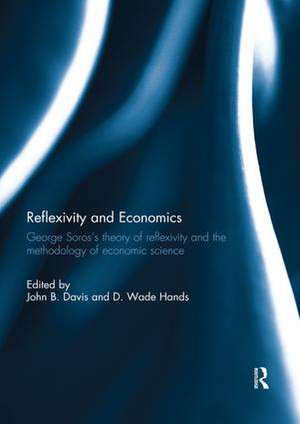
Reflexivity and Economics: George Soros's theory of reflexivity and the methodology of economic science
Editat de John Davis, D. Handsen Limba Engleză Paperback – 8 ian 2019
Although various versions of reflexivity have long been discussed, in recent years George Soros has been particularly effective in bringing ideas about reflexivity to the attention of the economic and financial communities. In a series of writings he has systematically argued that reflexivity is not only an important aspect of economic life, it is an aspect that is neglected in most mainstream theorizing; and in addition, that the neglect of reflexivity has been responsible for the failure of economists to predict, explain, or offer a solution for events such as the recent financial crisis.
Soros’ ideas about reflexivity have important methodological significance, and his chapter in this book summarizes and clarifies his arguments. His contribution is joined by those of thirteen scholars from a wide range of relevant fields, who provide a commentary on the idea of reflexivity in economics. This book was originally published as a special issue of The Journal of Economic Methodology.
Preț: 438.45 lei
Puncte Express: 658
Carte disponibilă
Livrare economică 27 octombrie-10 noiembrie
Livrare express 13-17 octombrie pentru 28.86 lei
Livrare prin curier în România Termenul estimat este afișat lângă disponibilitate.
Transport gratuit pentru acest produs Plată online sau ramburs, în funcție de opțiunile comenzii.
Retur gratuit în 14 zile Comandă securizată și suport în română.
Specificații
ISBN-13: 9780367030070
ISBN-10: 0367030071
Pagini: 166
Dimensiuni: 174 x 246 x 9 mm
Greutate: 0.31 kg
Ediția:1
Editura: Taylor & Francis
Colecția Routledge
Locul publicării:Oxford, United Kingdom
ISBN-10: 0367030071
Pagini: 166
Dimensiuni: 174 x 246 x 9 mm
Greutate: 0.31 kg
Ediția:1
Editura: Taylor & Francis
Colecția Routledge
Locul publicării:Oxford, United Kingdom
V-ar putea interesa
-
 -28%Preț: 367.88 lei511.45 lei
 -
 Economic Thought – A Brief HistoryHeinz Kurz-23%Preț: 585.90 lei760.92 lei
 -
 The Evolution of Economic Ideas and Systems: A Pluralist IntroductionGeoffrey Schneider-18%Preț: 1326.87 lei1618.14 lei
 -
 The Diffusion of Western Economic Ideas in East AsiaMalcolm WarnerPreț: 479.02 lei
 -
 -18%Preț: 1309.15 lei1596.51 lei
 -
 Economic Theory and its HistoryGiuseppe Freni-18%Preț: 769.40 lei938.29 lei
 -
 Preț: 471.36 lei
 -
 Preț: 465.84 lei
 -
 -18%Preț: 1128.77 lei1376.56 lei
 -
 Monetary Policy and Public FinanceG. C. Hockley-18%Preț: 1142.65 lei1393.47 lei
 -
 Economic Writings of James Pennington: 1826-1840R. S. SayersPreț: 448.63 lei
 -
 The Flow Analysis of Labour MarketsRonald SchettkatPreț: 464.26 lei
 -
 The Nature and Essence of Economic TheoryJoseph A. SchumpeterPreț: 454.42 lei
 -
 The Foundations of IndustrialismRobert LeRoux-23%Preț: 521.09 lei676.73 lei
 -
 On the use and misuse of theories and models in mainstream economicsLars Palsson SyllPreț: 169.16 lei
 -
 -18%Preț: 1113.42 lei1357.83 lei
 -
 Jerusalem in the Achaemenid PeriodJieun Kim-23%Preț: 510.97 lei663.59 lei
 -
 -23%Preț: 521.09 lei676.73 lei
 -
 Real Estate Valuation Theory: A Critical AppraisalManya M. Mooya-15%Preț: 671.31 lei789.78 lei
 -
 Homo Sapiens? Homo Rapiens!!Aaron Cato NirkowPreț: 165.90 lei
Public țintă
Postgraduate and UndergraduateCuprins
Introduction – Reflexivity and economics: George Soros’s theory of reflexivity and the methodology of economic science 1. Fallibility, reflexivity, and the human uncertainty principle 2. Reflexivity, complexity, and the nature of social science 3. Reflexivity unpacked: performativity, uncertainty and analytical monocultures 4. George Soros: Hayekian? 5. Reflections on Soros: Mach, Quine, Arthur and far-from-equilibrium dynamics 6. Soros’s reflexivity concept in a complex world: Cauchy distributions, rational expectations, and rational addiction 7. Hypotheses non fingo: Problems with the scientific method in economics 8. Fallibility in formal macroeconomics and finance theory 9. Reflexivity and equilibria 10. Reflexivity, expectations feedback and almost self-fulfilling equilibria: economic theory, empirical evidence and laboratory experiments 11. Soros and Popper: on fallibility, reflexivity, and the unity of method 12. Reflexivity, uncertainty and the unity of science 13. On the role of reflexivity in economic analysis 14. Broader scopes of the reflexivity principle in the economy
Descriere
The form of ‘reflexivity’ – defined by the dictionary as that which is ‘directed back upon itself’ – that is most relevant to economic methodology is that where observation of the economy leads to ideas that change behavior, which in turn changes (is directed back upon) the economy itself. This book discusses George Soros’ ideas about reflexivity and his argument that reflexivity has been neglected in mainstream theorizing, and that this neglect can be held responsible for the failure of economists to predict, explain, or offer a solution for events such as the recent financial crisis. This book was originally published as a special issue of The Journal of Economic Methodology.