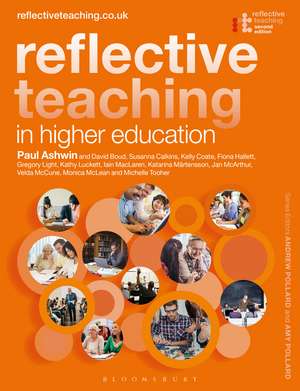
Reflective Teaching in Higher Education: Reflective Teaching
Autor David Boud, Susanna Calkins, Jan Mcarthur, Paul Ashwin, Fiona Hallett, Gregory Light, Iain MacLaren, Katarina Martensson, Kathy Luckett, Kelly Coateen Limba Engleză Paperback – 20 feb 2020
În peisajul academic actual, unde standardele de excelență pedagogică sunt într-o continuă redefinire, Reflective Teaching in Higher Education se poziționează ca un manual de referință pentru cadrele didactice aflate în orice etapă a carierei. Observăm că această a doua ediție nu se limitează la o simplă actualizare, ci integrează schimbări structurale profunde, răspunzând direct provocărilor contemporane din învățământul terțiar, de la digitalizare la echitate socială. Suntem de părere că forța acestui volum rezidă în echilibrul dintre rigoarea cercetării internaționale și aplicabilitatea imediată. Structura este organizată logic în patru secțiuni: de la explorarea identității academice și a proceselor de învățare, la crearea condițiilor optime de studiu și, în final, la strategiile concrete de predare și evaluare. Notăm cu interes includerea unor teme stringente precum decolonizarea curriculumului și utilizarea rețelelor sociale în educație, elemente care extind cadrul propus de University Teaching in Focus de Lynne Hunt cu date noi privind spațiile de învățare hibride și impactul Agendei ONU 2030. În contextul operei coordonatorului principal, Paul Ashwin, lucrarea rafinează conceptele explorate în Reflective Practice on Doctoral Education, mutând însă focusul de pe supravegherea de doctorat către procesul de predare la nivel de licență și masterat. Față de Enhancing Teaching Practice in Higher Education de Helen Pokorny, acest volum oferă o perspectivă mai globală, beneficiind de contribuțiile unei echipe vaste de experți din instituții de prestigiu mondial. Rezultatul este un ghid care nu oferă rețete fixe, ci instrumente pentru o practică reflexivă susținută, esențială pentru dezvoltarea profesională pe termen lung.





Preț: 244.22 lei
Preț vechi: 306.23 lei
-20%
Carte disponibilă
Livrare economică 19 mai-02 iunie
Livrare express 02-08 mai pentru 121.89 lei
Specificații
ISBN-10: 1350084662
Pagini: 472
Dimensiuni: 187 x 252 x 26 mm
Greutate: 0.93 kg
Ediția:2. Auflage
Editura: Bloomsbury Publishing
Colecția Reflective Teaching
Seria Reflective Teaching
Locul publicării:London, United Kingdom
De ce să citești această carte
Această carte este indispensabilă pentru universitarii care doresc să își fundamenteze metodele de predare pe dovezi științifice. Cititorul câștigă o înțelegere profundă a modului în care identitatea, mediul digital și politicile de incluziune influențează succesul studenților. Este o resursă rară care combină viziunea strategică asupra curriculumului cu tehnici practice de comunicare și evaluare, fiind ideală pentru portofoliul de dezvoltare academică.
Despre autor
Paul Ashwin este profesor de învățământ superior la Universitatea Lancaster din Marea Britanie, fiind recunoscut la nivel internațional pentru cercetările sale privind relația dintre predare, învățare și curriculum în mediul universitar. Alături de el, echipa de coautori reunește academicieni din Australia, SUA, Suedia și Africa de Sud, precum David Boud și Katarina Mårtensson. Coordonatorul seriei, Andrew Pollard, este o figură centrală în pedagogia britanică, autor al unor volume fundamentale pentru învățământul primar. Împreună, acești experți aduc o perspectivă multidisciplinară asupra profesionalismului academic contemporan.
Descriere
- practical guidance for day-to-day teaching, covering key issues such as strategies for improving learning, teaching and assessment, curriculum design, relationships, communication, and inclusion
- evidence-informed 'principle's to aid understanding of how theories can effectively inform teaching practices, offering ways to develop a deeper understanding of teaching and learning in higher education
In addition to new case studies from a wider variety of countries than ever before, this new edition includes discussion of:
- What is meant by 'agency'
- Gender, ethnicity, disability and university teaching
- Digital learning spaces and social media
- Teaching career development for academics
- Decolonising the curriculum
- Assessment and feedback practices
- Teaching excellence and 'learning gain'
- 2015 UN General Assembly 2030 Agenda for Sustainable Development
reflectiveteaching.co.uk provides a treasure trove of additional support. It includes supplementary sector specific material to support for considering questions around society's educational aims, and much more besides.
Cuprins
How to Use this Book
Introduction
Part I: Becoming Reflective
1. Identity. Who are we, and who are our students?
2. Learning. How do students develop their understanding?
3. Reflection. How can we develop the quality of our teaching?
4. Principles. What are the foundations of effective teaching and learning?
Part II: Creating Conditions for Learning
5. Contexts. How do they shape us and how do we shape them?
6. Relationships. How are we getting on together?
7. Engagement. How does our engagement with teaching influence student learning?
8. Spaces. How are we creating environments for learning?
Part III: Teaching for Learning
9. Curriculum. What is to be taught and learned?
10. Planning. How are we implementing curricula?
11. Teaching. How can we develop strategies focused on student understanding?
12. Communication. How can we support learning through dialogue?
13. Assessment. How does it make a contribution to learning?
Part IV: Reflecting on Consequences
14. Quality. How are we monitoring and enhancing the quality of teaching and learning?
15. Inclusion. How are we enabling opportunities?
Part V: Deepening Understanding
16. Expertise. How do we develop a career-long fascination with teaching?
17. Professionalism. How does reflective teaching contribute to society?
Reflective activities
List of case studies, figures and research briefings
Bibliography
Index
Recenzii
A popular and influential text. An impressive and newly constituted international team. A really up to date resource. Again, this book stands out from many others in this field. Although the book is rooted in very practical concerns, it takes its readership as a serious intellectual audience, and allows access to a field that recognises the complexity of what lecturers face.
An excellent resource for academic developers whose role it is to shape the kinds of academics who are able to respond to the legitimate learning needs of their diverse student body, to meet the challenges and demands of their disciplines and prepare students for a complex and unknowable future.
A significant collaborative achievement with Paul Ashwin again marshalling an all-star international cast in a well-executed update to their seminal text on Reflective Teaching: a cutting-edge resource for teachers and researchers
The definitive go-to handbook for supporting academic professional development, leading me to adopt it as the core recommended course reading in my professional development leadership role. The book's strengths include bringing together perspectives of a range of relevant experts, and a good blend of theory and practice, including recognisable empirical examples and activities to carry out alone or with others. The reflective focus of the book as well as its emphasis on the collaborative nature of the teaching endeavour are key strengths. This new edition further benefits from incorporation of key contemporary imperatives such as the decolonising agenda.
Pleased to find a textbook that addresses issues of the - often neglected - topics of communication and relationships in lecturing work, in addition to planning and designing the curriculum, and evaluating practice. Valuable for both new and experienced lecturers in higher education.
I have found the previous edition of this book very helpful, with a good balance between the practical and theoretical components and some excellent critical evaluation of key concepts. The 2nd edition contains new content that adds both depth and breadth to the existing material. In particular, the discussions on diversity, decolonizing, digital learning and teaching excellence are all highly relevant in the current context.