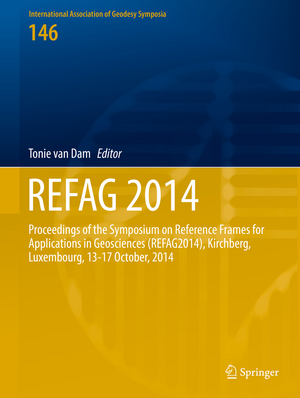
REFAG 2014: International Association of Geodesy Symposia, cartea 146
Editat de Tonie van Damen Limba Engleză Hardback – 13 apr 2017
Din seria International Association of Geodesy Symposia
- 15%
 Preț: 663.60 lei
 - 18%
 Preț: 925.86 lei
 - 18%
 Preț: 960.24 lei
 - 18%
 Preț: 971.82 lei
 -
 Preț: 429.94 lei
 -
 Preț: 434.35 lei
 -
 Preț: 418.79 lei
 -
 Preț: 394.07 lei
 - 15%
 Preț: 642.58 lei
 - 15%
 Preț: 644.75 lei
 - 15%
 Preț: 621.01 lei
 - 15%
 Preț: 619.37 lei
 - 15%
 Preț: 672.29 lei
 - 18%
 Preț: 982.11 lei
 - 15%
 Preț: 635.63 lei
 - 15%
 Preț: 635.16 lei
 - 15%
 Preț: 647.80 lei
 - 15%
 Preț: 669.25 lei
 - 15%
 Preț: 659.13 lei
 - 15%
 Preț: 667.22 lei
 - 20%
 Preț: 651.67 lei
 - 20%
 Preț: 615.71 lei
 - 18%
 Preț: 1793.80 lei
 - 18%
 Preț: 1236.28 lei
 - 18%
 Preț: 926.26 lei
 - 20%
 Preț: 643.02 lei
 - 18%
 Preț: 1174.15 lei
 - 18%
 Preț: 1186.88 lei
 - 24%
 Preț: 1162.15 lei
 - 18%
 Preț: 1231.68 lei
 - 24%
 Preț: 1315.83 lei
 - 18%
 Preț: 1236.43 lei
 - 18%
 Preț: 1233.10 lei
 - 18%
 Preț: 1184.90 lei
 - 18%
 Preț: 1239.75 lei
 - 24%
 Preț: 1200.83 lei
 - 18%
 Preț: 1194.16 lei
 - 24%
 Preț: 1256.33 lei
 - 24%
 Preț: 910.91 lei
 - 24%
 Preț: 1231.61 lei
 - 24%
 Preț: 1204.66 lei
 - 24%
 Preț: 917.19 lei
Preț: 880.11 lei
Preț vechi: 1158.04 lei
-24%
Puncte Express: 1320
Carte tipărită la comandă
Livrare economică 12-18 noiembrie
Livrare prin curier în România Termenul estimat este afișat lângă disponibilitate.
Transport gratuit pentru acest produs Plată online sau ramburs, în funcție de opțiunile comenzii.
Retur gratuit în 14 zile Comandă securizată și suport în română.
Specificații
ISBN-13: 9783319456287
ISBN-10: 3319456288
Pagini: 260
Ilustrații: XI, 246 p. 6 illus.
Dimensiuni: 215 x 285 x 20 mm
Greutate: 0.9 kg
Ediția:1st ed. 2017
Editura: Springer
Colecția International Association of Geodesy Symposia
Seria International Association of Geodesy Symposia
Locul publicării:Cham, Switzerland
ISBN-10: 3319456288
Pagini: 260
Ilustrații: XI, 246 p. 6 illus.
Dimensiuni: 215 x 285 x 20 mm
Greutate: 0.9 kg
Ediția:1st ed. 2017
Editura: Springer
Colecția International Association of Geodesy Symposia
Seria International Association of Geodesy Symposia
Locul publicării:Cham, Switzerland
V-ar putea interesa
-
 -18%Preț: 1693.06 lei2064.71 lei
 -
 Eriksen, A: Field GeophysicsJohn MilsomPreț: 265.10 lei
 -
 Seismic InterferometrySchuster Gerard ThomasPreț: 444.40 lei
 -
 Introduction to SeismologyPeter M. Shearer-11%Preț: 559.43 lei628.57 lei
 -
 3-D Seismic InterpretationM. Bacon-29%Preț: 376.76 lei533.04 lei
 -
 Physics of the EarthFrank Stacey-19%Preț: 710.28 lei876.89 lei
 -
 -23%Preț: 697.54 lei905.89 lei
 -
 Earthquake and Volcano DeformationPaul Segall-19%Preț: 695.94 lei859.18 lei
 -
 The Global Carbon CycleDavid ArcherPreț: 336.45 lei
 -
 The Physics of Rock Failure and EarthquakesMitiyasu Ohnaka-14%Preț: 709.30 lei824.77 lei
 -
 Solved Problems in GeophysicsElisa Buforn-11%Preț: 431.47 lei484.79 lei
 -
 X-Ray Fluorescence Spectrometry (XRF) in GeoarchaeologyM. Steven ShackleyPreț: 408.21 lei
 -
 Environmental Impacts of Hydraulic FracturingFrank R. Spellman-9%Preț: 1200.28 lei1318.99 lei
 -
 -26%Preț: 79.13 lei107.24 lei
 -
 Geoid DeterminationFernando Sansò-18%Preț: 1851.32 lei2257.72 lei
Cuprins
Part 1 - Theory and Concepts.- The Helmert transformation approach in network densification revisited.- A study of the role of the choice of reference system in the analysis of GNSS coordinate time series.- Validation of components of local ties.- Part 2 - Geodetic Measurement Techniques.- Combination of space-geodetic techniques on the observation level with c5++ - common nuisance parameters, data weighting and computational challenges.- The Processing of Single Differenced GNSS Data with VLBI Software.- IVS contribution to ITRF2014.- Antenna axis offsets and their impact on VLBI derived reference frames.- Scheduling VLBI observations to satellites with VieVS.- Refined Tropospheric Delay Models for CONT11.- Loading-induced deformation due to atmosphere, ocean and hydrology: Model comparisons and the impact on global SLR, VLBI and GNSS solutions.- The International Mass Loading Service.- Pre-combined GNSS-SLR Solutions: What could be the benefit for the ITRF?.- GGOS-SIM - Simulation of the Reference Frame for the Global Geodetic Observing System.- Overview of the ILRS contribution to the development of ITRF2013.- Part 3 - Regional Reference Frames.- A Spatial Analysis of Global Navigation Satellite Systems Stations within the context of the African Geodetic Reference Frame.- The development of a station coordinate prediction program to model time series from Continuous GPS stations in New Zealand.- Results from the regional AUSTRAL VLBI sessions for southern hemisphere reference frames.- Implementation of the ETRS89 in Europe: Current Status and Challenges.- Defining a Local Reference Frame using a Plate Motion Model and Deformation Model.- A Development of the Russian Geodetic Reference Network.- Weighted vs. unweighted MCs for the datum definition in regional networks.- Is Nubia plate rigid? A geodetic study of the relative motion of different cratonic areas within Africa.- Part 4 - Celestial to Terrestrial Frame Transformations.- How consistent are the current conventional celestial and terrestrial reference frames and the conventional Earth orientation parameters?.- Using quasar physics to improve the VLBI reference frame.- Towards Improved Lunar Reference Frames: LRO Orbit Determination.- Part 5 - Usage and applications of reference frames in Geosciences.- Terrestrial reference frame requirements for studies of geodynamics and climate change.- Advantage of the North America Land Data Assimilation System Phase 2 (NLDAS-2) products in modeling continental water storage driven surface displacement for the continuous Plate Boundary Observatory GPS stations.- Non-parametric estimation of seasonal variations in GPS-derived time series.- Spatial Truncation Errors in Continental Water Storage Variations Induced Displacements for Regional Study.- Part 6 - Georeferencing in Practice.- A Two-Frame National Geospatial Reference System Accounting for Geodynamics.