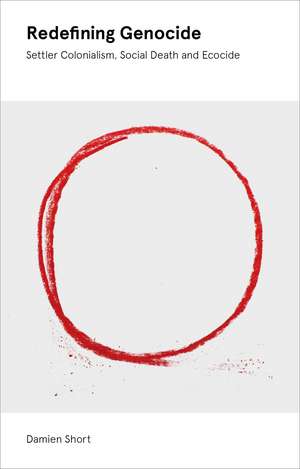
Redefining Genocide: Settler Colonialism, Social Death and Ecocide
Autor Damien Shorten Limba Engleză Hardback – 15 iun 2016
Rather than focusing solely on a narrow conception of genocide as direct mass-killing, through close empirical analysis of a number of under-discussed case studies - including Palestine, Sri Lanka, Australia and Alberta, Canada - the book reveals the key role played by settler colonialism, capitalism, finite resources and the ecological crisis in driving genocidal social death on a global scale.
Preț: 551.05 lei
Preț vechi: 726.82 lei
-24%
Puncte Express: 827
Carte tipărită la comandă
Livrare economică 24 noiembrie-08 decembrie
Livrare prin curier în România Termenul estimat este afișat lângă disponibilitate.
Transport gratuit pentru acest produs Plată online sau ramburs, în funcție de opțiunile comenzii.
Retur gratuit în 14 zile Comandă securizată și suport în română.
Specificații
ISBN-13: 9781842779309
ISBN-10: 1842779303
Pagini: 268
Dimensiuni: 143 x 222 x 19 mm
Greutate: 0.49 kg
Editura: Bloomsbury Publishing
Colecția Zed Books
Locul publicării:London, United Kingdom
ISBN-10: 1842779303
Pagini: 268
Dimensiuni: 143 x 222 x 19 mm
Greutate: 0.49 kg
Editura: Bloomsbury Publishing
Colecția Zed Books
Locul publicării:London, United Kingdom
V-ar putea interesa
-
 Imperialism: The Highest Stage of CapitalismVladimir LeninPreț: 55.88 lei
 -
 War Volunteering in Modern TimesC G Krüger-18%Preț: 752.71 lei917.95 lei
 -
 Preț: 386.98 lei
 -
 Preț: 411.23 lei
 -
 Exploring the Decolonial ImaginaryP. SchechterPreț: 409.28 lei
 -
 Preț: 392.00 lei
 -
 Preț: 412.99 lei
 -
 Decolonization and Its ImpactShipwayPreț: 310.17 lei
 -
 Year 501Noam Chomsky-8%Preț: 648.14 lei704.49 lei
 -
 Competing Visions of World OrderSebastian ConradPreț: 397.70 lei
 -
 Defending the WestIbn WarraqPreț: 211.02 lei
 -
 The Arab Spring: The End of PostcolonialismHamid Dabashi-10%Preț: 140.60 lei156.93 lei
Cuprins
Introduction
1. Definitional Conundrums: A Sociological Approach to Genocide
2. The Genocide-Ecocide Nexus
3. Palestine
4. Sri Lanka
5. Australia
6. Tar Sands and the Indigenous Peoples of Northern Alberta
7. Looking to the Future: Where to From Here?
Conclusion
1. Definitional Conundrums: A Sociological Approach to Genocide
2. The Genocide-Ecocide Nexus
3. Palestine
4. Sri Lanka
5. Australia
6. Tar Sands and the Indigenous Peoples of Northern Alberta
7. Looking to the Future: Where to From Here?
Conclusion
Recenzii
/i>'Redefining Genocide ... will undoubtedly have a significant impact within the social sciences.
Makes fascinating, compelling, and theoretically coherent connections between colonialism, genocide, and ecological destruction. The field of genocide studies puts out a number of books each year, but this one truly counts as a required reading that unites a number of fields of study that have remained separate for too long...one of the most important works published in the field in recent years.
/i>'Short's engaging text complicates the definition of genocide for scholars in law, history, politics, and sociology ...This book will undoubtedly stretch genocide scholars and spur debate.
Short should be commended for an engaging, well-supported and important contribution. Not only should this book be essential reading for genocide scholars, Redefining Genocide should be read across indigenous and environmental studies, criminology, sociology, international development and political science.
This is a very welcome and much needed book. In it, Short offers a timely and important challenge for us all to contend with the ongoing and intertwined threats of ecological and group destruction.
In this important and timely book, the sociologist Damien Short highlights the destruction wrought by the interaction of genocide and ecocide. Well-chosen case studies about indigenous peoples' catastrophic experiences of land appropriation and resource exploitation by state-authorized corporations reveal that the perfectly legal economic processes of settler colonialism manifest a largely ignored banality of evil.
Redefining Genocide is an incisive, bold, and illuminating exploration of the close links between genocide, colonialism, and ecocide. With flair and insight, it addresses the vulnerability of humanity in the perilous age of the Anthropocene.
Genocide scholars have a habit of not getting the bigger picture, they concentrate on the politics, the law, or the human psychology but leaving out the crucial environmental underpinning. If you wreck an environment upon which communities depend, their destruction will inexorably follow. Damien Short is one of the few genocide scholars who does get it and this book is to be vastly welcomed for the belated paradigm shift it augurs.
Short's discussion of genocide, ecocide and colonialist exploitation is delivered with clarity and intellectual insight. It is both an important reminder of some nearly forgotten histories of inhumanity and a warning about future dangers to the planet.
Short poses a fundamental challenge to scholars and citizens alike. He forces us to rethink our entire understanding of the crime of genocide, and more particularly its relationship with the environmental harms which will dominate the century to come. This is interdisciplinary scholarship at its very best, I urge you to read it now.
An important, path-breaking book. It expands genocide studies into disciplines and concerns that reach far beyond the academy. Policy-makers and activists, as well as scholars troubled by the genocidal potential and local impacts of global developments, must urgently engage with its arguments.
Makes fascinating, compelling, and theoretically coherent connections between colonialism, genocide, and ecological destruction. The field of genocide studies puts out a number of books each year, but this one truly counts as a required reading that unites a number of fields of study that have remained separate for too long...one of the most important works published in the field in recent years.
/i>'Short's engaging text complicates the definition of genocide for scholars in law, history, politics, and sociology ...This book will undoubtedly stretch genocide scholars and spur debate.
Short should be commended for an engaging, well-supported and important contribution. Not only should this book be essential reading for genocide scholars, Redefining Genocide should be read across indigenous and environmental studies, criminology, sociology, international development and political science.
This is a very welcome and much needed book. In it, Short offers a timely and important challenge for us all to contend with the ongoing and intertwined threats of ecological and group destruction.
In this important and timely book, the sociologist Damien Short highlights the destruction wrought by the interaction of genocide and ecocide. Well-chosen case studies about indigenous peoples' catastrophic experiences of land appropriation and resource exploitation by state-authorized corporations reveal that the perfectly legal economic processes of settler colonialism manifest a largely ignored banality of evil.
Redefining Genocide is an incisive, bold, and illuminating exploration of the close links between genocide, colonialism, and ecocide. With flair and insight, it addresses the vulnerability of humanity in the perilous age of the Anthropocene.
Genocide scholars have a habit of not getting the bigger picture, they concentrate on the politics, the law, or the human psychology but leaving out the crucial environmental underpinning. If you wreck an environment upon which communities depend, their destruction will inexorably follow. Damien Short is one of the few genocide scholars who does get it and this book is to be vastly welcomed for the belated paradigm shift it augurs.
Short's discussion of genocide, ecocide and colonialist exploitation is delivered with clarity and intellectual insight. It is both an important reminder of some nearly forgotten histories of inhumanity and a warning about future dangers to the planet.
Short poses a fundamental challenge to scholars and citizens alike. He forces us to rethink our entire understanding of the crime of genocide, and more particularly its relationship with the environmental harms which will dominate the century to come. This is interdisciplinary scholarship at its very best, I urge you to read it now.
An important, path-breaking book. It expands genocide studies into disciplines and concerns that reach far beyond the academy. Policy-makers and activists, as well as scholars troubled by the genocidal potential and local impacts of global developments, must urgently engage with its arguments.