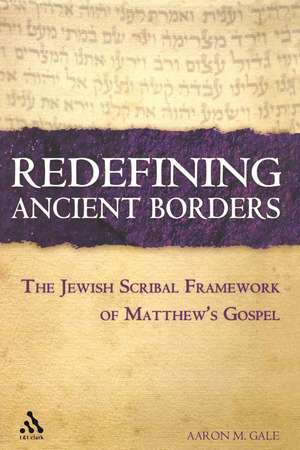
Redefining Ancient Borders: The Jewish Scribal Framework of Matthew's Gospel
Autor Aaron M. Galeen Limba Engleză Paperback – oct 2005
Preț: 643.66 lei
Preț vechi: 851.84 lei
-24%
Puncte Express: 965
Carte tipărită la comandă
Livrare economică 30 noiembrie-14 decembrie
Livrare prin curier în România Termenul estimat este afișat lângă disponibilitate.
Transport gratuit pentru acest produs Plată online sau ramburs, în funcție de opțiunile comenzii.
Retur gratuit în 14 zile Comandă securizată și suport în română.
Specificații
ISBN-13: 9780567025210
ISBN-10: 0567025217
Pagini: 208
Dimensiuni: 152 x 229 x 11 mm
Greutate: 0.38 kg
Ediția:New.
Editura: Bloomsbury Publishing
Colecția T&T Clark
Locul publicării:New York, United States
ISBN-10: 0567025217
Pagini: 208
Dimensiuni: 152 x 229 x 11 mm
Greutate: 0.38 kg
Ediția:New.
Editura: Bloomsbury Publishing
Colecția T&T Clark
Locul publicării:New York, United States
V-ar putea interesa
-
 Biblical Interpretation and Method: Essays in Honour of John BartonKatharine J. Dell-31%Preț: 966.21 lei1403.14 lei
 -
 Paul's Visual Piety: The Metamorphosis of the BeholderJ. M. F. Heath-31%Preț: 998.09 lei1454.49 lei
 -
 Joseph of Arimathea: A Study in Reception HistoryWilliam John Lyons-15%Preț: 244.70 lei286.74 lei
 -
 -31%Preț: 777.59 lei1125.85 lei
 -
 Finding God in the PsalmsTom WrightPreț: 85.23 lei
 -
 God Believes in Love: Straight Talk about Gay MarriageGene RobinsonPreț: 96.80 lei
 -
 Who on Earth is God?: Making Sense of God in the BibleNeil Richardson-25%Preț: 182.58 lei243.16 lei
 -
 How We Got the New TestamentStanley E PorterPreț: 156.15 lei
 -
 Theological Wordbook of the Old TestamentR Laird HarrisPreț: 410.57 lei
 -
 The Finished Work of ChristFrancis A. SchaefferPreț: 148.64 lei
 -
 A Short History of the New TestamentHalvor Moxnes-23%Preț: 104.07 lei134.29 lei
 -
 Esau's BlessingOra Horn ProuserPreț: 131.27 lei
Cuprins
PREFACE8
INTRODUCTION10
Research Topics and Presuppositions10
A Final Note: The Case for Utilizing Rabbinic Sources in New Testament Study17
CHAPTER 1: THE MATTHEAN COMMUNITY AND FORMATIVE JUDAISM27
The State of Judaism following 70 C.E.27
The State of Judaism in Galilee33
The State of Christianity following the Jewish War41
Struggles between Judaism and Jewish Christianity43
Evidence of Tension in the Matthean Gospel49
The Matthean Gospel as a Jewish Text51
CHAPTER 2: TRADITION IN TRANSITION, OR ANTIOCH VS. SEPPHORIS:63
RETHINKING THE MATTHEAN COMMUNITY'S LOCATION63
Preliminary Observations: Matthew's Community as a City Church63
The Matthean Community's Location: Antioch vs. Sepphoris70
Sepphoris: The Home to the Matthean Community87
CHAPTER 3: THE WEALTH OF THE MATTHEAN COMMUNITY96
Galilean Economics: A First-Century View96
Matthew as a Wealthy Galilean Community105
The Matthean Community in the Context of the Roman Economy113
Texts and Economics: The Existence of the Book Trade118
CHAPTER 4: SCRIBES AND CONFLICTS: LEADERSHIP IN THE MATTHEAN COMMUNITY129
The Role of the Scribe in the First Century129
Jewish Education, the Scribe, and the Roman Empire137
Matthew's View and Usage of the Term "Scribe"145
Matthew the Scribe: The Transfiguration as Evidence156
CHAPTER 5: EVIDENCE OF A LEARNED COMMUNITY163
Matthew's Utilization of the Old Testament and Targums163
Matthew's Jewish Exegetical Techniques178
Matthew's Continued Use of Jewish Exegetical Techniques: The Kal Vehomer194
The Matthean Gospel and Additional Literary Techniques207
Unity, Irony, Allusion, Allegory, and Multiple Levels of Meaning217
The Audience of Matthew: A Learned Group229
Chapter Conclusions230
CHAPTER 6: CONCLUSIONS234
Matthew: A Jewish Christian Community234
The Location of the Matthean Community235
The Wealth of the Matthean Community237
The Crux of the Debate: Matthew as a Learned Community238
WORKS CITED241
Index
INTRODUCTION10
Research Topics and Presuppositions10
A Final Note: The Case for Utilizing Rabbinic Sources in New Testament Study17
CHAPTER 1: THE MATTHEAN COMMUNITY AND FORMATIVE JUDAISM27
The State of Judaism following 70 C.E.27
The State of Judaism in Galilee33
The State of Christianity following the Jewish War41
Struggles between Judaism and Jewish Christianity43
Evidence of Tension in the Matthean Gospel49
The Matthean Gospel as a Jewish Text51
CHAPTER 2: TRADITION IN TRANSITION, OR ANTIOCH VS. SEPPHORIS:63
RETHINKING THE MATTHEAN COMMUNITY'S LOCATION63
Preliminary Observations: Matthew's Community as a City Church63
The Matthean Community's Location: Antioch vs. Sepphoris70
Sepphoris: The Home to the Matthean Community87
CHAPTER 3: THE WEALTH OF THE MATTHEAN COMMUNITY96
Galilean Economics: A First-Century View96
Matthew as a Wealthy Galilean Community105
The Matthean Community in the Context of the Roman Economy113
Texts and Economics: The Existence of the Book Trade118
CHAPTER 4: SCRIBES AND CONFLICTS: LEADERSHIP IN THE MATTHEAN COMMUNITY129
The Role of the Scribe in the First Century129
Jewish Education, the Scribe, and the Roman Empire137
Matthew's View and Usage of the Term "Scribe"145
Matthew the Scribe: The Transfiguration as Evidence156
CHAPTER 5: EVIDENCE OF A LEARNED COMMUNITY163
Matthew's Utilization of the Old Testament and Targums163
Matthew's Jewish Exegetical Techniques178
Matthew's Continued Use of Jewish Exegetical Techniques: The Kal Vehomer194
The Matthean Gospel and Additional Literary Techniques207
Unity, Irony, Allusion, Allegory, and Multiple Levels of Meaning217
The Audience of Matthew: A Learned Group229
Chapter Conclusions230
CHAPTER 6: CONCLUSIONS234
Matthew: A Jewish Christian Community234
The Location of the Matthean Community235
The Wealth of the Matthean Community237
The Crux of the Debate: Matthew as a Learned Community238
WORKS CITED241
Index
Recenzii
"Gale... offers some unique perspectives on Matthew's gospel.... Gale's study brings some creative points to the on going discussion."- The Bible Today, April/May 2006
Review by Fred W. Burnett, Anderson University, Religious Stduies review
"Redefining Ancient Borders sculpts a renewed vision of the origins of the gospel, the economic level of the community, and their literacy. But above all he argues that Matthew's community is a learned community. I could not read it through in one sitting, but I tried. He understands how to use archaeological evidence better than a host of others who have claimed such knowledge." --James F. Strange, Departments of Relgious Studies, University of South Florida
"Aaron Gale has added a new dimension to Matthean scholarship by proposing that the audience for the authors of Matthew's gospel was wealthy, aristocratic, and learned in Jewish texts. Edited and 'published' ca. 85 CE, Gale locates its Jewish Christian authors in Sepphoris, capital of Galilee in the time of Jesus. Whatever one's position on any of these key points might be, this attractive and accessible volume is sure to stimulate fruitful and important new discussions on the state of Jewish and Jewish Christian interaction in Palestine after 70 CE and on such important related topics as literacy and the original language of Matthew and his audience. Historians and New Testament scholars alike will benefit greatly from this innovative work." -Eric M. Meyers, Bernice and Morton Lerner Professor of Judaic Studies and Director of the Graduate Program in Religion, Duke University
"Aaron Gale has written a clear and informative book that will enrich current discussions about Matthew's meaning in context. Matthew's Gospel, incorporating sophisticated exegetical techniques, was the product of Torah-loyal scribes under the sponsorship of a wealthy Jewish Christian group in Sepphoris. Gale's careful depiction is especially valuable for its wide-ranging engagement with contemporary scholarship on Matthew and the social world of Roman Galilee." Douglas E. Oakman, Ph.D. Dean of Humanities and Associate Professor of Religion Pacific Lutheran University
In this revision of his doctoral thesis, Aaron M. Gale uses literary, social, political, and economic data to argue for a redefinition of both the provenance of the Gospel according to Matthew and the borders between formative Judaism and the first-century Jesus movement, especially the strand that gave rise to this most Jewish of gospels. Previous scholars such as Vermes, Neusner, Meier, and Saldarini have been chipping away at the notion of a monolithic Judaism in opposition to an idealized, universal Christianity of the first century CE. G's argument contributes what one hopes may be the last nail in the coffin of this anachronistic and overly-simplistic view of Christian history. His argument for a Galilean provenance of GMatt-with Sepphoris as a key contender-is allusive and wide-ranging, drawing from the most recent archaeological, economic, and social-historical studies. That case alone would make the book worthy of attention. The careful argument for the scribal nature of GMatt, based on detailed comparisons with Mishnaic texts and forms of argumentation, makes this volume even more valuable. G's analysis of the ruling on divorce in Matt 5:31-32 (cf. 19:9) as an example of the binyan av is a particularly strong case for understanding GMatt as a product of an educated, Jewish scribal culture. Whether considering the geographical or religio-cultural provenance, Redefining Ancient Borders contributes important insights to the contemporary discussion of GMatt. G's work is a worthwhile read for academic and lay audiences alike. --Shelia McGinn, Professor of Biblical Studies and Early Christianity, John Caroll University
Review by Fred W. Burnett, Anderson University, Religious Stduies review
"Redefining Ancient Borders sculpts a renewed vision of the origins of the gospel, the economic level of the community, and their literacy. But above all he argues that Matthew's community is a learned community. I could not read it through in one sitting, but I tried. He understands how to use archaeological evidence better than a host of others who have claimed such knowledge." --James F. Strange, Departments of Relgious Studies, University of South Florida
"Aaron Gale has added a new dimension to Matthean scholarship by proposing that the audience for the authors of Matthew's gospel was wealthy, aristocratic, and learned in Jewish texts. Edited and 'published' ca. 85 CE, Gale locates its Jewish Christian authors in Sepphoris, capital of Galilee in the time of Jesus. Whatever one's position on any of these key points might be, this attractive and accessible volume is sure to stimulate fruitful and important new discussions on the state of Jewish and Jewish Christian interaction in Palestine after 70 CE and on such important related topics as literacy and the original language of Matthew and his audience. Historians and New Testament scholars alike will benefit greatly from this innovative work." -Eric M. Meyers, Bernice and Morton Lerner Professor of Judaic Studies and Director of the Graduate Program in Religion, Duke University
"Aaron Gale has written a clear and informative book that will enrich current discussions about Matthew's meaning in context. Matthew's Gospel, incorporating sophisticated exegetical techniques, was the product of Torah-loyal scribes under the sponsorship of a wealthy Jewish Christian group in Sepphoris. Gale's careful depiction is especially valuable for its wide-ranging engagement with contemporary scholarship on Matthew and the social world of Roman Galilee." Douglas E. Oakman, Ph.D. Dean of Humanities and Associate Professor of Religion Pacific Lutheran University
In this revision of his doctoral thesis, Aaron M. Gale uses literary, social, political, and economic data to argue for a redefinition of both the provenance of the Gospel according to Matthew and the borders between formative Judaism and the first-century Jesus movement, especially the strand that gave rise to this most Jewish of gospels. Previous scholars such as Vermes, Neusner, Meier, and Saldarini have been chipping away at the notion of a monolithic Judaism in opposition to an idealized, universal Christianity of the first century CE. G's argument contributes what one hopes may be the last nail in the coffin of this anachronistic and overly-simplistic view of Christian history. His argument for a Galilean provenance of GMatt-with Sepphoris as a key contender-is allusive and wide-ranging, drawing from the most recent archaeological, economic, and social-historical studies. That case alone would make the book worthy of attention. The careful argument for the scribal nature of GMatt, based on detailed comparisons with Mishnaic texts and forms of argumentation, makes this volume even more valuable. G's analysis of the ruling on divorce in Matt 5:31-32 (cf. 19:9) as an example of the binyan av is a particularly strong case for understanding GMatt as a product of an educated, Jewish scribal culture. Whether considering the geographical or religio-cultural provenance, Redefining Ancient Borders contributes important insights to the contemporary discussion of GMatt. G's work is a worthwhile read for academic and lay audiences alike. --Shelia McGinn, Professor of Biblical Studies and Early Christianity, John Caroll University