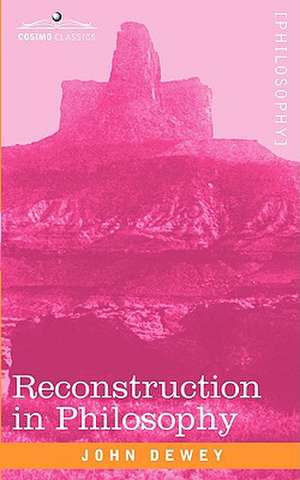
Reconstruction in Philosophy
Autor John Deweyen Limba Engleză Paperback – 31 oct 2008
Preț: 112.01 lei
Puncte Express: 168
Carte tipărită la comandă
Livrare economică 20 noiembrie-04 decembrie
Livrare prin curier în România Termenul estimat este afișat lângă disponibilitate.
Transport gratuit de la 400.00 lei Plată online sau ramburs, în funcție de opțiunile comenzii.
Retur gratuit în 14 zile Comandă securizată și suport în română.
Specificații
ISBN-13: 9781605203461
ISBN-10: 1605203467
Pagini: 236
Dimensiuni: 129 x 205 x 24 mm
Greutate: 0.27 kg
Editura: COSIMO INC
ISBN-10: 1605203467
Pagini: 236
Dimensiuni: 129 x 205 x 24 mm
Greutate: 0.27 kg
Editura: COSIMO INC
V-ar putea interesa
-
 Preț: 346.79 lei
 -
 Liberal Politics and Public Faith: Beyond SeparationKevin VallierPreț: 454.20 lei
 -
 The Fascinated ObserverKristy SweetlandPreț: 102.15 lei
 -
 The Role of Intuitions in Philosophical MethodologySerena Maria Nicoli-15%Preț: 615.83 lei724.51 lei
 -
 -18%Preț: 1256.11 lei1531.84 lei
 -
 The Science of PhilosophyF. GeorgePreț: 355.98 lei
 -
 EthicsJohn DeweyPreț: 299.89 lei
 -
 Preț: 196.98 lei
 -
 Logic - The Theory of InquiryJohn DeweyPreț: 355.44 lei
 -
 Preț: 178.03 lei
 -
 -17%Preț: 171.55 lei207.26 lei
 -
 A Theory of NothingD. N. Warren-Smith MSc.Preț: 189.83 lei
 -
 How We Think (New Edition)John DeweyPreț: 131.57 lei
 -
 The Child and the CurriculumJohn DeweyPreț: 47.35 lei
 -
 The Internal Structure of Predicates and NamesRichard L EpsteinPreț: 258.69 lei
 -
 Erfahrung, Erkenntnis und WertMartin SuhrPreț: 147.90 lei
 -
 Preț: 152.41 lei
Notă biografică
John Dewey (FAA October 20, 1859 ߝ June 1, 1952) was an American philosopher, psychologist, and educational reformer whose ideas have been influential in education and social reform. Dewey was an important early developer of the philosophy of pragmatism and one of the founders of functional psychology. He was a major representative of progressive education and liberalism. Although Dewey is known best for his publications concerning education, he also wrote about many other topics, including experience, nature, art, logic, inquiry, democracy, and ethics. In his advocacy of democracy, Dewey considered two fundamental elements—schools and civil society—as being major topics needing attention and reconstruction to encourage experimental intelligence and plurality.
Recenzii
"It was with this book that Dewey fully launched his campaign for experimental philosophy." - The New Republic
Textul de pe ultima copertă
The basic postulate of the text: namely, that the distinctive office, problems and subjectmatter of philosophy grow out of stresses and strains in the community life in which a given form of philosophy arises, and that its specific problems vary with the changes in human life that are always going on.