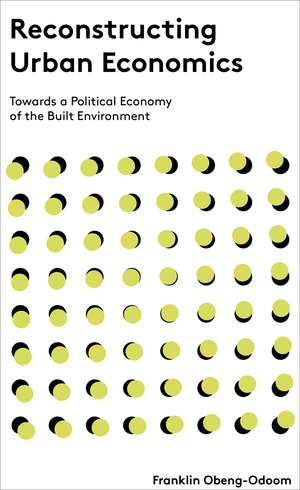
Reconstructing Urban Economics: Towards a Political Economy of the Built Environment
Autor Franklin Obeng-Odoomen Limba Engleză Paperback – 15 aug 2016
In this book, Franklin Obeng-Odoom draws on institutional, Georgist and Marxist economics to clearly but comprehensively show what the key issues are today in thinking about urban economics. In doing so, he demonstrates the widespread tensions and contradictions in the status quo, showing how to reconstruct urban economics in order to create a more just society and environment.
Preț: 170.96 lei
Preț vechi: 230.96 lei
-26%
Puncte Express: 256
Carte disponibilă
Livrare economică 16-30 noiembrie
Livrare prin curier în România Termenul estimat este afișat lângă disponibilitate.
Transport gratuit de la 400.00 lei Plată online sau ramburs, în funcție de opțiunile comenzii.
Retur gratuit în 14 zile Comandă securizată și suport în română.
Specificații
ISBN-13: 9781783606597
ISBN-10: 1783606592
Pagini: 256
Ilustrații: Tables, black and white 10 ; Figures 14
Dimensiuni: 134 x 216 x 18 mm
Greutate: 0.38 kg
Editura: Bloomsbury Publishing
Colecția Zed Books
Locul publicării:London, United Kingdom
ISBN-10: 1783606592
Pagini: 256
Ilustrații: Tables, black and white 10 ; Figures 14
Dimensiuni: 134 x 216 x 18 mm
Greutate: 0.38 kg
Editura: Bloomsbury Publishing
Colecția Zed Books
Locul publicării:London, United Kingdom
V-ar putea interesa
-
 The Oxford Handbook of Urban PlanningRachel Weber-27%Preț: 426.07 lei581.44 lei
 -
 Urban Dynamics: Designing an Integrated ModelC.S. Bertuglia-18%Preț: 1479.81 lei1804.64 lei
 -
 -18%Preț: 1255.17 lei1530.69 lei
 -
 Real Estate, Construction and Economic Development in Emerging Market EconomiesRaymond Talinbe Abdulai-18%Preț: 1425.47 lei1738.38 lei
 -
 The Towers of New CapitalP. TiwariPreț: 432.92 lei
 -
 Urban EconomicsJohn M. Hartwick-18%Preț: 766.59 lei934.86 lei
 -
 -18%Preț: 1248.98 lei1523.15 lei
 -
 Discussions on Agglomeration DynamicsJúlia SzámadóPreț: 311.22 lei
 -
 Preț: 336.80 lei
 -
 Caribbean TourismJean S. HolderPreț: 305.79 lei
Cuprins
Preface
Introduction: Dissent and Reconstruction
Part I: Establishing Principles for Urban Progress
1. Scaffolding the Principles and Values of Reconstruction
2. The Urban Challenge
3. The Urban Economy
Part II: Analysing Material Conditions in Cities
4. Urban Economic Growth: Globalisation, Trade, and Convergence
5. Informal Economies
6. Urban Poverty; Socio-Spatial Inequality
Part III: Creating a Socio-Ecologically Sensitive Future
7. Housing
8. Homo Automobilus
9. Sustainable Urban Development
Conclusion: Towards A Political Economy of the Built Environment
Introduction: Dissent and Reconstruction
Part I: Establishing Principles for Urban Progress
1. Scaffolding the Principles and Values of Reconstruction
2. The Urban Challenge
3. The Urban Economy
Part II: Analysing Material Conditions in Cities
4. Urban Economic Growth: Globalisation, Trade, and Convergence
5. Informal Economies
6. Urban Poverty; Socio-Spatial Inequality
Part III: Creating a Socio-Ecologically Sensitive Future
7. Housing
8. Homo Automobilus
9. Sustainable Urban Development
Conclusion: Towards A Political Economy of the Built Environment
Recenzii
The book reminds us that issues of the urban question around spatial inequality in terms of housing, transport, jobs or other metrics, are issues that have historical precedents, are trans-national and trans-cultural . So when politicians, think-tanks, industry peak bodies, or universities offer simple solutions that promote the status quo, books like this one help us to articulate our rebuttals.
[The] book has substantial merit. It provides a useful set of counter-arguments to the received wisdom on urban economics and the built environment. As such, it has the potential to broaden theoretical and practical perspectives on a topic where quite narrow views often predominate.'
/i>'An invaluable compendium of information for anyone wishing to become acquainted with the most recent and most important publications on urban economics.
Recommended for readers who seek a heterodox perspective on urban economics.
Reconstructing Urban Economics is a most welcome addition to the canon of progressive urban scholarship and Obeng-Odoom is its well qualified author.
Obeng-Odoom joins a long list of thoughtful analysts and social reformers ... who have sought to keep the proposals of Henry George in the public dialogue.
A significant new book on urban political economic analysis, issues and policy . Obeng-Odoom rightly criticises the prevailing Anglo- American bias in urban studies and makes an effective case for drawing on post-colonial perspectives that offer a better means of understanding the challenges faced by developing nations.
Obeng-Odoom's attempt to challenge the dominant perspective in urban economics deserves praise and recognition ... highly recommended reading for students and researchers of urban studies.
A lively and up-to-date introduction to urban economics, which will encourage readers to think outside-the-box on a topic which is too important for our collective future to be left to urban specialists alone.
Obeng-Odoom throws down the gauntlet by challenging the dominant voices in urban economics who assure us that a market equilibrium will bring about a happy result for everyone. Without any of the sound and fury of a self-proclaimed prophet, Obeng-Odoom quietly shows us that African thought has the potential to begin to heal the rifts in Eurocentric thought, rifts that continue to cause great suffering in the world.
This powerful and timely new book challenges the prevailing orthodoxy within urban studies. It blends diverse theories, international experience and a global viewpoint. Students of urban economics, real estate and planning will find it a refreshing alternative to the standard texts.
This book presents an alternative map of urban economics. Obeng-Odoom's command of the facts, eye for absurdity, and appreciation of the balance between heterodox and orthodox slants makes his book the most authoritative, educative and inspiring text on the subject. Anyone interested in political economy, development and the built environment will treasure this book.
A welcome addition to the existing literature on urban and property economics. I would recommend this book to both students and seasoned scholars of urban and land economy and urban development more generally.
A major contribution to the urban economics of the built environment and a thoughtful counterbalance to mainstream neoclassical and neoliberal framing of urban systems.
[The] book has substantial merit. It provides a useful set of counter-arguments to the received wisdom on urban economics and the built environment. As such, it has the potential to broaden theoretical and practical perspectives on a topic where quite narrow views often predominate.'
/i>'An invaluable compendium of information for anyone wishing to become acquainted with the most recent and most important publications on urban economics.
Recommended for readers who seek a heterodox perspective on urban economics.
Reconstructing Urban Economics is a most welcome addition to the canon of progressive urban scholarship and Obeng-Odoom is its well qualified author.
Obeng-Odoom joins a long list of thoughtful analysts and social reformers ... who have sought to keep the proposals of Henry George in the public dialogue.
A significant new book on urban political economic analysis, issues and policy . Obeng-Odoom rightly criticises the prevailing Anglo- American bias in urban studies and makes an effective case for drawing on post-colonial perspectives that offer a better means of understanding the challenges faced by developing nations.
Obeng-Odoom's attempt to challenge the dominant perspective in urban economics deserves praise and recognition ... highly recommended reading for students and researchers of urban studies.
A lively and up-to-date introduction to urban economics, which will encourage readers to think outside-the-box on a topic which is too important for our collective future to be left to urban specialists alone.
Obeng-Odoom throws down the gauntlet by challenging the dominant voices in urban economics who assure us that a market equilibrium will bring about a happy result for everyone. Without any of the sound and fury of a self-proclaimed prophet, Obeng-Odoom quietly shows us that African thought has the potential to begin to heal the rifts in Eurocentric thought, rifts that continue to cause great suffering in the world.
This powerful and timely new book challenges the prevailing orthodoxy within urban studies. It blends diverse theories, international experience and a global viewpoint. Students of urban economics, real estate and planning will find it a refreshing alternative to the standard texts.
This book presents an alternative map of urban economics. Obeng-Odoom's command of the facts, eye for absurdity, and appreciation of the balance between heterodox and orthodox slants makes his book the most authoritative, educative and inspiring text on the subject. Anyone interested in political economy, development and the built environment will treasure this book.
A welcome addition to the existing literature on urban and property economics. I would recommend this book to both students and seasoned scholars of urban and land economy and urban development more generally.
A major contribution to the urban economics of the built environment and a thoughtful counterbalance to mainstream neoclassical and neoliberal framing of urban systems.