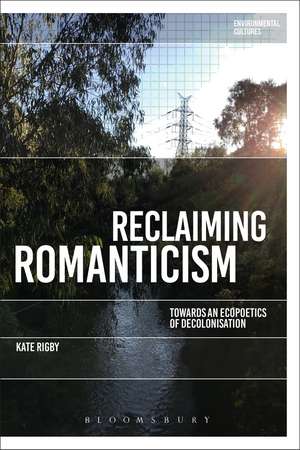
Reclaiming Romanticism: Towards an Ecopoetics of Decolonization: Environmental Cultures
Autor Professor Kate Rigbyen Limba Engleză Paperback – 18 noi 2021
The ebook editions of this book are available open access under a CC BY-NC-ND 4.0 licence on bloomsburycollection.com. Open access was funded by Knowledge Unlatched.
Din seria Environmental Cultures
- 29%
 Preț: 138.35 lei
 - 10%
 Preț: 141.15 lei
 - 32%
 Preț: 600.82 lei
 - 16%
 Preț: 247.65 lei
 - 31%
 Preț: 216.28 lei
 - 31%
 Preț: 213.66 lei
 - 30%
 Preț: 214.93 lei
 - 26%
 Preț: 213.94 lei
 - 36%
 Preț: 614.39 lei
 - 25%
 Preț: 260.96 lei
 - 16%
 Preț: 248.53 lei
 - 36%
 Preț: 582.82 lei
 - 27%
 Preț: 249.54 lei
 - 32%
 Preț: 594.01 lei
 - 15%
 Preț: 263.91 lei
 - 24%
 Preț: 244.70 lei
 - 16%
 Preț: 146.06 lei
 - 36%
 Preț: 550.47 lei
 - 25%
 Preț: 243.45 lei
 - 23%
 Preț: 246.95 lei
 - 26%
 Preț: 211.53 lei
 - 33%
 Preț: 835.84 lei
 - 26%
 Preț: 213.66 lei
 - 27%
 Preț: 253.30 lei
 - 26%
 Preț: 213.66 lei
 - 26%
 Preț: 211.83 lei
 - 25%
 Preț: 281.33 lei
 - 25%
 Preț: 256.34 lei
 - 15%
 Preț: 258.53 lei
Preț: 214.03 lei
Preț vechi: 288.23 lei
-26%
Puncte Express: 321
Carte tipărită la comandă
Livrare economică 20 noiembrie-04 decembrie
Livrare prin curier în România Termenul estimat este afișat lângă disponibilitate.
Transport gratuit de la 400.00 lei Plată online sau ramburs, în funcție de opțiunile comenzii.
Retur gratuit în 14 zile Comandă securizată și suport în română.
Specificații
ISBN-13: 9781350243262
ISBN-10: 1350243264
Pagini: 256
Dimensiuni: 154 x 232 x 14 mm
Greutate: 0.36 kg
Editura: Bloomsbury Publishing
Colecția Bloomsbury Academic
Seria Environmental Cultures
Locul publicării:London, United Kingdom
ISBN-10: 1350243264
Pagini: 256
Dimensiuni: 154 x 232 x 14 mm
Greutate: 0.36 kg
Editura: Bloomsbury Publishing
Colecția Bloomsbury Academic
Seria Environmental Cultures
Locul publicării:London, United Kingdom
Cuprins
Acknowledgements
Introduction
Chapter One
'Come forth into the light of things': Contemplative Ecopoetics
Chapter Two
'Seasons of mist and mellow fruitfulness': Affective Ecopoetics
Chapter Three
'Piping in their honey dreams': Creaturely Ecopoetics
Chapter Four
'the wrong dream': Prophetic Ecopoetics
Chapter Five
'deeper tracks wind back': Decolonial Ecopoetics
Postscript: Ecopoetics beyond the page
Works cited
Introduction
Chapter One
'Come forth into the light of things': Contemplative Ecopoetics
Chapter Two
'Seasons of mist and mellow fruitfulness': Affective Ecopoetics
Chapter Three
'Piping in their honey dreams': Creaturely Ecopoetics
Chapter Four
'the wrong dream': Prophetic Ecopoetics
Chapter Five
'deeper tracks wind back': Decolonial Ecopoetics
Postscript: Ecopoetics beyond the page
Works cited
Recenzii
Reclaiming Romanticism takes some risks in its approach, but invites trust from the reader thanks in part to Rigby's clear, likeable style, which incorporates accounts of the author's personal experiences. Ultimately Reclaiming Romanticism is able to bear the weight of its ambition because Rigby is in control of her wide range of material and knows when to temper her claims for what literature, and literary criticism, can achieve.
Rigby's ability to combine multiple, distinct fields of knowledge - from climate science to theology to new materialism - into seamless, productive amalgamations ... is unparalleled in ecocriticism, and it makes Reclaiming Romanticism both a pleasure to read and genuinely impressive.
Rigby presents a powerfully persuasive argument that Romanticism, having emerged at a 'time of rupture' comparable with the upheavals of the present moment, might yet have much to offer. The book combines a bold methodology with the ability to cross literary eras and draw on a wide range of literature and philosophy, while always keeping the discussion pertinent to the ecological crisis of our times. As such, Rigby has provided us with a beacon for ecocritical scholarship.
In this elegantly written study from within the ecological humanities, Kate Rigby addresses the complex inheritances of Romanticism in what she calls the 'perilous present'. With its depth of historical knowledge of Romantic discourse. and its breadth of understanding of the afterlives of Romanticism in decolonising and Indigenous contexts, particularly North American and Australian, these readings are exemplary of literary scholarship in touch with urgent contemporary realities. Rigby's decolonising ecopoetics shows us, with an impressive grasp of intellectual history and theoretical power, how artistic movements like Romanticism are able to inform our grappling with the crises of the present.
Bursting with ideas, close readings, and warnings, Reclaiming Romanticism revitalises questions about nature and the Anthropocene, kinship and care, theology and creation, decolonisation and communities, and meets its own worry and sadness with possibilities of hope and liberation.
Rigby's ability to combine multiple, distinct fields of knowledge - from climate science to theology to new materialism - into seamless, productive amalgamations ... is unparalleled in ecocriticism, and it makes Reclaiming Romanticism both a pleasure to read and genuinely impressive.
Rigby presents a powerfully persuasive argument that Romanticism, having emerged at a 'time of rupture' comparable with the upheavals of the present moment, might yet have much to offer. The book combines a bold methodology with the ability to cross literary eras and draw on a wide range of literature and philosophy, while always keeping the discussion pertinent to the ecological crisis of our times. As such, Rigby has provided us with a beacon for ecocritical scholarship.
In this elegantly written study from within the ecological humanities, Kate Rigby addresses the complex inheritances of Romanticism in what she calls the 'perilous present'. With its depth of historical knowledge of Romantic discourse. and its breadth of understanding of the afterlives of Romanticism in decolonising and Indigenous contexts, particularly North American and Australian, these readings are exemplary of literary scholarship in touch with urgent contemporary realities. Rigby's decolonising ecopoetics shows us, with an impressive grasp of intellectual history and theoretical power, how artistic movements like Romanticism are able to inform our grappling with the crises of the present.
Bursting with ideas, close readings, and warnings, Reclaiming Romanticism revitalises questions about nature and the Anthropocene, kinship and care, theology and creation, decolonisation and communities, and meets its own worry and sadness with possibilities of hope and liberation.
Caracteristici
Brings writers such as Wordsworth, Shelley and Clare into conversation with contemporary US and Australian poets
Notă biografică
Kate Rigby is Professor of Environmental Humanities at Bath Spa University and Adjunct Professor at Monash University, Australia. One of the world's foremost ecocritics, she was the founding President of the Association for the Study of Literature and the Environment (Australia-New Zealand). Her previous books include Topographies of the Sacred: The Poetics of Place in European Romanticism (2004) and Dancing with Disaster: Environmental Histories, Narratives, and Ethics for Perilous Times (2015).