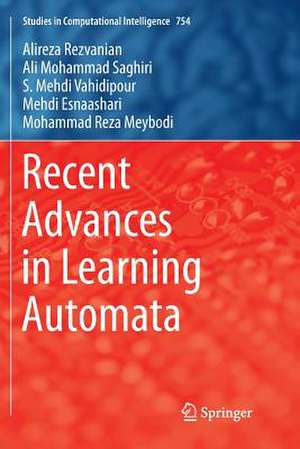
Recent Advances in Learning Automata
Autor Alireza Rezvanian, Ali Mohammad Saghiri, Seyed Mehdi Vahidipour, Mehdi Esnaashari, Mohammad Reza Meybodien Limba Engleză Paperback – 6 iun 2019
This book collects recent theoretical advances and concrete applications of learning automata (LAs) in various areas of computer science, presenting a broad treatment of the computer science field in a survey style. Learning automata (LAs) have proven to be effective decision-making agents, especially within unknown stochastic environments. The book starts with a brief explanation of LAs and their baseline variations. It subsequently introduces readers to a number of recently developed, complex structures used to supplement LAs, and describes their steady-state behaviors. These complex structures have been developed because, by design, LAs are simple units used to perform simple tasks; their full potential can only be tapped when several interconnected LAs cooperate to produce a group synergy.
In turn, the next part of the book highlights a range of LA-based applications in diverse computer science domains, from wireless sensor networks, to peer-to-peer networks, to complex social networks, and finally to Petri nets. The book accompanies the reader on a comprehensive journey, starting from basic concepts, continuing to recent theoretical findings, and ending in the applications of LAs in problems from numerous research domains. As such, the book offers a valuable resource for all computer engineers, scientists, and students, especially those whose work involves the reinforcement learning and artificial intelligence domains.
Preț: 658.55 lei
Preț vechi: 823.19 lei
-20%
Puncte Express: 988
Carte tipărită la comandă
Livrare economică 23 noiembrie-07 decembrie
Livrare prin curier în România Termenul estimat este afișat lângă disponibilitate.
Transport gratuit pentru acest produs Plată online sau ramburs, în funcție de opțiunile comenzii.
Retur gratuit în 14 zile Comandă securizată și suport în română.
Specificații
ISBN-13: 9783319891828
ISBN-10: 3319891820
Pagini: 480
Ilustrații: XIX, 458 p. 240 illus., 126 illus. in color.
Dimensiuni: 155 x 235 x 26 mm
Greutate: 0.72 kg
Ediția:Softcover reprint of the original 1st edition 2018
Editura: Springer
Locul publicării:Cham, Switzerland
ISBN-10: 3319891820
Pagini: 480
Ilustrații: XIX, 458 p. 240 illus., 126 illus. in color.
Dimensiuni: 155 x 235 x 26 mm
Greutate: 0.72 kg
Ediția:Softcover reprint of the original 1st edition 2018
Editura: Springer
Locul publicării:Cham, Switzerland
Cuprins
Learning automata theory.- Cellular learning automata.- Learning automata for wireless sensor networks.- Learning automata for cognitive Peer-to-peer networks.- Learning automata for Complex Social Networks.- Adaptive petri net based on learning automata.- Summary and future directions.
Textul de pe ultima copertă
This book collects recent theoretical advances and concrete applications of learning automata (LAs) in various areas of computer science, presenting a broad treatment of the computer science field in a survey style. Learning automata (LAs) have proven to be effective decision-making agents, especially within unknown stochastic environments. The book starts with a brief explanation of LAs and their baseline variations. It subsequently introduces readers to a number of recently developed, complex structures used to supplement LAs, and describes their steady-state behaviors. These complex structures have been developed because, by design, LAs are simple units used to perform simple tasks; their full potential can only be tapped when several interconnected LAs cooperate to produce a group synergy.
In turn, the next part of the book highlights a range of LA-based applications in diverse computer science domains, from wireless sensor networks, to peer-to-peer networks, to complex social networks, and finally to Petri nets. The book accompanies the reader on a comprehensive journey, starting from basic concepts, continuing to recent theoretical findings, and ending in the applications of LAs in problems from numerous research domains. As such, the book offers a valuable resource for all computer engineers, scientists, and students, especially those whose work involves the reinforcement learning and artificial intelligence domains.
Caracteristici
Addresses key issues and topics related to learning automata theories, architectures, models, algorithms, and their applications Presents a broad treatment of the computer science field in a survey style Highlights recent research advances
Notă biografică
¿Reza Vafashoar received the B.S. degree in Computer Engineering from Urmia University, Urmia, Iran, in 2007, and the M.S. degree in Artificial Intelligence from Amirkabir University of Technology, Tehran,Iran, in 2010. He also received the Ph.D. degree in Computer Engineering at the Computer Engineering Department from Amirkabir University of Technology (Tehran Polytechnic), Tehran, Iran, in 2019. His research interests include learning systems, cellular learning automata, evolutionary computing, and other computational intelligence techniques.
Hossein Morshedlou received the B.Sc. degree in computer engineering from Ferdowsi University,Mashhad, Iran, and the M.Sc. degree in computer engineering from the Amirkabir University of Technology, Tehran, Iran, in 2005 and 2008,respectively. He also received the Ph.D. degree in Computer Engineering at the Computer Engineering Department from Amirkabir University of Technology (Tehran Polytechnic), Tehran, Iran, in 2017. Since 2019, he has been an assistant professor with the Faculty of Computer Engineering and Information Technology, Shahrood University of Technology, Shahrood, Iran. His research interests include distributed systems, cloud computing, learning automata, reinforcement learning, parallel algorithms, and soft computing.
Alireza Rezvanian received the B.Sc. degree from Bu-Ali Sina University of Hamedan, Iran, in 2007, the M.Sc. degree in Computer Engineering with honors from Islamic Azad University of Qazvin, Iran, in 2010, and the Ph.D. degree in Computer Engineering at the Computer Engineering Department from Amirkabir University of Technology (Tehran Polytechnic), Tehran, Iran, in 2016. Currently, he is an Assistant Professor with the Department of Computer Engineering, University of Science and Culture, Tehran, Iran. He worked from 2016 to 2020 as a researcher at the School of Computer Science from the Institute for Research in Fundamental Sciences (IPM), Tehran, Iran. He has authored or co-authored more than 70 research publications in reputable peer-reviewed journals and conferences including IEEE, Elsevier, Springer, Wiley and Taylor & Francis. He has been a guest editor of the special issue on new applications of learning automata-based techniques in real-world environments for the journal of computational science (Elsevier). He is an associate editor of both human-centric computing and information sciences (Springer) and CAAI Transactions on Intelligence Technology (IET). His research activities include soft computing,learning automata, complex networks, social network analysis, data mining, data science, machine learning, and evolutionary algorithms.
Mohammad Reza Meybodi received the B.S. and M.S. degrees in Economics from the Shahid Beheshti University in Iran, in 1973 and 1977, respectively. He also received the M.S. and Ph.D. degrees from Oklahoma University, USA, in 1980 and 1983, respectively, in Computer Science. Currently, he is a Full Professor in the Computer Engineering Department, Amirkabir University of Technology, Tehran, Iran. Prior to the current position, he worked from 1983 to 1985 as an Assistant Professor at the Western Michigan University and from 1985 to 1991 as an Associate Professor at Ohio University, USA. His current research interests include learning systems, cloud computing, soft computing, and social networks.